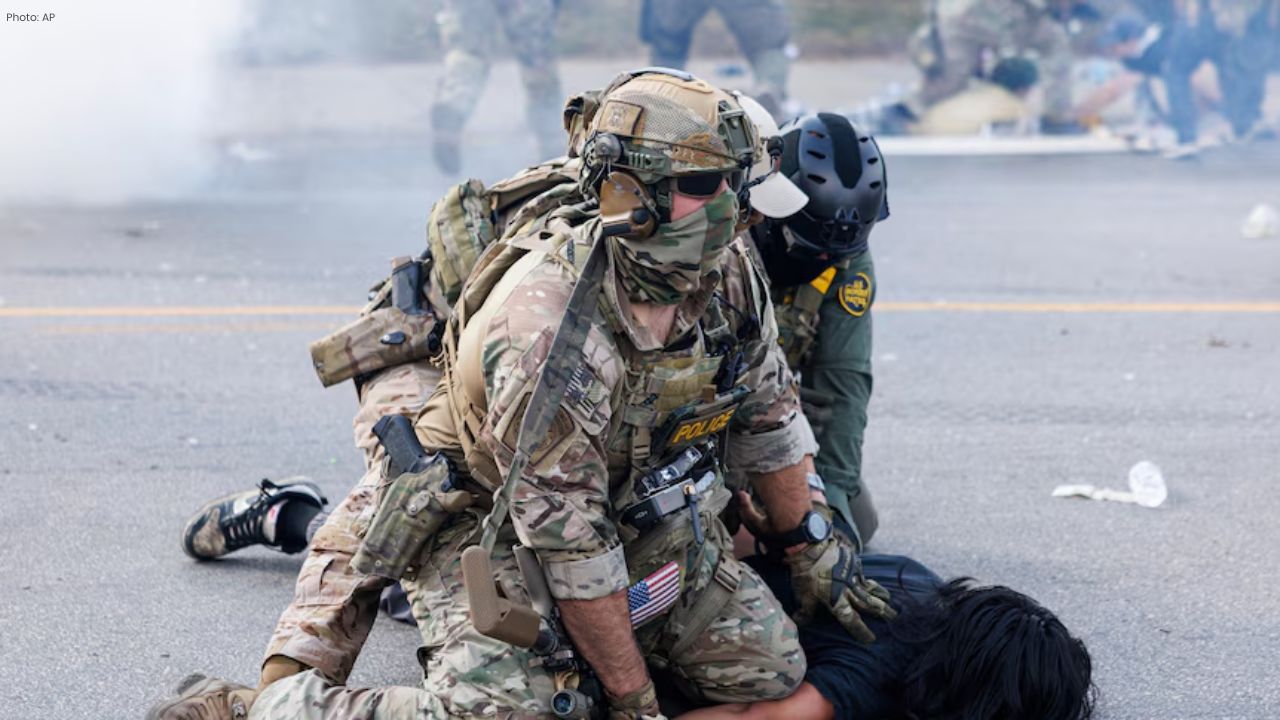
Illinois went to court on Monday to try to stop U.S. President Donald Trump from sending National Guard troops to Chicago. This escalates tensions between Democratic-led states and the Republican federal administration during a strict immigration enforcement operation in the city, which is the third-largest in the United States.
The lawsuit came just hours after a judge in Oregon blocked a similar deployment of National Guard troops to Portland over the weekend. Officials in both Illinois and Oregon argued that sending military forces into cities was unnecessary and could make the situation worse. They said the federal government’s actions were “unlawful and dangerous.”
A federal judge in Chicago, April Perry, has given the Trump administration until midnight Wednesday to respond to Illinois’ lawsuit. A hearing on the case is scheduled for Thursday. The judge has not immediately blocked the deployment. Despite the legal challenge, a presidential memo issued Monday evening confirmed that Trump had called up 300 members of the Illinois National Guard.
Illinois Governor J.B. Pritzker, a Democrat, called the planned deployment “Trump’s invasion.” He said the 300 Illinois troops would be federalized and sent to Chicago, along with 400 troops from Texas. The lawsuit states, “The American people, regardless of where they live, should not face the threat of occupation by the U.S. military, simply because their city or state leadership is not favored by the president.”
President Trump has indicated that he could bypass governors if needed by using the Insurrection Act of 1807. This law allows the president to send active-duty military into states to stop insurrections or enforce federal law when local authorities cannot. Trump said in a press briefing, “We have an Insurrection Act for a reason. If people were being killed, and courts or governors were holding us up, I would use it.”
Later, Trump said he would only invoke the act if necessary, adding, “If you look at Portland, it has been ongoing for a long time. That is insurrection. That is pure insurrection.”
Governor Pritzker called on Republican Texas Governor Greg Abbott to block the deployment, but Abbott said the federal operation was needed to protect federal workers in the city involved in immigration enforcement.
Chicago Mayor Brandon Johnson signed an executive order blocking federal immigration agents from using city property, including parking lots, garages, and vacant land, for enforcement operations. Protests have often taken place near a federal immigration facility outside the city. Federal officials reported that 13 protesters were arrested last Friday near an ICE (U.S. Immigration and Customs Enforcement) building in Broadview.
The presence of armed Border Patrol agents in Chicago, making arrests near major landmarks, has increased concerns among residents. The federal crackdown targets areas with large immigrant populations, especially Latino communities.
The American Civil Liberties Union (ACLU) of Illinois also sued Trump, ICE, the Department of Homeland Security (DHS), and others on Monday. The organization claimed federal agents had used violent and intimidating methods against peaceful protesters and journalists. According to the lawsuit, agents used tear gas, rubber bullets, pepper balls, and flash grenades, violating First Amendment rights.
A DHS spokesperson said, “The First Amendment protects speech and peaceful assembly — not rioting.” Earlier, the department admitted that agents shot a woman on Chicago’s southwest side. DHS said it happened after Border Patrol agents were boxed in by ten cars and “rammed by vehicles.”
Meanwhile, in Portland, Oregon, U.S. District Judge Karin Immergut granted a temporary restraining order to stop the deployment of National Guard troops from Oregon and California. The judge, who was appointed by Trump during his first term, expressed disbelief that the president sent additional troops from California and Texas just hours after her initial ruling.
The situation highlights the ongoing conflict between state leaders, who argue local control is sufficient, and the federal government, which is aggressively enforcing immigration laws. Legal and political battles are expected to continue as Illinois and other states challenge the federal actions in court.
Residents, local officials, and civil rights groups have voiced concerns that using military force in American cities could escalate tensions, put civilians at risk, and undermine trust in local governance. Protesters in Chicago continue to rally against the federal immigration operations, while federal authorities insist the measures are necessary to enforce the law and protect government employees.
The coming days are likely to see further court hearings and public debate over the limits of presidential power, the proper role of the National Guard in domestic cities, and the balance between public safety and civil rights.