Photo:AP
Massive federal shake-up redefines U.S. diplomatic strategy
In a bold and contentious restructuring of American foreign policy machinery, the Trump administration has executed a sweeping series of layoffs within the U.S. State Department, resulting in the termination of more than 1,300 domestic employees. The action, which officials say aligns with President Trump's “America First” doctrine, has sent shockwaves across Washington and among international diplomatic circles. The move is widely seen as the most significant downsizing of U.S. diplomatic personnel in recent history. Carried out in the wake of a Supreme Court ruling that expanded executive authority over federal employment decisions, the layoffs reflect a broader vision for redefining America’s role in the world—less about boots on foreign soil and more about prioritizing internal efficiency and streamlined diplomacy.
The scale and scope of the layoffs
More than 1,300 positions have been eliminated, primarily affecting civil servants and domestic foreign service officers. These employees represented key support systems for international development, refugee processing, human rights initiatives, and democratic stabilization programs. The cuts were comprehensive, touching departments dealing with multilateral affairs, environmental diplomacy, and global public health outreach. The administration claims this is a necessary measure to reduce bureaucratic inefficiency and prioritize core national security goals. However, critics warn the move may cripple America’s ability to engage in proactive foreign policy at a time when geopolitical tensions are mounting.
How the cuts unfolded inside Foggy Bottom
Sources within the department described an atmosphere of chaos and disbelief as the notifications were delivered. Some employees were locked out of their systems overnight, unable to access files, finish reports, or even bid farewell to their teams. Offices once filled with specialists on nuclear treaties, counterterrorism, and global development were emptied almost instantly. Many staffers were in the middle of long-term projects, including interagency coordination on global refugee resettlement and tracking the spread of disinformation. With their sudden departure, institutional knowledge disappeared with them, leaving gaps that no short-term solution can immediately fill.
Political backdrop and strategic vision
These cuts are not happening in a vacuum. They are part of a broader Trump administration effort to reshape the federal bureaucracy. For years, Trump and his advisers have pushed a view that the federal workforce is overgrown, slow, and overly ideological. The layoffs serve as both symbolic and functional shifts in that direction. In place of long-standing diplomatic teams, the administration plans to roll out leaner, more tightly controlled task forces focused narrowly on core security threats and trade policy. The White House argues that this model will allow the country to act more swiftly and decisively on the global stage, without what they characterize as the ideological drift of previous administrations.
Legal hurdles cleared by Supreme Court decision
Prior to these layoffs, efforts to reorganize the State Department were stalled by a series of legal challenges filed by federal unions and career diplomats. Plaintiffs claimed the administration’s actions violated protections for civil servants and unfairly targeted politically inconvenient departments. However, a recent Supreme Court ruling gave the president broad authority to reshape executive branch personnel, effectively greenlighting the purge. While litigation is ongoing, the decision created enough legal certainty for the administration to begin layoffs en masse. This ruling could set a precedent for similar overhauls across other federal agencies in the months to come.
A human toll beyond the headlines
For many affected employees, the layoffs aren’t just about job loss—they are about identity, legacy, and purpose. Dozens of longtime public servants, some with decades of experience, have been ousted from roles that defined their careers. Many of these individuals worked in politically neutral capacities, focusing on technical expertise and program implementation rather than partisan advocacy. Their removal has been deeply personal and, for some, humiliating. Testimonies from insiders speak of people sobbing in stairwells, stunned to see entire departments dismantled within hours. Several former staffers say they’ve been left disillusioned by a system they once believed in.
Impact on ongoing foreign policy missions
The timing of the layoffs couldn’t be more sensitive. The U.S. is currently engaged in diplomatic efforts across hotspots including Eastern Europe, the Middle East, the Indo-Pacific, and Latin America. Several of the offices hit hardest by layoffs were leading negotiations on climate cooperation, human rights compliance, and pandemic readiness. With these experts gone, coordination with allies has slowed. Foreign diplomats have expressed concern that their American counterparts have vanished overnight. Intelligence officials have also flagged the disruptions as problematic, especially in missions that rely on nuanced local knowledge and cross-agency collaboration. There are fears that this move might cede diplomatic ground to adversarial powers eager to expand their own influence.
International reactions and reputational risk
Across global capitals, the response to the layoffs has been swift and skeptical. NATO allies, already navigating strained relations with Washington, are worried that the U.S. is retreating from its traditional role as a global stabilizer. In the European Union, several foreign ministers voiced concern over the abrupt dismissal of officials who were their points of contact on trade, energy, and defense coordination. Meanwhile, authoritarian regimes are watching closely. Analysts fear that countries like Russia, China, and Iran may exploit this moment to challenge American influence or undermine international norms once championed by U.S. diplomacy. If the restructuring is perceived as a permanent drawdown, it could have lasting implications for global power dynamics.
Internal criticism and public protest
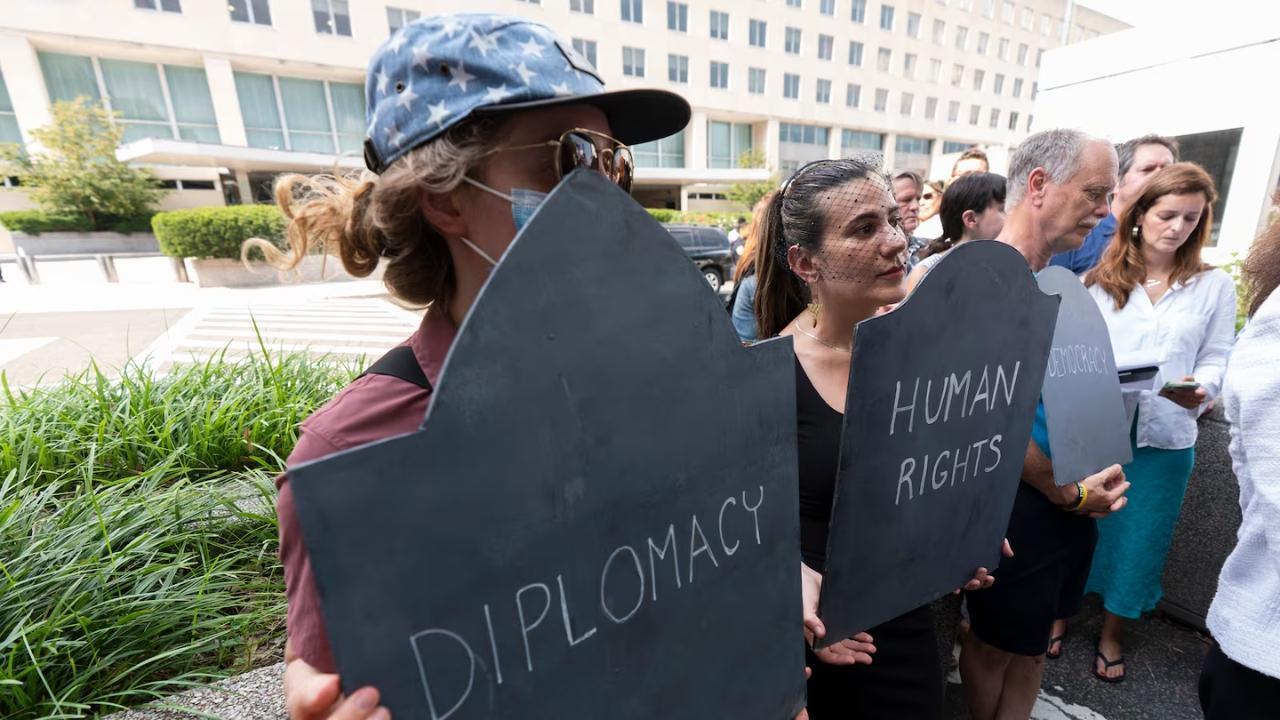
The response at home has been just as fierce. Mass protests erupted outside the State Department headquarters in Washington, D.C., led by career diplomats, unions, former ambassadors, and advocacy groups. Protesters decried the firings as politically motivated, accusing the administration of hollowing out institutions to serve ideological ends. Banners reading “Protect Diplomacy” and “America Needs Experts” waved across the plaza as chants echoed through the federal district. Some members of Congress have joined the chorus, promising hearings and oversight into how the layoffs were conducted and which departments were most affected. At least three congressional committees have launched inquiries into the legality, transparency, and impact of the dismissals.
Rubio and Trump’s rationale for downsizing diplomacy
Secretary of State Marco Rubio, tasked with implementing the reorganization, defended the move in a press briefing. He stated that many departments had grown “redundant” and “unaccountable,” claiming that their existence was more about sustaining themselves than serving strategic goals. Rubio argued that the new structure will allow the State Department to respond faster to global developments without “layers of bureaucracy.” President Trump echoed that sentiment, suggesting that the government had become “too bloated” and needed to focus more on direct outcomes rather than endless conferences, memos, and committee reviews. He pointed to trade deals, military deterrence, and border control as key areas where diplomatic energy should be concentrated.
Long-term implications for recruitment and talent retention
The sudden nature of these layoffs has damaged the State Department’s reputation as a stable and desirable workplace. Already struggling with recruitment in recent years, the department may find it even harder to attract young professionals interested in global affairs. Many graduates of international relations programs are now questioning whether they should pursue careers in public service. Several universities have reported declines in students applying for federal internship pipelines or taking the Foreign Service Officer Test. If the perception that diplomatic work is disposable takes root, it may deprive the U.S. of the next generation of experts at a time when global complexity is increasing.
Civil society and NGO pushback
Outside the government, non-governmental organizations that often partner with the State Department are voicing concerns about the ripple effect of the layoffs. Humanitarian agencies, environmental NGOs, and democracy promotion groups rely on U.S. diplomats for funding coordination, logistical support, and global advocacy. With their counterparts gone or unreachable, many programs are now in limbo. This could mean delays in humanitarian aid, stalled peace initiatives, and missed opportunities to curb corruption or promote human rights abroad. Several large organizations are already revising their operational plans for the next fiscal year, anticipating reduced engagement with U.S. counterparts.
Will the restructuring achieve its stated goals?
Supporters of the administration say it’s too early to judge the effectiveness of the shake-up. They argue that the U.S. government must evolve with modern realities, including budget constraints and digital communication. According to this view, leaner agencies will be more agile, focusing on outcomes rather than process. However, critics point out that diplomacy is not a short-term operation. Building relationships, understanding cultures, and promoting values takes years, sometimes decades. They warn that dismissing experts who have built trust abroad could undo progress that cannot easily be replaced by newer, faster teams. The debate over this restructuring is likely to continue well beyond the 2025 fiscal year.
Conclusion: a turning point for U.S. diplomacy
The mass layoffs at the State Department mark a decisive shift in how the United States conducts foreign policy. Whether seen as an overdue reorganization or a reckless dismantling, the move has already changed the tone and capacity of American diplomacy. The world is watching how this new structure unfolds. Allies are recalibrating expectations. Adversaries are testing the limits. Domestically, the federal workforce is grappling with uncertainty, and civic trust in nonpartisan public institutions is being tested. The full consequences of this moment may take years to materialize, but one thing is clear: American diplomacy is at a crossroads. What emerges from this upheaval could either redefine its strength—or diminish its role for generations to come.