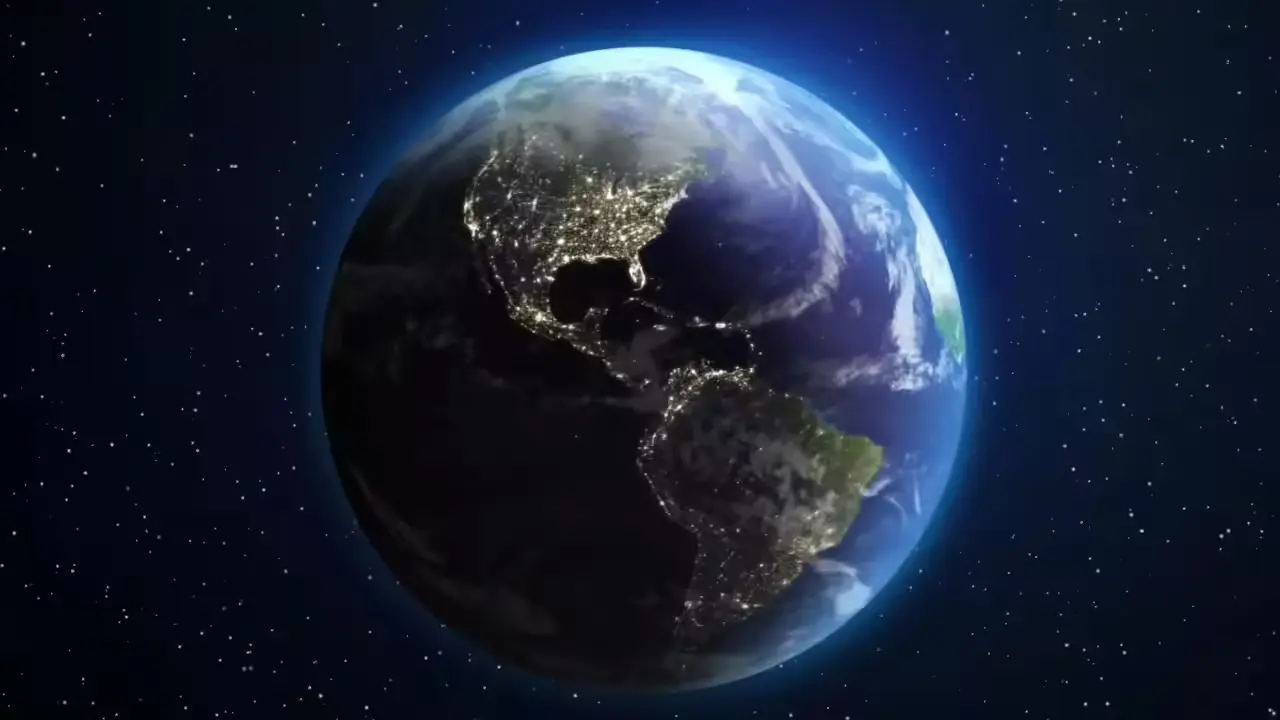
The notion of Earth abruptly halting its rotation may sound like a scene ripped from science fiction. Many imagine being propelled into space, oceans spilling over landmasses, or one hemisphere freezing while the other scorches. While such scenarios have a hint of truth, the actual implications of a pause in Earth’s spin are intricate, alarming, and scientifically captivating.
The rotation of our planet is so essential that it often fades from our awareness. We may feel stationary, yet Earth whirls at an impressive 1,670 kilometres per hour at the equator. This movement influences gravity, weather patterns, ocean behaviors, ecosystems, and even human physiology. Without it, the familiar world we inhabit would disappear.
This article investigates the possible outcomes if Earth were to stop spinning—either suddenly or gradually—and reveals that the most significant dangers are often unexpected.
Significance of Earth’s Spin Beyond Gravity
Earth’s rotation plays a vital role beyond just marking day and night. It subtly adjusts gravity itself. The centrifugal force arising from its spin diminishes gravitational pull, particularly at the equator, causing Earth to take the shape of an oblate spheroid. If rotation ceased, gravity would immediately reconfigure the planet into a more spherical shape, leading to severe coastline alterations and widespread flooding.
This rotation also sustains the Coriolis effect, which directs winds and ocean currents. Without it, global weather systems would disintegrate, resulting in catastrophic climate disruptions.
The Brutal Shock of an Instantaneous Stop
Should Earth halt its spin abruptly, inertia would wreak havoc. Every entity on the surface—air, water, structures, and living beings—would continue to drift eastward at the speed of rotation.
At the equator, this speed surpasses many aircraft. The immediate consequences would be devastating on a global scale:
Tsunamis would erupt as oceans surge eastward.
Supersonic winds would tear through the atmosphere.
Cities would face catastrophic destruction from kinetic energy.
Forests would be decimated on a colossal scale.
This isn’t a slow-motion calamity; it would unfold in mere minutes.
However, envisioning an instantaneous stop is unrealistic. The more thought-provoking scenario is considering a gradual decrease in rotation.
The Implications of a Gradual Spin Down
A slow deceleration sidesteps immediate obliteration but invites prolonged planetary degradation.
Prolonged Days and Nights
Currently, Earth completes a full rotation every 24 hours. As this movement slows:
Days would lengthen considerably.
Nights would become more severe.
Temperature variations would become extreme.
Over time, Earth could become tidally locked, such that one hemisphere perpetually faces the Sun while the other remains in shadow—much like the Moon’s relationship with Earth.
Life would no longer experience 'days' but rather extended periods of light and dark.
The Deterioration of Weather Patterns
Weather is a product of uneven heating coupled with rotation. Removing this rotation would completely reorganize atmospheric circulation.
Earth would likely form one extensive convection system:
Warm air would rise on the sunlit side.
This air would then traverse at high altitude toward the dark side.
On the dark side, air would plunge into perpetual cold.
Eventually, the air would return near the surface.
This shift could lead to constant megastorms where light meets dark, with winds stronger than any hurricane recorded.
Some areas might see uninterrupted rainfall while others could face extreme drought.
The Redistribution of Oceans
Oceans are unevenly distributed due to rotation, causing water to swell at the equator. Without this spin, the bulge would vanish.
Water would shift towards the poles, revealing vast dry equatorial regions and inundating polar areas under thick layers of ocean.
This new geography would present:
Expanded dry supercontinents near the equator.
Deep ocean expanses at the poles.
Ecosystems along coastlines completely disrupted.
Coral reefs and fish populations facing extinction.
Marine ecosystems would struggle, encountering pressures from temperature shifts and declining oxygen levels.
A Weakening Magnetic Shield
Earth’s magnetic field arises from the swirling molten iron in its outer core, a process affected by theplanet's rotation.
As the spin decelerates, the geodynamo weakens. Over time:
The magnetic field could collapse.
Cosmic radiation may directly impact the atmosphere.
The atmosphere would gradually lose its particles.
Overall exposure to harmful radiation would increase.
This change wouldn't be immediate but could lead Earth down a path akin to that of Mars—cold, arid, and unprotected.
Strain on Life’s Evolution
While life wouldn't vanish instantaneously with a gradual spin-down, species would face intense pressure to adapt.
On the Heated Side
Life may adapt by retreating underground or evolving forms resistant to radiation.
On the Frozen Side
Only extremophiles, organisms resilient to harsh conditions, would likely endure.
The Habitable Twilight Zone
The region between light and dark would become the most hospitable area, where life would centralize, much like ecosystems thriving around deep-sea hydrothermal vents today.
Collapse of Human Civilization
Modern society relies on:
Consistent weather patterns.
Reliable agriculture.
An effective global transportation system.
Energy distribution networks.
Each of these aspects is intertwined with Earth’s rotational dynamics.
Agricultural systems would collapse as seasonal cycles fail. Infrastructure would buckle under climatic strains, and migration pressures would spiral out of control.
Even with groundbreaking technology, sustaining a burgeoning population under these conditions would be unworkable.
Why Earth Can't Halt Naturally
Earth isn’t on a trajectory to randomly cease spinning. Its rotation is preserved by angular momentum. Stopping it would necessitate an external force colossal enough to likely obliterate the planet.
Only cosmic events like:
A significant planetary collision.
A close brush with a rogue celestial body.
Direct impacts by a stellar force.
could effectively alter Earth’s rotation, all of which would herald extinction-level calamities before spin cessation became a concern.
Debunking a Common Myth: Gravity Would Not Disappear
One frequently held misconception is that stopping Earth’s spin would eliminate gravity. This is untrue.
Gravity stems from mass, not motion. Even without rotation, Earth would still exert nearly the same gravitational force.
What would change is the sensation of gravity, especially at the equator where centrifugal forces currently mitigate a fraction of gravity’s pull. Humans would feel slightly heavier, yet this trivial concern pales in comparison to the planet’s other challenges.
The Lessons from This Thought Experiment
This hypothetical scenario is not a prediction of the future. It highlights the delicate balance sustaining Earth.
Rotation impacts:
Climate equilibrium.
Ocean currents.
Atmospheric safety.
Habitability.
Earth is not merely a rock in space; it exists as a meticulously finely-tuned system where motion equates to life.
The Profound Insight: The Stability of Life
The most astonishing takeaway isn't solely the potential violence of Earth's fate should it stop spinning but rather how
precisely it must continue rotating for life to thrive.
A marginally faster spin could exacerbate storms, whereas a slower rotation would lead to climate instability. Earth exists within a narrow bandwidth where complexity flourishes.
That equilibrium is too often taken for granted—until you envision its absence.
Final Reflection
If Earth ceased spinning, it wouldn't culminate in people hurtling into space or an immediate loss of light. Instead, it would dismantle the unseen systems that quietly support life.
The true peril lies not in dramatic spectacles but in systemic disintegration.
Earth rotates not just to delineate day and night but to sustain oceans, shield the atmosphere, manage climate, and support every life form on the planet. Without this vital motion, Earth may remain in existence but would no longer be a thriving world.
Disclaimer:
This article serves informational and educational purposes only. The scenario illustrated is speculative and not indicative of any probable planetary occurrence.