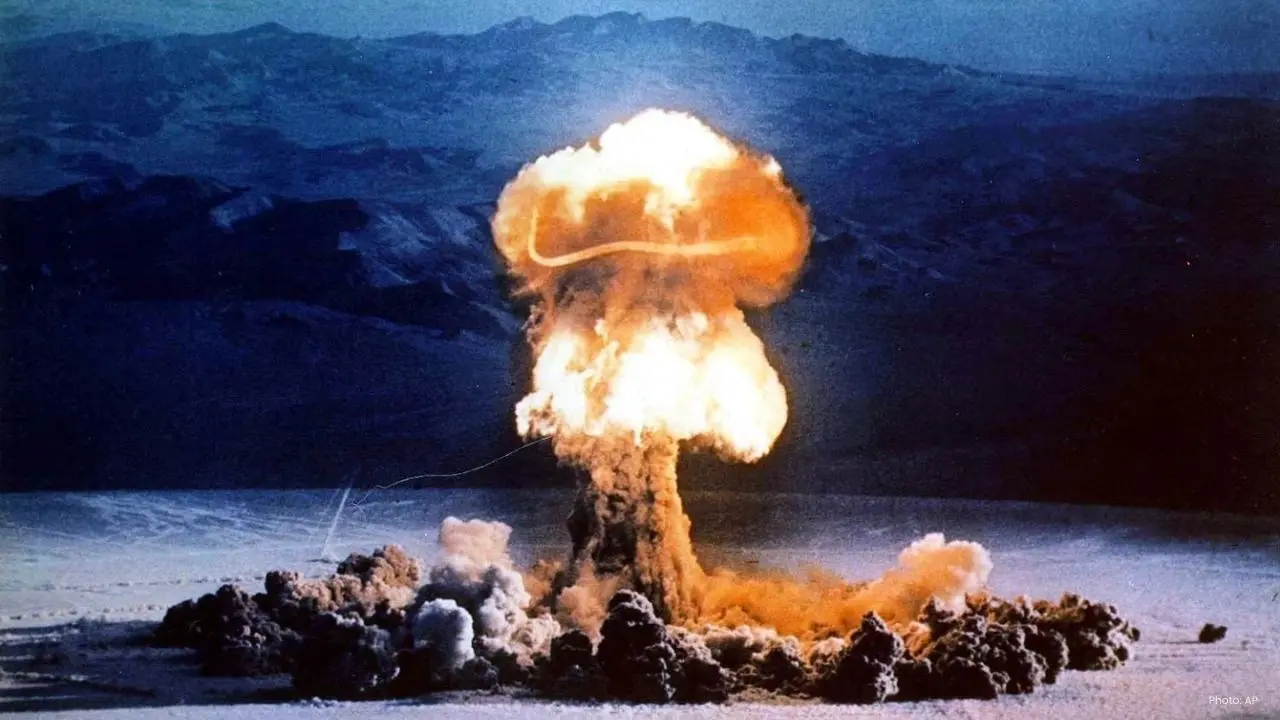
The United States has asserted the potential to resume nuclear tests, citing escalating worries surrounding Russia, China, and North Korea. This statement follows remarks by U.S. President Donald Trump earlier this year, who suggested that the U.S. might need to reinstate nuclear testing to keep pace with activities allegedly being carried out by other nuclear powers.
During a private meeting on November 10, U.S. Chargé d’Affaires at the International Organizations in Vienna, Howard Solomon, made this declaration. The meeting was organized by the Preparatory Commission of the Comprehensive Nuclear-Test-Ban Treaty Organization (CTBTO), which monitors global nuclear test bans. These comments surfaced through a leak to The Associated Press.
Solomon indicated that preparations for nuclear tests at the same level as other nuclear-capable nations would be initiated by the U.S. He underscored the importance of maintaining transparency while safeguarding the nation’s security throughout the process. Solomon further accused Russia and China of possibly breaching their commitments to cease nuclear testing, particularly with regard to low-yield explosions since 2019.
Low-yield nuclear explosions, which are minimal in scale, involve compressing nuclear materials to generate a chain reaction, yet remain prohibited under the Comprehensive Nuclear-Test-Ban Treaty (CTBT). Any such explosion, no matter how small, violates treaty obligations.
Heightened Concerns Regarding Russia, China, and North Korea
Solomon referenced longstanding U.S. anxieties about Russia and China's adherence to the nuclear test ban. He noted possible evidence of testing activities at China's Lop Nur in Xinjiang and at Russia's Novaya Zemlya site in the Arctic. Though both nations signed the CTBT, they have yet to ratify it, claiming to uphold a strict moratorium on testing and rejecting allegations of breaches.
The discussion also highlighted North Korea's ongoing nuclear tests, which the nation has conducted six times this century. These tests were significant enough to be detected by the CTBTO's monitoring network. However, experts emphasize that low-yield tests conducted deep underground may evade detection, raising suspicions of covert testing by some countries.
Trump's Assertions and U.S. Stance
Recently, President Trump claimed that Russia and China conduct nuclear tests without public acknowledgment. He argued that the U.S., being an open society, discusses its policies transparently, unlike its rivals. A White House official clarified that Trump's intention was for U.S. testing to align with that of other nations, though no specific details were provided.
Russia Responds to U.S. Claims
Russia condemned Solomon's comments, with representative Mikhail Ulyanov warning that resuming nuclear tests could jeopardize global security and undermine the nuclear non-proliferation framework. Ulyanov categorically denied the U.S.’s accusations, labeling them as “false” and “unacceptable,” insisting that Russia has adhered to its testing moratorium.
Wider Arms Control Issues
In the meeting, Solomon also took issue with Russia's suspension of its engagement in the New START treaty and criticized its significant stockpile of nonstrategic nuclear weapons and its nuclear policy doctrine.
Nonstrategic nuclear weapons, designed for use on battlefields, are not restricted by major arms control pacts, complicating regulation efforts. Though smaller than strategic nuclear arms, these weapons pose a considerable risk of causing mass destruction. Experts warn that they are more likely to be deployed during conflict due to their battlefield utility.
Estimates suggest that Russia possesses between 1,000 and 2,000 nonstrategic nuclear warheads, compared to approximately 200 held by the U.S., highlighting a concerning disparity.
Strategic Nuclear Weapons and New START Context
Strategic nuclear weapons, which are far more potent, are intended to penetrate deep into enemy territory. Both the U.S. and Russia maintain comparable numbers—1,770 for the U.S. and 1,718 for Russia—as regulated by the New START treaty enacted in 2010. Although Russia halted its participation in 2023, President Vladimir Putin stated that the country would adhere to the treaty limits for an additional year.
The treaty is set to terminate on February 5, posing a looming threat of unrestricted nuclear arsenals for both nations for the first time in decades.
A Pivotal Moment for Global Nuclear Arms Control
The current dialogue around nuclear testing reveals a broader crisis in global arms regulation. Trust among major nuclear powers is waning, and essential treaties face mounting pressures. The potential for renewed testing could exacerbate international instability and trigger a new arms race.
The U.S. maintains that any resumption of testing would be a direct response to competing nations’ violations, claims which Russia and China contest. Meanwhile, North Korea's weapons program advancement continues to heighten uncertainties.
With escalating global tensions, experts warn of the possible return of nuclear brinkmanship. The deterioration of treaties like the New START and disputes over CTBT compliance may compel nations to escalate and expand their arsenals.