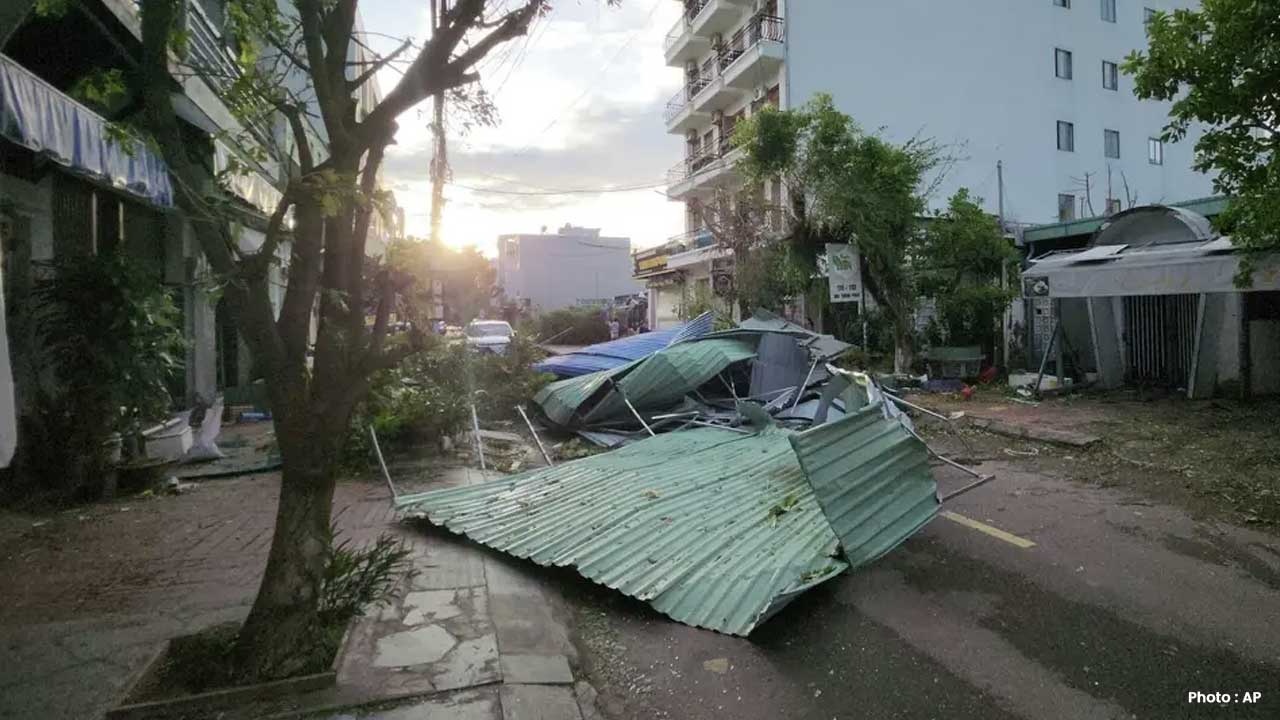
In a harrowing aftermath of its passage through the Philippines, Typhoon Kalmaegi slammed into central Vietnam with ferocious winds and torrential rain, leaving a toll of at least five lives lost, numerous individuals missing, and thousands forced from their homes. This storm ranks among the most severe recorded in Vietnam's history, striking provinces such as Gia Lai and Dak Lak, where homes were flattened, trees uprooted, and power lines downed.
Local officials reported three fatalities in Dak Lak and two in Gia Lai, alongside three people still unaccounted for in Quang Ngai province. The Ministry of Natural Resources and Environment indicated that 57 homes were completely destroyed and almost 2,600 others suffered significant damage, with Gia Lai bearing the brunt of the devastation.
Social media footage depicted chaotic scenes from affected regions: fierce winds prompting residents to abandon their cars, seawater inundating homes in Binh Dinh Province, and roofs being torn off buildings as Kalmaegi swept through. Eyewitness accounts described the conditions as “terrifying,” as gusts peaked at 149 km/h and relentless rainfall flooded communities.
As of Friday morning, authorities were still evaluating the full scale of the destruction. Emergency crews were dispatched to rescue those trapped, while military units joined in clearing debris and restoring communication networks. Although the typhoon has diminished into a tropical storm while continuing its path towards Cambodia, the damage left in its wake is monumental.
Kalmaegi initially hit the Philippines earlier this week, causing catastrophic consequences: at least 188 deaths, 135 missing persons, and over half a million evacuations. In response, the government declared a national emergency as rescue operations persist amidst concerns about an impending storm, Typhoon Fung-wong, projected to impact the area shortly.
Meteorologists attribute the increasing frequency of tropical cyclones in the region to global climate change. Elevated ocean temperatures contribute to stronger storms and more substantial rainfall, making typhoons like Kalmaegi not only more common but also more damaging across Southeast Asia.
Experts recommend that nations in the region enhance disaster preparedness protocols, invest in improved early warning systems, and adopt climate resilience strategies to safeguard vulnerable coastal areas.
As recovery efforts continue in both Vietnam and the Philippines, families are grieving their losses, reconstructing homes, and preparing for the next adverse weather event—illustrating the stark reality of the changing storm pattern fueled by climate change in Asia.