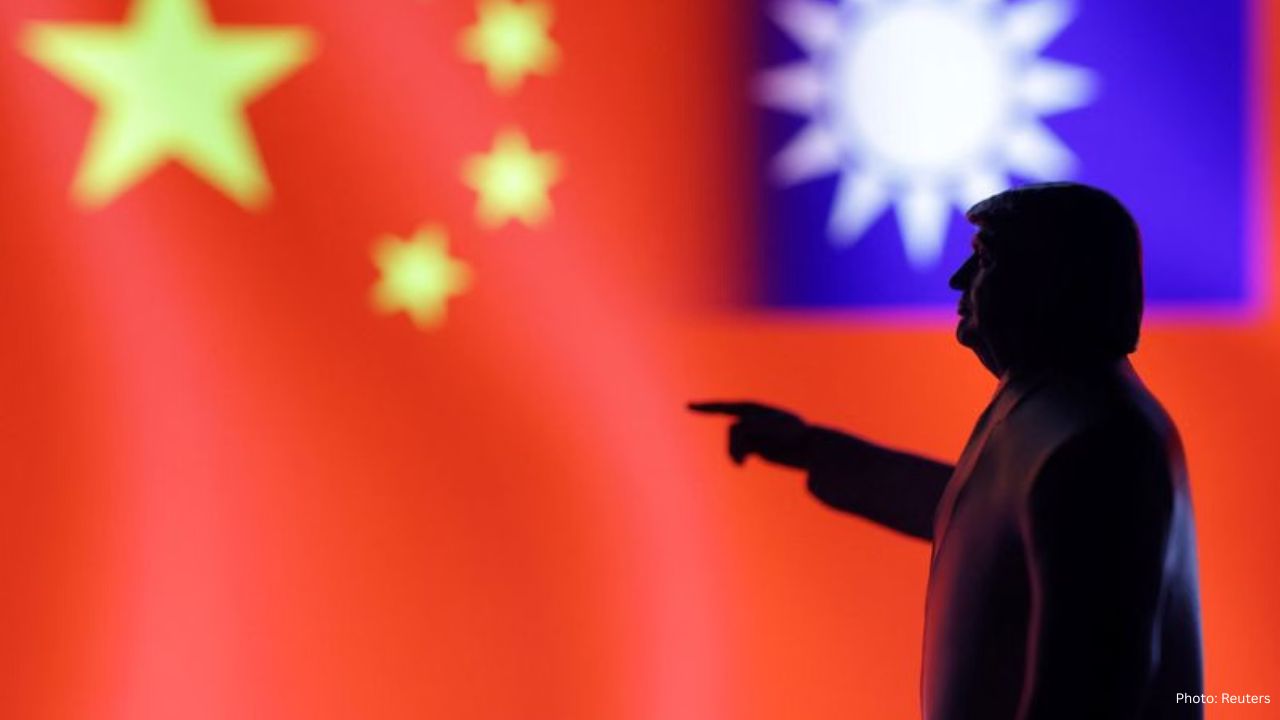
The Trump administration has introduced a refined National Security Strategy aimed at thwarting potential disputes with China in relation to Taiwan and the South China Sea. This initiative underscores the importance of bolstering military capabilities, urging allies to contribute more to collective defense, and ensuring stability in a pivotal trade and technology corridor.
China views Taiwan as a part of its territory and has not dismissed the option of utilizing force for control. Meanwhile, the South China Sea remains a contentious area, with Beijing asserting claims over nearly all waters, leading to objections from neighboring nations. Taiwan, a democratic entity, significantly depends on U.S. support for its defenses despite the absence of formal diplomatic ties with Taipei.
Trump’s revamped strategy places greater emphasis on Taiwan compared to previous plans. The 2025 document references Taiwan eight times, underscoring its significance in trade and semiconductor production, which are crucial to the global tech landscape. It states that the U.S. will uphold military capacities necessary to counter aggression along an island chain stretching from Japan to Southeast Asia. Nevertheless, it insists that the U.S. cannot act alone and must rely on allies for increased spending and active participation in regional security.
Measures already undertaken by the administration to bolster support for Taiwan include Trump signing a law mandating periodic assessments of U.S.-Taiwan relations and approving a $330 million transaction for fighter jets and associated parts. These actions are designed to enhance Taiwan's defense capabilities without provoking China.
Moreover, Trump is striving to navigate relations with China cautiously. A trip to Beijing is on the agenda for April to engage with Chinese President Xi Jinping on trade and regional concerns. Additionally, Trump has subtly advised regional leaders, including Japanese Prime Minister Sanae Takaichi, to avoid intensifying tensions over Taiwan, indicating a delicate balance between deterrence and diplomacy.
The strategy advocates for allies, notably Japan and South Korea, to elevate defense expenditures and assume more engaged roles in collective security efforts. The objective is to thwart any maneuvers to claim Taiwan and to enable rapid responses from the U.S. and its partners if tensions escalate.
Experts suggest this approach is a blend of military readiness and diplomatic prudence, indicating the U.S. commitment to defend its interests and support Taiwan while simultaneously striving to sidestep direct confrontations with China.
In summary, Trump’s latest strategy reflects Hong Kong's significance within global security frameworks and technological landscapes. It merges enhanced military preparedness with diplomatic efforts and highlights the necessity for U.S. allies to shoulder shared responsibilities. As tensions intensify in East Asia, this tactic will attract close scrutiny from governments, corporations, and the Taiwanese populace whose safety and future hinges on regional stability.