Photo:AP
A Diplomatic Moment Turned Viral: Trump Praises Liberian Leader’s English Skills
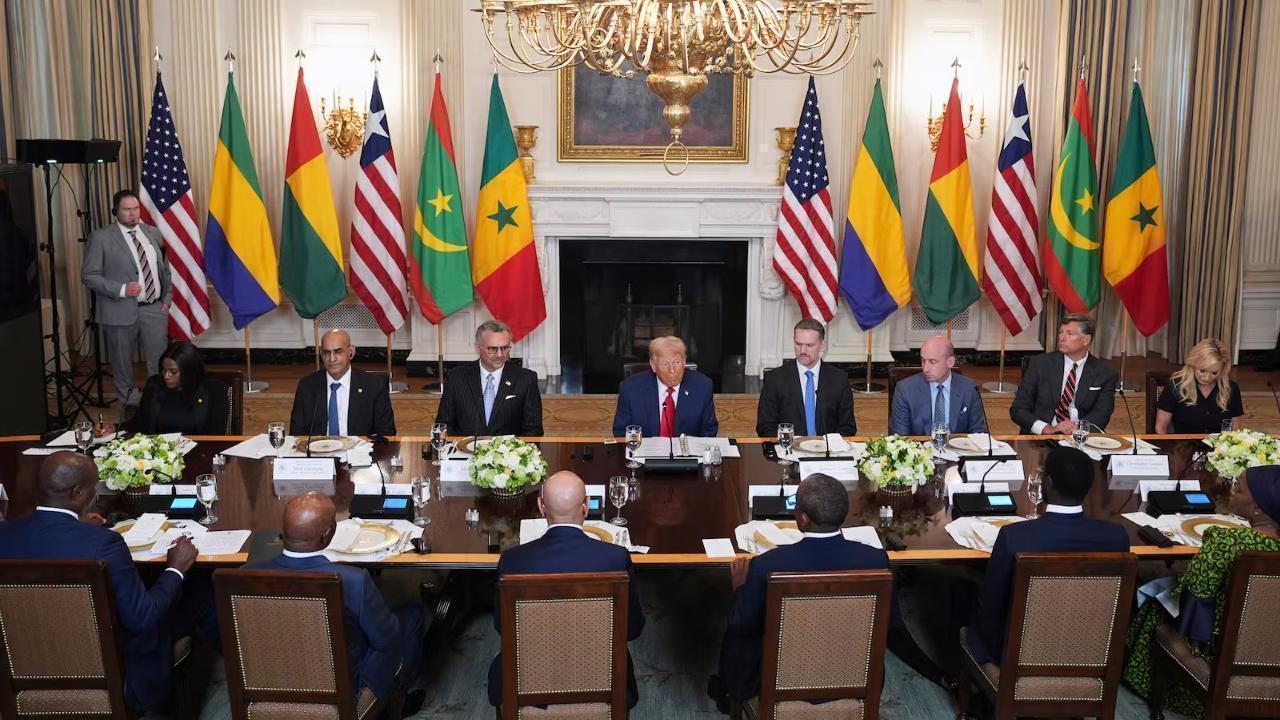
During a recent diplomatic luncheon hosted at the White House, former U.S. President Donald Trump made headlines again—this time for his remarks directed at Liberian President Joseph Boakai. The two were part of a broader West African delegation meeting aimed at revitalizing trade relations between the United States and several African nations. In a moment meant to be complimentary, Trump asked Boakai where he learned to speak “such beautiful English.” What may have seemed like a benign remark quickly turned into a point of viral discussion across social media, political circles, and international diplomacy observers.
The reason? English has been the official language of Liberia since its founding in the 19th century by freed American slaves. President Boakai, like most educated Liberians, grew up speaking English as his first language, received his education in it, and has used it throughout his political career. The exchange between the two leaders, while cordial on the surface, shed light on broader issues surrounding cultural assumptions, historical knowledge, and the optics of diplomacy.
The Historical Roots of Liberia’s English-Speaking Identity
To understand the nuances behind this interaction, it’s important to explore the unique history of Liberia. The West African nation was founded in the early 1800s by freed African Americans through the efforts of the American Colonization Society, which promoted the repatriation of freed Black slaves to Africa. Liberia declared independence in 1847, adopting English as its official language—a legacy of its American influence. The country modeled many of its institutions, including government, education, and legal systems, on those of the United States.
Liberia’s capital, Monrovia, was named after U.S. President James Monroe, and its constitution was heavily inspired by the U.S. Constitution. English was not only the official language—it became a foundational pillar of national identity, especially among Americo-Liberians, the descendants of the freed slaves who governed the country for decades. Today, English remains the language of government, education, and commerce in Liberia. For Liberians, speaking English fluently is not an anomaly—it is the norm.
The Optics of the Comment
Trump’s question to Boakai—“Where did you learn to speak such good English?”—was clearly intended as a compliment. However, it unintentionally revealed a gap in understanding of African history and geopolitics. For many observers, it echoed a pattern of Western leaders expressing surprise at African competence, excellence, or sophistication—often based on assumptions rooted in outdated stereotypes.
This is not the first time such gaffes have made headlines. Over the years, numerous public figures have stumbled when interacting with foreign dignitaries, mispronouncing names, referencing inaccurate histories, or making remarks that come off as patronizing. What makes this particular moment significant is the way it illuminates the lingering disconnect between surface-level diplomacy and deeper cultural knowledge.
President Boakai’s Calm, Gracious Response
President Boakai, an experienced politician with a calm demeanor, responded to Trump’s comment with grace and a touch of good humor. He explained that he learned English in Liberia, where it is the national language. Boakai, born in the remote town of Worsonga, had a modest upbringing but eventually rose through the ranks of Liberian politics, serving as vice president before assuming the presidency. His education and political acumen are well-respected across the African continent.
Boakai’s demeanor during the exchange reflected diplomatic maturity. Instead of taking offense, he used the moment to reaffirm Liberia’s cultural identity and historical ties to the United States. His ability to redirect the narrative helped neutralize what might have otherwise become an embarrassing international incident.
Media and Public Reaction: Amusement, Frustration, and Debate
As news of the exchange spread, reactions poured in from all corners. Social media lit up with memes, jokes, and debates. Some users mocked the comment as another example of Trump’s uninformed style of diplomacy. Others viewed it as harmless and suggested the media was overreacting. Commentators on African news networks weighed in with more serious reflections, calling for better global education about Africa’s history and the legacy of colonialism and Western influence.
The diplomatic community responded with mixed views. Some saw the remark as a teachable moment—a reminder of the importance of cultural sensitivity in international relations. Others felt it exposed a deeper issue in American foreign policy: a tendency to treat Africa as monolithic and underdeveloped, despite its complex and diverse societies.
The Broader Implications for U.S.–Africa Relations
Trump’s Africa policy has historically drawn criticism for being minimalistic and aid-centric. His administration focused less on long-term strategic partnerships and more on transactional diplomacy. While trade discussions have taken place and some infrastructure investments have occurred under U.S. programs like Power Africa, the continent has often felt overlooked compared to regions like Asia and the Middle East.
This luncheon was an effort to change that narrative. Trump emphasized a new strategy of trade over aid, aiming to position African nations as equal partners in economic growth. The leaders of Liberia, Senegal, Mauritania, and others welcomed the engagement, expressing interest in boosting exports and attracting American investment. However, incidents like the one with Boakai remind observers that personal diplomacy—how leaders speak and act—can shape the tone of international relations just as much as official policy.
The Importance of Cultural Competency in Leadership
In a globalized world, leaders must do more than just talk policy—they must show cultural awareness, emotional intelligence, and historical knowledge. Cultural competency isn’t just about avoiding gaffes; it’s about fostering mutual respect and trust. Diplomacy is a delicate dance, and seemingly small moments can shift perceptions dramatically.
This moment is also a case study in media amplification. While the remark could have remained a footnote in a diplomatic lunch, its viral nature shows how easily such incidents become symbols of larger issues. It’s not just about one question—it’s about the backdrop of historical misunderstanding, the optics of power dynamics, and the ability of media to shape international narratives.
A Look at the Legacy of American Influence in Liberia
The shared history between the U.S. and Liberia is unique among African nations. From the beginning, Liberia has looked to the United States as a political, economic, and cultural model. Many Liberian leaders have been educated in American universities, and diplomatic ties have remained steady even through Liberia’s civil conflicts in the 1990s and early 2000s.
Today, the U.S. continues to provide aid, invest in healthcare and education, and support Liberian governance reforms. American private companies operate in sectors such as mining, telecommunications, and agriculture. Peacekeeping, anti-terrorism, and Ebola response efforts have further solidified the bond between the nations.
Given this legacy, moments like the Trump-Boakai exchange carry additional weight. They’re not just diplomatic miscues—they’re reminders of a complex and evolving relationship shaped by centuries of intertwined history.
Liberia’s Global Image and the Role of Language
Language is more than communication—it’s identity, heritage, and power. For Liberia, the use of English is not a borrowed trait; it is intrinsic to its statehood and self-definition. Unlike many African countries that retained colonial languages for administrative purposes, Liberia’s English is rooted in its very founding.
By questioning Boakai’s English skills, Trump inadvertently suggested that fluency was unusual for an African leader—thereby perpetuating a perception that competence in global norms is surprising rather than expected. That perception can reinforce harmful stereotypes and diminish the credibility of African states on the world stage.
Conclusion: More Than a Soundbite
The story of Trump’s compliment to Boakai is about more than a momentary lapse or awkward phrasing. It reflects the ongoing journey of global diplomacy—where words, gestures, and assumptions carry immense weight. It’s a call to leaders everywhere to prepare thoroughly, to listen more than they speak, and to remember that in international affairs, respect is currency.
As Boakai continues his term as Liberia’s head of state, his poise during the exchange sets a tone of dignity and confidence. For Trump, whether the remark will affect his diplomatic credibility depends on how such moments are contextualized. For observers, the lesson is clear: genuine curiosity is welcome, but it must be paired with cultural awareness and historical understanding.
In today’s hyperconnected world, no comment exists in isolation. It travels, it multiplies, and it resonates. This one comment reminded millions about the deep and often overlooked ties between America and Liberia—and perhaps, that’s the true silver lining.