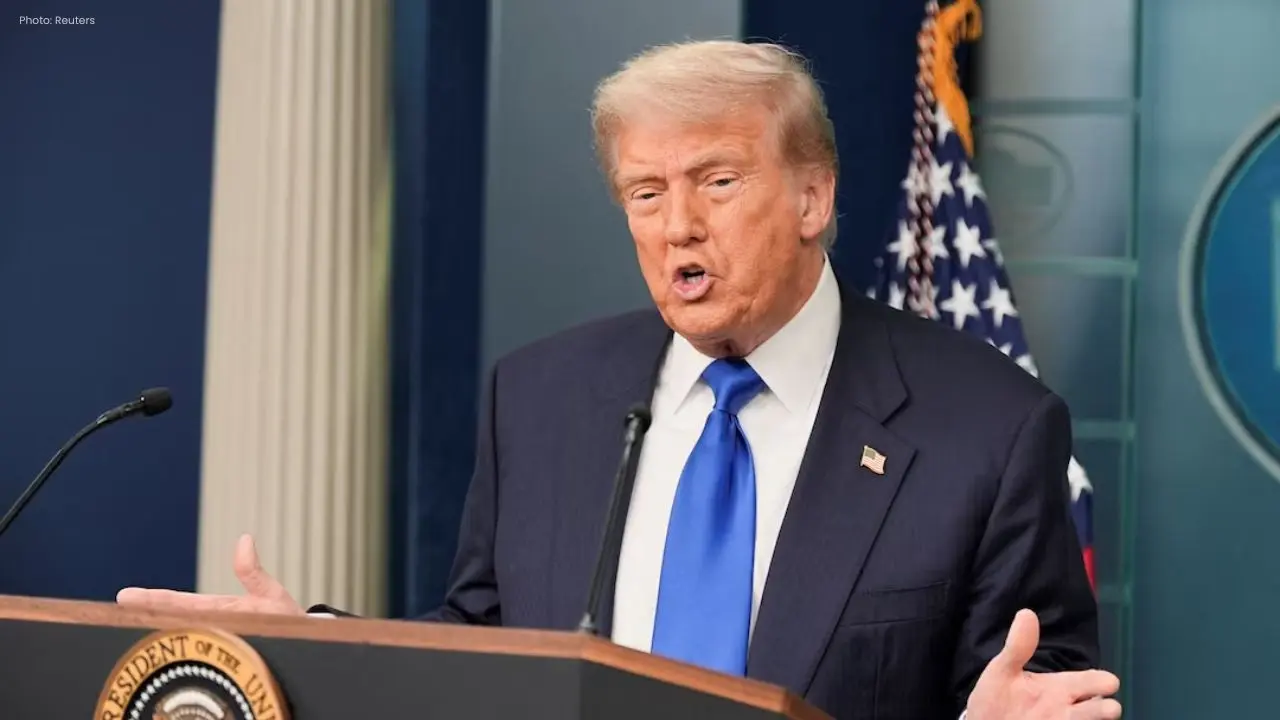
On Friday, US President Donald Trump expressed strong criticism towards Canada for dismissing his proposed “Golden Dome” missile defense initiative associated with Greenland. He argued that the system was designed to extend protection to Canada, yet accused the country of gravitating towards China rather than backing US-led security efforts.
In a post on Truth Social, Trump lamented Canada’s stance against the Golden Dome despite its potential security benefits. He cautioned that the increasing trade ties with China might pose significant threats to Canada. Trump warned that China could “consume them” within a year if the situation continues.
These remarks arise amid escalating tensions between the US and Canada, exacerbated by Canadian Prime Minister Mark Carney's recent statements at the World Economic Forum (WEF) in Davos.
During his address at the 56th Annual WEF Summit, Carney discussed the onset of heightened global rivalry and expressed concerns regarding economic pressure tactics, implying that the established rules-based global order is in decline. His speech was viewed as a subtle critique of Washington’s policies, specifically concerning Greenland.
In response to Carney’s comments, Trump criticized Canada for not being more appreciative of the benefits it receives from the US, including robust security assistance. He argued that Canada should recognize the protections afforded by its southern neighbor.
Trump underscored Canada’s reliance on the US, implying that the country’s survival is largely due to American support. He aimed his comments directly at Carney, urging him to keep in mind America’s strategic significance in public discussions.
Meanwhile, Canada recently unveiled a trade agreement with China, which Prime Minister Carney suggested would unlock over $7 billion in new export opportunities for Canadian industries. The Canadian government aims to diversify its trade partnerships and bolster its economy amid global uncertainties.
Reports indicate that Canada has agreed to slash its tariff on Chinese electric vehicles, previously set at 100 percent. In return, China is expected to reduce tariffs on essential Canadian agricultural exports, like canola seeds.
As part of the plan, Canada will impose an annual limit on 49,000 Chinese EV imports, gradually increasing to around 70,000 over the next five years. Simultaneously, China will decrease its tariff on canola seeds from 84 percent to about 15 percent.
Carney also mentioned that Canada’s recent dealings with China have resulted in clearer benefits. He characterized China as a more reliable partner compared to the US, particularly as Canada navigates significant trade pressures from Washington.
Canada currently contends with high US tariffs, including a 35 percent tax on Canadian goods and broader duties such as 50 percent on metals and 25 percent on non-US automobiles.
Simultaneously, US-China trade tensions persist, with both sides having threatened heavy tariffs. However, a meeting between Trump and Chinese President Xi Jinping resulted in a postponement of certain proposed tariffs until November 10, 2026.
Trump’s latest comments exacerbate the strain on US-Canada relations, particularly as Canada seeks to strengthen its trade connections beyond the US and find more economic flexibility in a rapidly evolving global landscape.