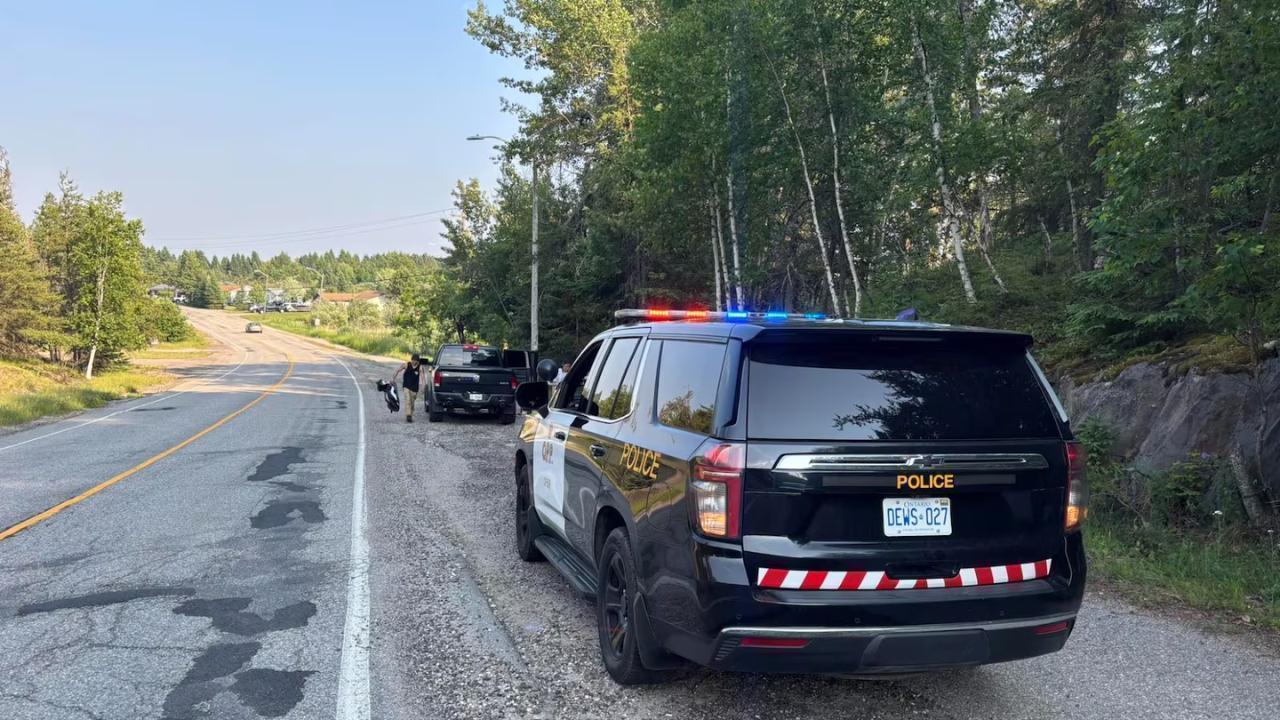
Photo:Ontario Provincial Police
It was an ordinary traffic enforcement checkpoint in Northern Ontario that turned into a wake-up call for child safety. An officer pulled over a vehicle during a routine stop and noticed immediately that something was terribly out of place: a young toddler was not secured in a car seat or safety belt. The sight was alarming. The officer acted swiftly and decisively. The child was removed from the vehicle and taken to safety, and the driver was subsequently charged. It is a moment that illustrates how one routine traffic check can unveil a serious threat—one that is often hidden in plain sight.
Authorities confirm the driver now faces multiple charges, including failing to secure a child in a properly anchored restraint system and driving with insufficient safety measures. The driver is also accused of impeding a peace officer. These charges underscore the seriousness with which law enforcement treats child safety violations. For the toddler involved, the narrow escape from potential harm speaks volumes about the importance of following safety regulations that too often are overlooked or taken lightly.
Police are reminding all motorists that child passenger safety isn't optional or just a suggestion. Child restraint laws are in place because they save lives. Even at low-speed vehicle movements, sudden braking or minor traffic hiccups can propel an unsecured child into severe injury. Sensors in the brain cannot yet distinguish between understandable curiosity and catastrophic danger. So whether it’s a short drive to daycare, a school run, or a family outing, buckling up every time makes a difference.
The concern isn't misplaced. Tragically, accidents involving unrestrained children often end in devastating outcomes. According to child safety data, unrestrained kids have a significantly higher footprint in fatal crashes. Even in lower-speed impacts, loose bodies can become lethal projectiles. In Northern Ontario, with long rural roads and sparse traffic, there can be a mindset that the risk is minimal. Yet, it only takes one unexpected hazard—an animal crossing, sudden stop, or unseen pothole—to transform the moment into tragedy.
In recent years, provincial education campaigns have tried to shutter that false confidence. Signs at rest areas, TV and radio ads, and free community events teaching parents how to properly select, install, and use car seats have become more common. Public health officials say that rural areas often report higher incidents of non-compliance with child restraint rules—not because people don’t care, but because they underestimate how quickly disaster can strike on even a familiar route.
Vehicle stops like this one serve a dual purpose: enforcement and education. Drivers who might argue they didn’t realize a seatbelt was necessary for a preschooler are given a moment to reflect. The officer’s intervention saved the toddler from potential harm, while the ticket and court appearance raise awareness of the legal consequences. And if nothing else shifts, at least the root message is clear: buckling up is non-negotiable.
This incident also highlights another concern: what happens when those responsible for the child are negligent or unaware. Support systems exist to help parents and caregivers. Child Safety Seat Clinics offer expert assistance, ensuring that seats are appropriate for age and size and are correctly installed. Community volunteer groups also lend a hand in providing seats to families in need. Affordability should never be an excuse when programs and charity partnerships offer access to certified seats and installations at low or no cost.
Of course, there are legal consequences for non-compliance. The driver now faces tickets that could cost over $300 under provincial law. If convicted, the driver will receive demerit points. The judge could impose additional conditions such as mandatory road safety education, installation of child safety equipment, or probation conditions aimed at ensuring compliance. It may seem heavy-handed, but the aim is prevention. By penalizing non-compliance, authorities hope to send a clear deterrent message to other families.
The ongoing case will also involve a probationary period where the court may require the driver to show proof of obtaining and installing an approved car seat properly. Instructive programs often accompany punishment—drivers learn through brief classes and interactive training. Rehabilitating awareness is often more beneficial than pure punishment, bridging a gap between ignorance and responsibility.
Broadly speaking, the incident shines light on the importance of consistency. While one poorly restrained toddler might seem like a single lapse, if that was their child or grandchild, it would matter profoundly. Every year across Canada, hundreds of children are injured in collisions; some fatalities could have been prevented with a correctly used restraint system. The lesson isn’t just about the law—it goes to parenting, caregiving, and community vigilance.
Community reactions have varied. Social media buzzed with shock at the officer’s observation, but also applause for the swift action. Many voices decried the driver’s apparent disregard, but some offered compassion—suggesting that caregivers might struggle with installation or knowledge. That is precisely why extra help programs exist. No one should pay the price of lack of information, especially when the resources remain underutilized.
Health professionals note that parents often discover their mistakes too late. Roadside checks have the power to identify and correct mistakes. Especially on a stretch of highway where families visit grandparents, haul gear for recreation, or simply commute, every seat should hold a secure child. Law enforcement encourages ongoing checks—when a car seat is replaced, when the child grows, or when the vehicle changes. A good caregiver checks the manual and double-checks the buckle.
In Northern Ontario, where long distances and isolated roads lull drivers into comfort, it's crucial to maintain vigilance. A short trip to the grocery store or to the park can become a life-and-death scenario in less than a second. The officer at the checkpoint likely saved a toddler from an outcome irreversible and tragic.
Child safety advocates say this event should be used as a launching point for broader conversation. Schools, childcare programs, community centres, and medical clinics can re-emphasize car seat checks when children enroll, attend their first physical, or get immunizations. Every touchpoint is an opportunity to remind, inform, and offer help. Supporting caregivers avoids blame and accelerates action.
The province offers subsidized car seat programs. This roadside stop revealed a gap between resources and usage. Outreach needs to be more strategic. Public service announcements, mail-outs, text reminders, and local partnerships matter. If caregivers receive a free seat but don’t use it, or don’t know how to install it, a check is essential.
Insurance groups add another layer. Some auto insurers offer premium discounts or matching contributions for caregivers who complete a recognized car seat training program. Those insurance incentives are valuable. They create financial reward and reinforce the behavioral shift needed to make safety habitual.
When the driver attends court, they may be ordered to attend a child passenger safety course as part of their sentence. That course will usually include hands-on demonstration, education on how restraint systems work, weight and height guidelines, and often private seat fitting time. It is not shaming—it is teaching. Rehabilitative justice helps ensure community safety rather than just punishment.
Future checkpoints will likely see reinforced messaging. The OPP and local police boards may increase visibility of fines as well as free seat services. The officer in this incident reported feeling both relieved and determined. Relieved because the injury did not occur, and determined because the reminder of how close the risk was tangible and urgent.
School bus drivers, healthcare workers, daycare staff—everyone who touches families—can connect dots between policy and safety. A reminder on bulletin boards or during parent orientation can mention that children may not ride unrestrained at any age or distance. Quite simply: no short drive is worth risking a child’s life.
Experts emphasize a culture shift: from reacting to car accidents to proactively preventing them. The security of knowledge and routines builds awareness for generations. Every caregiver must reimagine buckling up as a reflex—automatic, not optional.
Some argue the law should require mandatory seat checks at pick-up spots, like daycares or schools, but others worry about privacy and enforcement boundaries. Still, the idea sparks a needed debate: how can accountability meet support and convenience? Some jurisdictions have installed reminder systems or signs that demand passengers to buckle up before ignition allows the engine to run. Technology may help. But so far, human attention and care remain the front line.
Yet the question remains: why was the toddler unrestrained in the first place? Inquiries may reveal complicated answers. A car seat that does not fit the vehicle, caregiver uncertainty, seat sharing, or life chaos can contribute. None justify the oversight, but they demand deeper understanding. If the public process names, shames, or ridicules, it could deter others from seeking help. Better to amplify the message: oversight harms; education saves.
At the heart of the matter is a child’s life. At two or three years old, toddlers are naturally curious and unsteady. Their size puts them at great vulnerability in crashes. A forward-facing seat may welcome older children, but younger ones should begin in rear-facing seats until age two or the weight limit of the seat. This account reveals that knowledge still lags practice. The court case will highlight common misunderstandings—when seats should be changed, how restraints secure heads and chests, and which angle to place seats when traveling on roads with varying conditions like those in Northern Ontario.
Another layer is the ethical imperative. A child may not ask for a seat belt, but guardians must provide. A license to drive carries the duty of protecting passengers—starting with the smallest. Public conversations about the incident should extend beyond the narrow lens of a traffic ticket. Instead, they should include empathy, shared responsibility, and collective will to improve outcomes for all children.
A campaign launched in response could integrate multi-sector partners: police, healthcare, education, insurance, transportation. A unified message—“Every trip, every child buckled” —can become a mantra. If even one toddler is saved because a caregiver thinks twice, the legal costs and court visits are worth it.
It’s also essential to ensure long-term retention of lessons. Caregivers may buckle correctly when warned, but complacency returns quickly. Periodic reminders, seasonal campaigns (like before school year or holiday travel), and positive reinforcement help retain safe behaviours. Access to free or low-cost checks, supported by local businesses or nonprofits, should continue even beyond one roadside encounter.
The story of the Northern Ontario toddler serves as both a cautionary tale and a catalyst. The officer did his job, yes, but the real hero is the system coming together to prevent tragedy and encourage safety. That’s public service at its best—not only enforcing the rules but uplifting them through knowledge and care.
As the court date approaches, all eyes will be watching not only the verdict but the follow-up. Will the driver plead guilty, complete the required training, and become an advocate for seatbelt safety? Will local media amplify the message? Will the community meet the moment by implementing offered support systems? The outcome could shape next steps in how safety culture grows in remote areas.
Most importantly, the toddler is now safe. That child will perhaps never know how close harm seemed, but others may. If the message resonates, the unrestrained toddler became a turning point, not a statistic. The traffic stop served as a frontline intervention in a silent crisis. The law caught up, yes, but the greater victory lies in preventing tragedy before it forms.
Unrestrained toddlers should never be out of sight or mind. Caregivers rather than careening must buckle. Communities must equip to support. Laws enforce, but culture transforms. Here in Northern Ontario, a routine stop became rescue. And perhaps that rescue will echo through many more rides to come.