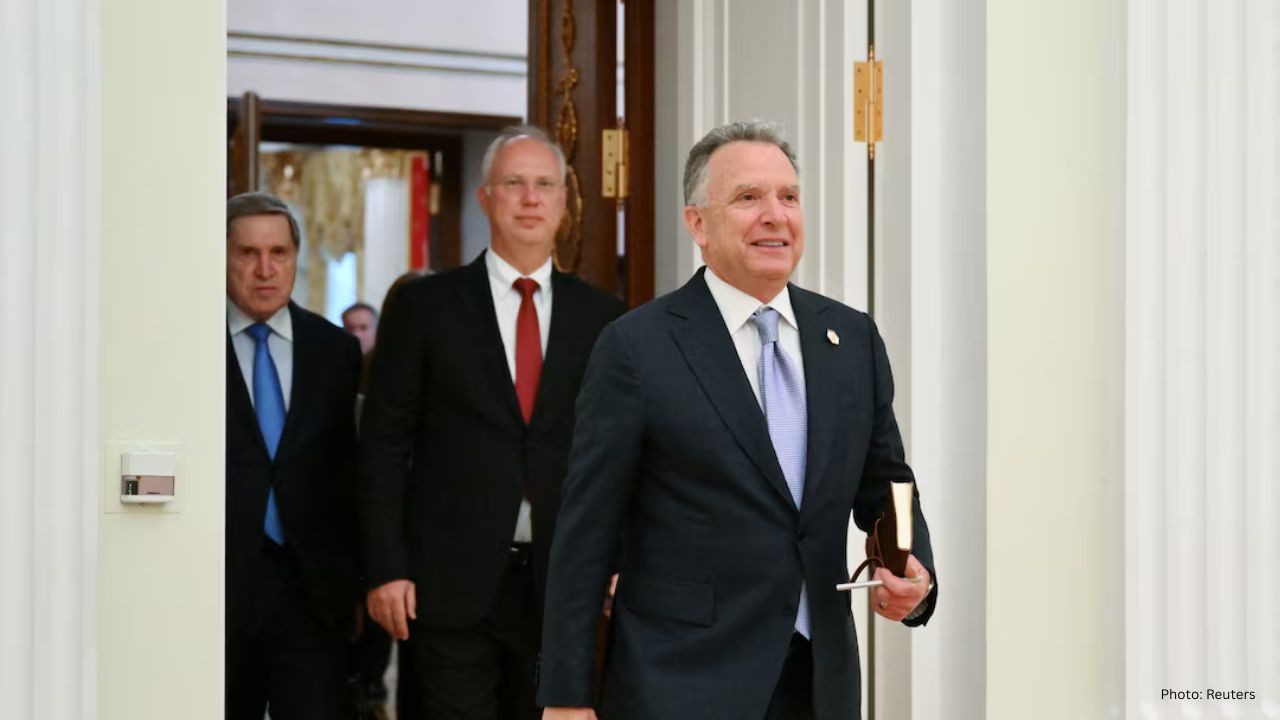
Russia has expressed strong condemnation regarding the disclosure of a private conversation involving key advisers from U.S. President Donald Trump and Russian President Vladimir Putin, describing it as an “unacceptable” incident that jeopardizes ongoing peace negotiations concerning the Ukraine conflict. The transcript, disseminated by Bloomberg News, has heightened tensions and raised inquiries about the source of the leak.
This particular recording stems from a call that took place on October 14 between Steve Witkoff, an envoy for Trump, and Yuri Ushakov, a prominent foreign policy adviser to Putin. Reports indicate that Witkoff offered insights on how Russia could frame a peace proposal for Ukraine to President Trump. Although Bloomberg claimed to have vetted the recording, the means by which they acquired such sensitive information remains undisclosed.
Ushakov vocally criticised the public nature of the call, asserting it was not intended for exposure. He conveyed to Russian news outlets that the release was clearly a calculated move to interfere with dialogues between the U.S. and Russia aimed at resolving the war in Ukraine, calling the act “unacceptable” and suggesting the leak was a ploy to sabotage diplomatic efforts.
He disclosed that some communications between himself and Witkoff utilized secure government channels, which are typically not intercepted unless there is a deliberate intent for the information to be released. Nevertheless, Ushakov maintained that none of the individuals engaged in the call are liable for the leak. He expressed an intention to address the matter directly with Witkoff.
Ushakov also indicated that exchanges via applications like WhatsApp are more susceptible to interception, implying that the breach might have targeted less secure modes of communication.
Another transcript released by Bloomberg included an October 29 conversation featuring Ushakov and Kirill Dmitriev, the head of the Russian Direct Investment Fund and a senior envoy for Putin. Dmitriev described Bloomberg’s account as “fake” and refuted the authenticity of the recorded dialogue.
The situation intensified further when Russian Deputy Foreign Minister Sergei Ryabkov remarked that specific media outlets are being harnessed by European governments as instruments in a broader “hybrid information war” against Russia, aiming to weaken Moscow’s ties with Washington and disrupt ongoing discussions related to Ukraine.
Bloomberg has yet to respond to Russia's allegations or clarify how it secured access to these high-level recordings. Such leaks are exceptional and usually entail intricate surveillance or deliberate insider actions.
This controversy has sparked broader apprehensions surrounding the privacy of international diplomatic communications and has exacerbated the tension around ongoing peace talks regarding Ukraine, where both Russia and the United States are striving to navigate a resolution following years of conflict.
For the time being, Moscow’s stance is unmistakable: it perceives the leak not merely as a violation of privacy but as a strategic maneuver aimed at undermining trust, escalating confusion, and obstructing global diplomatic efforts.