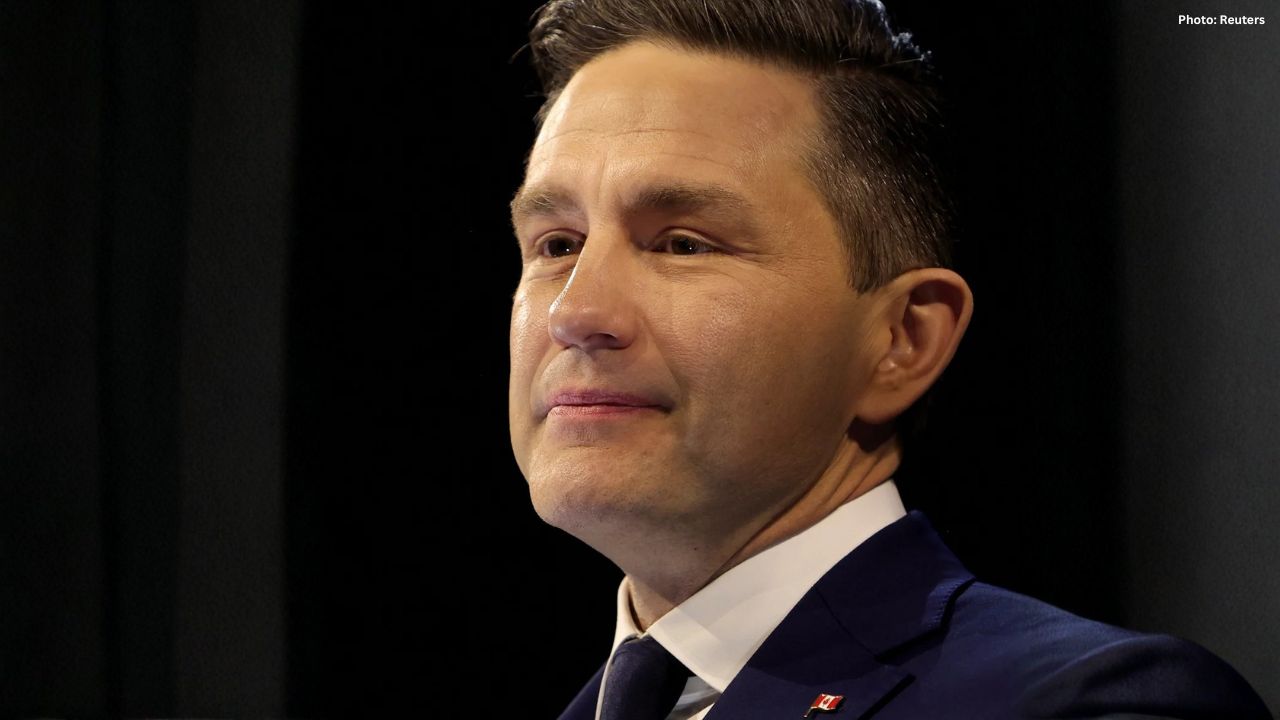
Pierre Poilievre has been re-elected as leader of the Conservative Party of Canada after securing 87.4% support in a mandatory leadership review held among party delegates in Calgary. The review was triggered after the Conservatives’ loss in the 2025 federal election, in which Poilievre not only failed to defeat Mark Carney’s Liberals but also lost his long-held parliamentary seat.
Despite these setbacks, delegates overwhelmingly endorsed Poilievre, signalling strong internal confidence as the party looks ahead to the next national campaign. During an hour-long speech prior to the vote, Poilievre urged Conservatives to remain united in the face of what he called an increasingly “uncertain world,” invoking the warning that “a house divided cannot stand.”
Poilievre’s address focused heavily on core Conservative themes: affordability, crime, small government, and the need to support Canadians “who have felt unseen for too long.” He also linked domestic policies to Canada’s global position, arguing that strengthening affordability and economic independence would help Canada “stand on its own two feet” amid geopolitical tensions, including increasingly strained relations with the United States.
The vote took place against a backdrop of rising separatist sentiment in both Alberta and Quebec. In Alberta, activists are gathering signatures for a potential independence referendum, while the Parti Québécois is leading polls in Quebec on a platform that includes a future sovereignty vote. Poilievre acknowledged these developments, blaming the governing Liberals for allowing Canadians to “lose hope in the confederation.”
Delegates who spoke to us said Poilievre’s speech struck the right balance between traditional Conservative messaging and direct engagement with the “elephant in the room” — growing regional separatism. Many praised his attempt to project unity while confronting internal and national divisions.
Poilievre’s popularity inside the party remains strong despite turbulence. After losing his Ontario seat in 2025, he returned to Parliament months later by winning an Alberta by-election with more than 80% of the vote. Supporters credit him with delivering the Conservatives’ largest popular-vote share in history — 41% — even though that was not enough to form government.
However, challenges remain. Two sitting Conservative MPs have crossed the floor to join the Liberals under Carney’s more centrist leadership, raising questions about unity and the party’s ideological direction. Poilievre has also struggled with broader public perception: more than half of Canadians view him unfavourably, with critics citing his combative tone and perceived lack of moderation.
In addition, Poilievre faces persistent scrutiny over the party’s stance toward Donald Trump, whose policies — including tariffs and comments about Canada becoming the 51st U.S. state — have unsettled many Canadians. Polls continue to show the Conservatives trailing the Liberals by nine points, suggesting Poilievre must broaden his appeal beyond the party base to contend in the next election.