Photo:reuters
Alberta Byelection Debate Draws Spotlight: Poilievre Faces Fierce Local and Independent Challenge
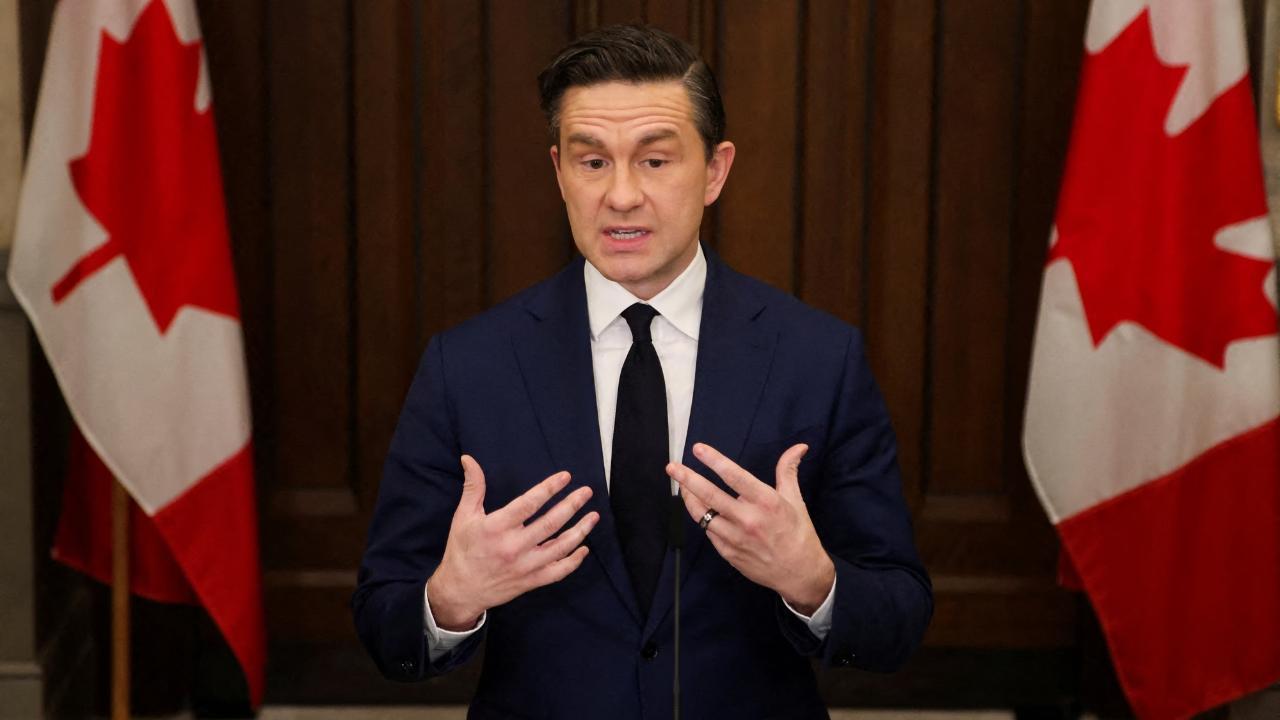
In what has become one of the most closely watched byelections in recent Canadian political memory, Conservative Party leader Pierre Poilievre is entering a heated debate tonight in Alberta’s Battle River–Crowfoot riding. What was expected to be a routine by-election has taken on national significance due to the extraordinary number of registered candidates—many of whom are independents—raising questions about democratic integrity, representation, and the dynamics of political power in Canada.
The Context: Battle River–Crowfoot as a Conservative Stronghold
Located in eastern Alberta, Battle River–Crowfoot is a historically safe riding for the Conservative Party. The late Damien Kurek, who recently vacated the seat, won with an overwhelming 82% of the vote in the last election. This made the riding an obvious choice for Poilievre’s attempt to return to the House of Commons after losing his Carleton seat in Ontario.
The Conservative leader’s move into Alberta is seen by critics as “parachuting,” a term often used to describe politicians who seek election in ridings where they have no established roots but enjoy favorable electoral math. Poilievre, despite being born in Calgary, has built most of his political career in Ottawa. That has led to strong resistance from local candidates and civic voices who believe local representation should be rooted in the community—not in national ambition.
An Unusual Byelection: Dozens of Independent Candidates Register
This by-election is unlike any other in recent Canadian memory. Over 50 independent candidates—and some reports suggesting as many as 138—have officially registered for the race. Most of these are unaffiliated individuals from the region who argue that mainstream party politics are disconnected from the everyday needs of Albertans. They also protest the concept of party leaders entering ridings for strategic gains, rather than community representation.
Several of the independents have backgrounds in military service, agriculture, education, or business. They have launched grassroots campaigns on social media and in community centers, focusing on themes like democratic reform, voter transparency, and restoring local voices to Parliament.
Tonight’s Debate: A Crucial Public Stage
The debate tonight in Camrose is expected to be a flashpoint. It is being held at a local community center with limited seating, yet it has already attracted widespread attention both locally and nationally. The debate gives voters a chance to hear from Poilievre directly, alongside many of the independents and other party-affiliated candidates who are running.
Some of the key themes expected in the debate include:
-
The legitimacy of parachute candidacies: Many locals are expected to press Poilievre on his connections to the community.
-
Rural economic development: Candidates will focus on farming, energy, and infrastructure issues that impact day-to-day life in the region.
-
Accountability in government: A major theme, especially among independents, centers around trust in politicians and parties.
-
Separatist sentiment vs. federal unity: Some candidates have hinted at Alberta-first approaches, while others focus on national cooperation.
-
Democratic integrity: With the massive number of candidates, concerns around ballot design, voter confusion, and fair campaigning are at the forefront.
Pierre Poilievre’s Stakes: A Political Crossroads
For Poilievre, the byelection is about more than regaining a seat—it’s about regaining a platform in Parliament at a crucial time. With Parliament set to reconvene in September and the next general election looming in late 2025 or early 2026, Poilievre needs to restore his presence in the House of Commons to maintain his visibility and authority as party leader.
However, the unconventional nature of this campaign may present challenges. While it’s widely expected that Poilievre will win, the risk of public backlash—especially around the narrative of strategic seat-switching—could affect public perception and campaign momentum.
Local Voices and Alternative Campaigns
Among the more organized independent challengers is Bonnie Critchley, a local veteran who has campaigned on transparency, government accountability, and the need to “return politics to the people.” She criticizes Poilievre’s entry as an undemocratic maneuver and pledges to elevate local voices in Parliament.
Another strong voice is Sarah Spanier, a local educator and advocate for family support services, who argues that large party machines have failed to deliver for rural Alberta. She is campaigning on healthcare access, infrastructure investments, and local decision-making.
Meanwhile, the Liberal Party, which has typically struggled in this region, nominated Darcy Spady, a petroleum engineer with roots in the riding. Spady presents a professional alternative to Poilievre, although his party affiliation presents challenges in a region skeptical of Ottawa’s energy and climate policies.
The Public Response: A Mix of Excitement and Concern
Interest in this byelection has surged. Online forums, town halls, and even rural coffee shops are abuzz with talk of the debate. Many voters say they are watching more closely than usual—not necessarily to choose a different party, but because of what the race represents about the health of democracy in Canada.
Some, however, express concern that the sheer number of candidates could dilute the democratic process. A long ballot with dozens—potentially over a hundred—names could confuse voters and inadvertently favor the most recognizable candidate, namely Poilievre. Others see the high number of contenders as a “peaceful protest” against party centralization.
National Implications: More Than Just One Seat
Though the Battle River–Crowfoot seat is only one of 338 in Parliament, the symbolism of this race stretches far beyond Alberta. The outcome—and more importantly, the tone of the campaign—could influence how other parties approach candidate selection, rural engagement, and the balance between national strategy and local accountability.
If Poilievre wins convincingly, it will solidify his party’s organizational discipline and ability to control narrative despite controversy. If independent candidates outperform expectations, it may trigger deeper questions inside all major parties about how much grassroots dissatisfaction is brewing below the surface.
Electoral Reform Debates Reignited
This byelection has also reignited national discussions about electoral reform. Critics argue that Canada’s first-past-the-post system enables one candidate to win despite the presence of dozens or even hundreds of others, often with a fraction of the total vote. Several independents in this race are calling for ranked ballots, proportional representation, or stricter rules on byelection candidate qualifications.
The debate comes at a time when disillusionment with traditional parties is growing. The high number of independent entries suggests a hunger for alternative forms of representation, particularly in rural Canada.
Campaign Challenges and Organizational Chaos
Organizing a debate with so many candidates is a logistical nightmare. Event organizers had to limit debate participants to a smaller number through a selection process, further fueling tensions. Some candidates protested their exclusion, while others praised the effort to maintain a structured, time-limited event.
Poilievre’s campaign, meanwhile, has been tightly managed. Local volunteers are directing media access and controlling optics carefully, knowing that the narrative of “outside interference” can become a liability in a rural, tight-knit community.
A Debate That May Define the Summer
Tonight’s debate may not be the final word in the Battle River–Crowfoot byelection, but it will surely set the tone. With high engagement, diverse candidates, and a party leader on the stage, this event marks a rare and vivid moment of democratic contest in a region more accustomed to quiet, predictable electoral outcomes.
Regardless of the winner on August 18, the Battle River–Crowfoot race stands as a referendum—not just on Pierre Poilievre, but on how Canada defines representation, community engagement, and the role of party leaders in local politics.