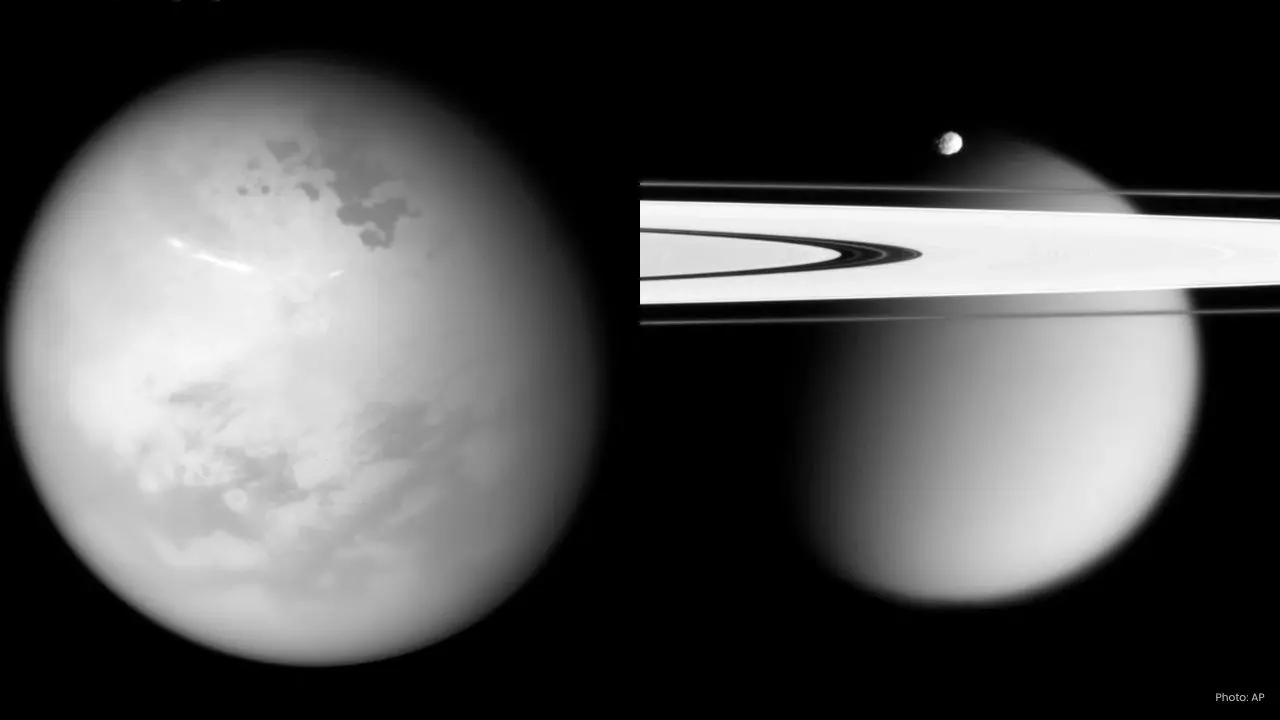
Researchers are revisiting their assumptions about the subsurface of Titan, the largest moon of Saturn. For over a decade, many experts speculated that Titan housed a significant underground ocean comparable to those on other celestial bodies like Europa or Enceladus. However, recent findings from NASA's Jet Propulsion Laboratory (JPL) challenge this prevailing theory.
New evidence indicates that instead of a massive ocean, Titan may consist of thick ice layers interspersed with slush and small amounts of liquid water. This blend resembles partially melted ice found in Earth's polar regions rather than an expansive ocean. Yet, this revelation does not diminish hopes for life; rather, it enables new possibilities, despite the absence of direct evidence of life.
Significance of Titan in the Quest for Life
As the solar system's second-largest moon at approximately 3,200 miles (5,150 kilometers) in diameter, Titan is only slightly smaller than Ganymede, Jupiter's largest moon. The moon presents a unique and intriguing environment. Its frigid surface boasts lakes and rivers of liquid methane, alongside a dense atmosphere and dynamic chemical processes, making it a primary target in the search for extraterrestrial life.
The latest study does not suggest that Titan is devoid of life. Instead, it hints at a different ecological setting that may still permit microscopic organisms to thrive. Baptiste Journaux from the University of Washington, a contributor to the study, notes that the near-melting conditions beneath Titan's surface might render it more conducive to life than previously believed. He pointed out that nature's surprises might soon reveal life forms beyond our current understanding.
Key Discoveries from the Study
The research team scrutinized data collected by NASA's Cassini spacecraft, which entered orbit around Saturn in 2004 and spent over a decade gathering detailed information before its mission concluded in 2017. By employing advanced modeling and data processing techniques, the scientists reassessed Cassini’s data, discovering that Titan’s interior reacts to Saturn’s intense gravitational pull in a manner that implies the ground is not completely liquid. If a substantial ocean existed, Titan’s surface would shift immediately under gravitational influence. Instead, researchers identified a 15-hour delay.
This delay indicates the presence of several interior layers within Titan:
A robust outer crust of ice approximately 100 miles (170 kilometers) thick
Thick, slushy ice layers beneath
And deeper pockets of liquid water
Collectively, these layers could extend over 340 miles (550 kilometers) in depth, with water in the deepest regions potentially reaching temperatures as high as 68°F (20°C)—charmingly warm for such a distant moon from the Sun.
The Mechanics Behind Surface Movement
Titan is tidally locked to Saturn, causing one hemisphere to always face the planet, much like Earth’s Moon. As a result, the gravitational force from Saturn stretches and distorts Titan's surface.
During its closest approach in orbit, the moon’s surface can rise up to 30 feet (10 meters). The critical timing associated with this movement aided researchers’ recent conclusions. The observed delay suggests a slushy interior rather than a free-flowing ocean.
Ongoing Debate
This study does not conclude the debate. Some scientists, like Luciano Iess from Sapienza University in Rome, remain skeptical about the new interpretation. Having previously used Cassini data to support the existence of an underground ocean, he posits that while the new findings are intriguing, they don't adequately eliminate the ocean theory.
Such discourse reflects Titan's complexities. Direct exploration is unfeasible, meaning that scientists must rely on indirect evidence that can be interpreted variably.
The Implications for Future Explorations
NASA's forthcoming Dragonfly mission aims to shed more light on Titan's mysterious surface and subsurface. Slated to launch later this decade, this helicopter-like robot will explore Titan's environment, collect samples, and investigate underground activities.
The Dragonfly mission will seek answers to crucial questions:
Is Titan’s interior predominantly frozen?
Are liquid water pockets widespread?
Is there a potential for life in those regions?
How has Titan's interior evolved over time?
Understanding these aspects could alter our comprehension of habitable environments beyond Earth.
Titan's Role in the Broader Context
Titan represents just one of many icy moons that scientists speculate could harbor water—and perhaps life.
Other notable examples include:
Ganymede, the largest moon of Jupiter
Europa, recognized for its subsurface ocean and surface fissures
Enceladus, known for its water geysers erupting into space
Saturn boasts the greatest number of moons in the solar system—274 confirmed—highlighting its significance as a region for probing potential habitable environments.
The Importance of Water in Space Science
The presence of liquid water is a crucial factor when considering the potential for life in space. Even in the harshest conditions on Earth—ranging from polar ice to extreme deep-sea vents—microorganisms manage to thrive. If Titan conceals warm pockets of water encased in ice and methane, the elementary requirements for life could indeed be satisfied.
Researchers emphasize that any prospective life forms on Titan would likely be microscopic and vastly different from those on Earth. Nevertheless, the notion of life thriving in such frigid and remote conditions underscores the resilience and ingenuity of nature.
Looking Ahead
As existing data is reanalyzed and new missions unfold, our understanding of Titan continues to develop. The latest study does not eliminate the prospect of hidden oceans; instead, it broadens the spectrum of possibilities—implying that Titan might still be one of the most intriguing places in our solar system to seek extraterrestrial life.