Photo:AP
A pivotal warning in a shifting global trade era
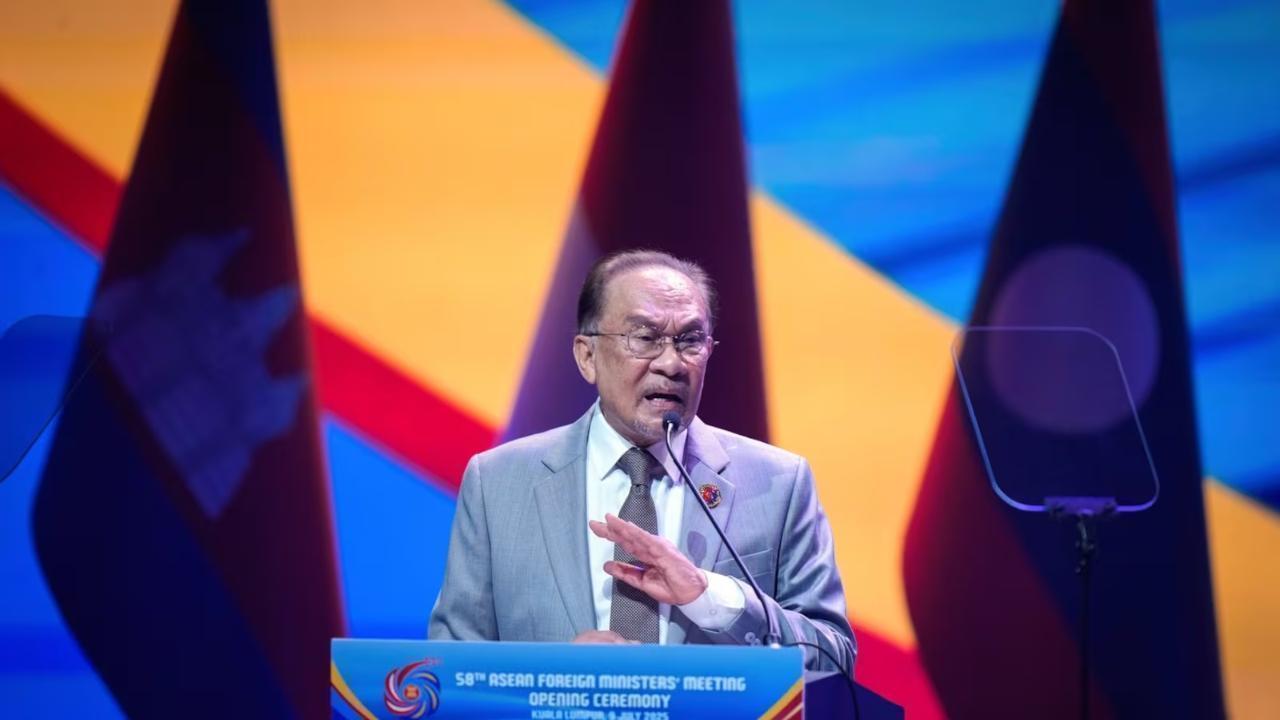
At a crucial moment in Southeast Asia’s economic future, Malaysian Prime Minister Anwar Ibrahim has issued a stark warning: the growing global trade war is no longer a passing storm but a permanent transformation in international relations. Speaking during the ASEAN foreign ministers’ summit, Anwar emphasized that global economic pressures—from escalating tariffs to strategic decoupling between the U.S. and China—are not episodic disturbances but symptoms of a deeper geopolitical reordering. His words marked a turning point in how Southeast Asia may choose to position itself in a world increasingly fractured by economic nationalism and trade weaponization.
Understanding the new global “weather”
Anwar described the changing trade dynamics not as isolated challenges, but as a new “weather pattern” that must be endured and adapted to. Gone are the days when free trade principles were the uncontested rule. In their place, countries are seeing the resurgence of protectionism, sanctions, and discriminatory tariffs used as tools of political leverage. The Malaysian leader urged his ASEAN counterparts to stop waiting for normalcy to return and instead begin building long-term resilience, treating this moment as an irreversible turning point.
Why this warning matters now
The timing of Anwar’s speech coincides with U.S. announcements of sweeping tariff increases against several Southeast Asian economies. These measures are part of a broader strategy to reshape global supply chains and reduce dependency on countries perceived to be too closely aligned with China. While the intent may be to isolate strategic adversaries, many nations caught in the middle—like Malaysia, Thailand, and Indonesia—face collateral damage. U.S. tariffs on electronics, steel, palm oil, and digital services from Southeast Asia are poised to upend export-dependent economies, threatening millions of jobs and billions in revenue.
Malaysia’s own economic adjustments
In anticipation of these challenges, Malaysia has already taken proactive steps to soften the blow. The central bank recently cut interest rates for the first time in five years, signaling that monetary authorities expect prolonged external headwinds. This policy aims to stimulate domestic consumption and investment, hoping to partially offset potential declines in exports. At the same time, Malaysia is diversifying trade relationships, boosting intra-ASEAN commerce, and investing in emerging markets in Africa, the Middle East, and Latin America.
A call for ASEAN solidarity
One of the central messages in Anwar’s address was the need for ASEAN to act as a unified economic bloc. Rather than each country negotiating bilaterally with superpowers and accepting inconsistent terms, he proposed a coordinated economic policy framework to enhance internal trade, establish collective bargaining power, and reduce vulnerability to unilateral external actions. This includes expanding regional digital infrastructure, harmonizing customs regulations, and fostering joint innovation hubs. By strengthening interdependence within Southeast Asia, member states can create a buffer against global economic volatility.
Strategic partnerships and the path to autonomy
In addition to internal cooperation, Anwar advocated for ASEAN to forge new partnerships based on mutual respect rather than dependency. He emphasized the importance of technological self-sufficiency, green innovation, and diversified trade routes to prevent bottlenecks caused by geopolitical friction. He called for investment in renewable energy, halal-certified exports, AI and robotics, and high-value agriculture—all aimed at positioning Southeast Asia as a competitive global region with leverage of its own.
Trade minister’s stance on negotiation red lines
Malaysian Trade Minister Tengku Zafrul Aziz clarified the government's position: while Malaysia remains open to dialogue with the United States, there are clear red lines. Any deals involving steel tariffs, forced data sharing, procurement discrimination, or interference in domestic standards such as halal certification will be met with firm resistance. Malaysia, he said, would never trade economic compliance for sovereignty. Negotiations are ongoing, but Malaysia's strategic posture suggests it is preparing for a scenario in which accommodation may not be possible.
The broader ASEAN summit: what’s at stake
The Kuala Lumpur meeting saw representatives from all 10 ASEAN nations, plus regional partners, discussing not only economic security but also geopolitical risks. Internal divisions—such as the Myanmar civil conflict and maritime disputes in the South China Sea—complicate regional unity. However, leaders reaffirmed their commitment to the ASEAN Economic Community blueprint and renewed discussions on a code of conduct for disputed waters, nuclear disarmament, and cyber security cooperation.
Impact on regional investment flows
The uncertainty surrounding global tariffs has already had visible consequences on investment trends. Foreign direct investment in Southeast Asia has slowed in 2025 compared to 2024, particularly in export-led manufacturing sectors. Countries are beginning to see capital shift toward less volatile regions or be redirected into safer assets. To reverse this trend, ASEAN governments are offering new incentives, including tax breaks, green transition subsidies, and simplified visa systems to attract global talent.
Global reactions to Anwar’s remarks
International observers have largely praised Prime Minister Anwar’s address as a necessary dose of realism. Analysts in Europe, the Middle East, and South America agree that Anwar is articulating a view increasingly shared in the Global South: that smaller nations must develop strategies to avoid becoming pawns in the great-power chess game between the U.S. and China. However, not all responses were favorable. Some Western analysts viewed the remarks as a veiled criticism of Washington, while certain think tanks in Washington D.C. accused Anwar of indirectly legitimizing China’s influence.
Intra-regional comparisons: how ASEAN nations are reacting
Vietnam has negotiated a separate deal with the U.S., capping its new tariff rate at 20%, below the levels faced by others. This reflects Vietnam’s role as a crucial partner in U.S. supply chain realignment efforts. Thailand and Indonesia, meanwhile, are seeking joint lobbying channels, while the Philippines is engaging Japan and India as alternative trade partners. These moves indicate a region still fragmented in its response, underscoring Anwar’s urgency for greater coordination.
Economic diversification as a long-term shield
Malaysia has launched its 2030 Economic Recovery Roadmap focused on digital transition, agricultural modernization, and sustainable finance. This blueprint includes a vision to reduce dependency on any single trading partner by capping national exposure at 25% of total exports. Malaysia is also leading efforts to digitize SMEs and integrate AI into manufacturing and logistics. These efforts, if successful, may offer a model for other ASEAN economies facing similar challenges.
Technology and innovation as ASEAN’s advantage
Southeast Asia’s digital economy is expected to surpass USD 1 trillion by 2030. Anwar called on the region to leverage its youthful population and fast-growing internet penetration to leapfrog industrial models and adopt innovation-led strategies. This includes AI, fintech, biotechnology, and educational platforms. Initiatives such as the ASEAN Digital Corridor and cross-border e-wallet regulations are in development to streamline digital trade.
Educational reform to match economic shifts
To prepare for this transition, Malaysia is reforming its education sector to emphasize critical thinking, digital fluency, and entrepreneurship. Anwar stressed the need for “brains over brawn,” saying future resilience depends not just on policy but on people’s ability to innovate and adapt. Universities and vocational institutions are being partnered with private-sector industries to ensure alignment with job market needs.
Conclusion: A region at an inflection point
Prime Minister Anwar’s address will be remembered as a defining moment in Southeast Asia’s economic journey. His message was not simply one of caution but of responsibility—a call for ASEAN to take ownership of its future, reject dependency, and reimagine growth in a fractured global system. The trade war, he said, is not a passing storm, but a new climate. It demands a new mindset. How ASEAN responds—not just in words but in coordinated policy and long-term investment—will determine whether the region remains resilient or recedes into economic vulnerability. In this new age of economic geopolitics, only regions that understand and adapt to the climate will thrive.