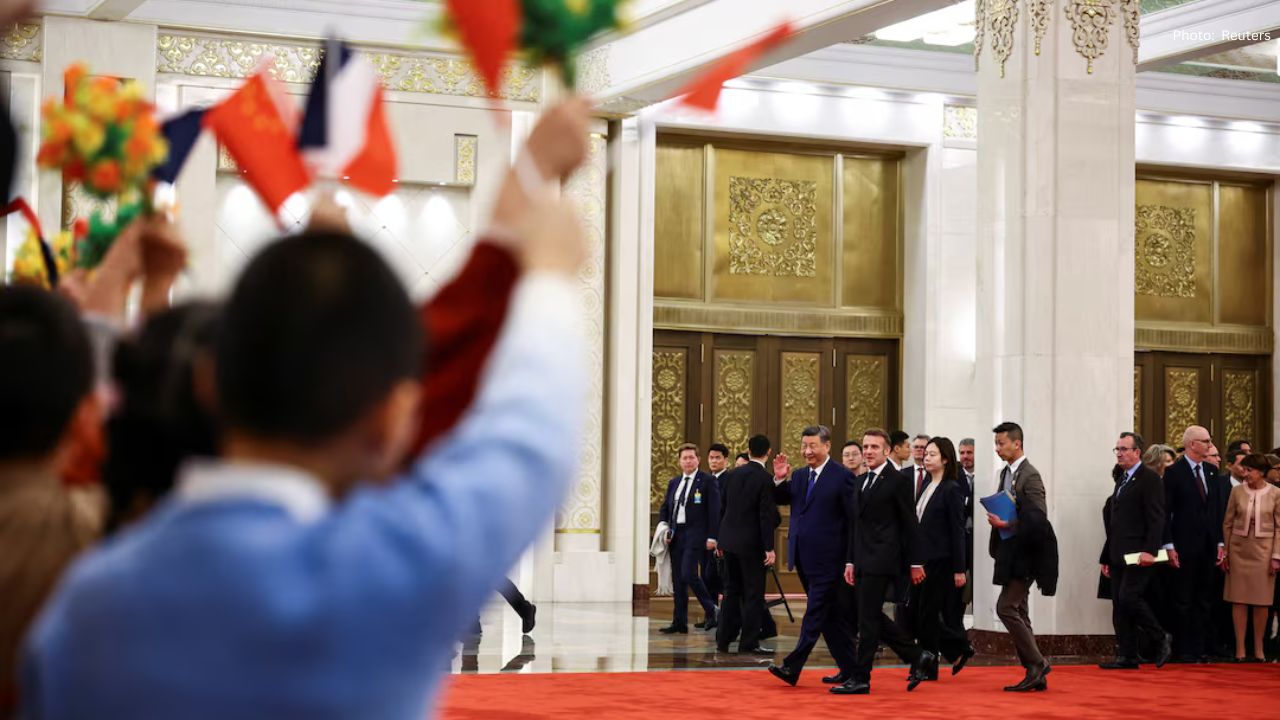
During a three-day state visit to Beijing, French President Emmanuel Macron engaged in discussions with Chinese President Xi Jinping, emphasizing the need for China to take a more proactive role in resolving the Ukraine conflict and ensuring a more balanced approach to global trade. This marks Macron's fourth visit to China, accompanied by a significant delegation of business leaders aiming to forge new economic partnerships while enhancing France's influence ahead of the upcoming 2027 presidential elections.
In their meeting at the Great Hall of the People, Macron articulated the necessity of cooperation between France and China, proposing three key domains for collaboration: global stability, equitable economic practices, and environmental conservation. He reiterated the importance of ending the conflict in Ukraine and highlighted the significance of China's backing in achieving lasting peace.
China currently confronts various challenges, including added pressure from the United States due to new tariffs affecting international markets. Concurrently, there is a desire within China to mitigate tensions with the European Union following disagreements regarding electric vehicle subsidies, making it essential for China to reaffirm its status as a reliable trade ally.
Macron's trip comes amid deeply entwined economic and political issues. With the European Union seeking to reduce its reliance on Chinese imports for essential goods, upcoming EU economic security regulations are on the horizon. This dynamic, while fostering a public display of camaraderie between the two leaders, also sets boundaries on their potential cooperation.
One significant area of uncertainty remains the anticipated deal involving the acquisition of 500 Airbus aircraft, which is unlikely to receive approval from China at present as it seeks to maintain leverage in its trade discussions with the United States. Additionally, France's luxury sectors, particularly cognac, may not achieve improved trading conditions following China's anti-dumping investigation initiated last year in response to EU tariffs on Chinese electric vehicles.
China shows no indication of reducing duties on European pork imports, as it expects Europe to ease pressures related to its electric vehicle exports. France's backing of the EU's tariff imposition on Chinese EVs complicates relations further.
On the topic of Ukraine, any signals from Xi favoring diplomatic approaches will likely be approached cautiously, considering that China continues to affirm its strong partnership with Russia, which consequently restricts how openly China can endorse Ukraine-related negotiations.
Nonetheless, Xi welcomed Macron warmly and plans to accompany him to Sichuan province—a rare gesture for a foreign dignitary. The two leaders explored deeper collaboration in sectors like nuclear energy, aerospace, artificial intelligence, and sustainable development. Following their discussions, they formalized 12 agreements addressing various matters, including aging populations, investment opportunities, nuclear energy, and panda conservation.
High-profile executives from major French companies, including Airbus, BNP Paribas, Schneider, Alstom, and leading food producers, participated in the visit, all hoping that improved ties with China will facilitate expansion into one of the largest global markets. China currently imports approximately $35 billion worth of French goods annually, covering items such as cosmetics, aircraft components, and alcoholic beverages, while France brings in around $45 billion of Chinese goods, predominantly low-cost products sold online.
Macron expressed that France and China should unite with other nations to establish equitable economic regulations that protect global supply chains and mitigate instability. He cautioned against trade frameworks governed by the notion of 'survival of the fittest', arguing instead for mutual trust and shared accountability.
While Macron's visit signifies a robust commitment to further cooperation, the underlying political and economic constraints remain evident. Both leaders aspire for advancement, yet are mindful of prioritizing their respective national interests, particularly regarding trade and global security. The forthcoming months will indicate whether Macron's visit will catalyze substantive reform or simply foster temporary diplomatic cordiality.