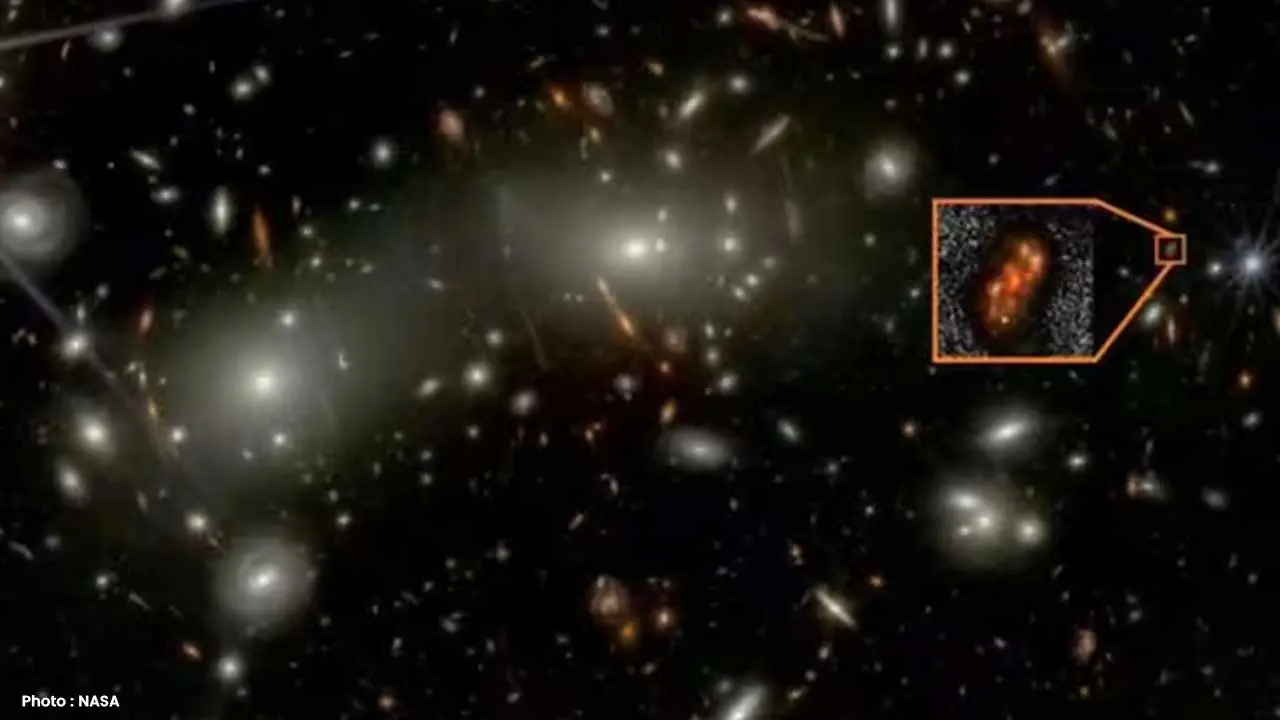
Researchers in India have made a groundbreaking discovery that is altering the scientific narrative surrounding the early Universe. Utilizing the advanced James Webb Space Telescope (JWST), a team has identified a large, fully formed spiral galaxy that dates back to when the Universe was merely 1.5 billion years old—just about one-tenth of its present age of 13.8 billion years.
Led by researcher Rashi Jain, alongside Prof. Yogesh Wadadekar from the National Centre for Radio Astrophysics (NCRA-TIFR) based in Pune, the findings were published in November within the European journal Astronomy and Astrophysics.
This galaxy has been named Alaknanda, after a river in the Himalayas, and it has astonished scientists by defying expectations that galaxies formed in such early cosmic epochs would be small and chaotic in structure. In sharp contrast, Alaknanda showcases a well-defined spiral form akin to our Milky Way—an incredibly rare occurrence from such an ancient era.
Prof. Wadadekar remarked that this galaxy appears “remarkably similar to the Milky Way,” despite being from a very youthful Universe. He described the formation of such an extensive disc with spiral arms in a timespan of merely a few hundred million years as “astonishing by cosmic standards.”
The galaxy spans roughly 30,000 light-years, about one-third the size of our Milky Way, and is home to around 10 billion stars. As per the researchers, it is generating new stars at a rate 20 to 30 times quicker than our galaxy does at present.
Jain initially discovered the spiral galaxy earlier this year while analyzing JWST data. Among nearly 70,000 celestial objects, one stood out for its distinct spiral formation. She observed that the galaxy exhibited a classic “beads-on-a-string” pattern, with clusters of stars elegantly arranged along its arms—a phenomenon rarely observed in galaxies from the early Universe.
When she presented her findings to Prof. Wadadekar, his immediate response was one of skepticism. The notion of such a mature and large galaxy emerging so swiftly post-Big Bang challenges long-held views regarding the rapidity of galaxy evolution during the Universe’s early years, typically depicted as chaotic and underdeveloped.
Astrophysicists assert that while there are billions of galaxies in the Universe, most initial galaxies were anticipated to be small, dim, and disorderly. However, Alaknanda provides compelling evidence that the early cosmos might have been more complex and organized than previously believed. Since its operational debut, the James Webb Telescope has unveiled several ancient galaxies, but this discovery significantly reinforces the idea that intricate structures were capable of forming in the early Universe much sooner than expected.
The light from Alaknanda has journeyed for 12 billion years to reach Earth, essentially allowing astronomers to peer back into the past. However, its current state remains a mystery. As Prof. Wadadekar aptly put it, “If you want to know where it is now, you’ll have to wait another 12 billion years.”
The research team aims to conduct further examinations using the JWST or the ALMA observatory in Chile, hoping to clarify how such a colossal spiral galaxy formed its arms so early in cosmic time. Gaining insights into galaxies like Alaknanda could offer profound understanding into the history of the Universe and address pivotal questions regarding the evolution of galaxies into the structures we observe today.