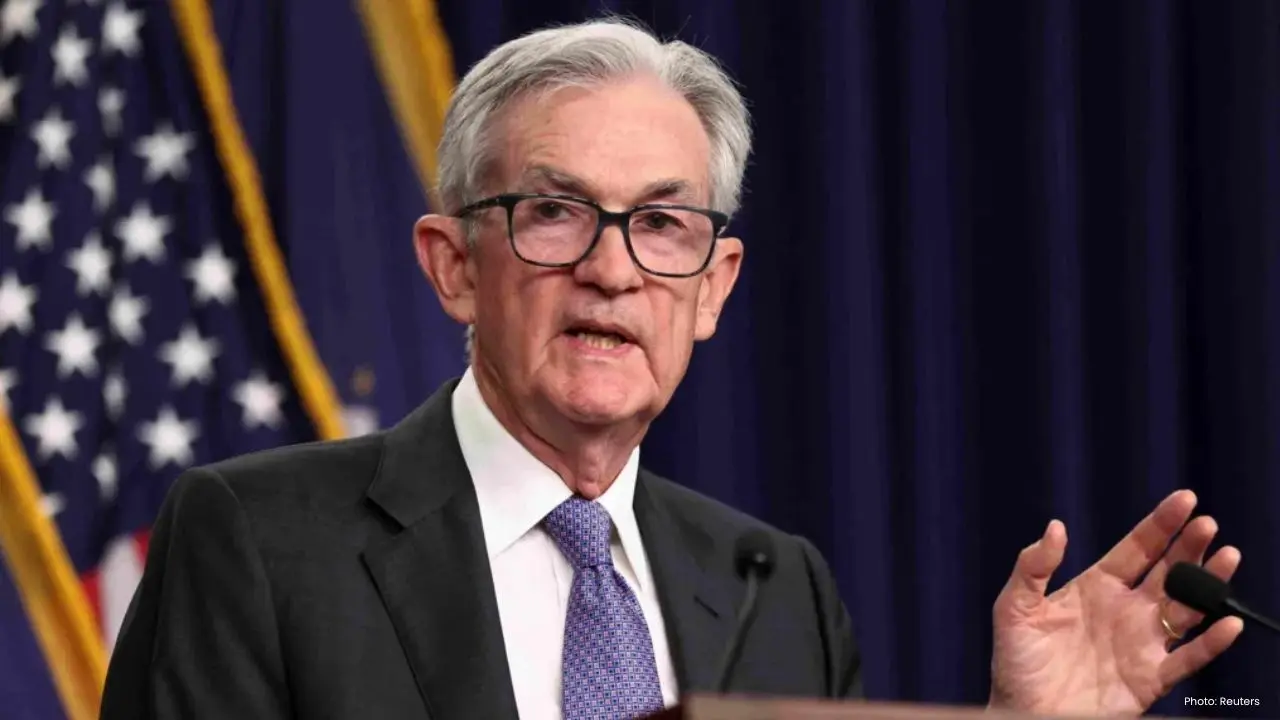
The US Federal Reserve has executed its third interest rate cut this year, lowering the rate by 0.25 percentage points to a range of 3.50%–3.75%, a level not seen in three years. This decision arises amidst notable disagreements within the central bank regarding the balance between a faltering job market and continuing inflationary challenges.
Projected economic outcomes suggest a potential for further cuts next year, although officials stressed that any forthcoming actions will hinge on new economic data.
Chair Jerome Powell underscored the need to assess the impacts of prior cuts before committing to additional measures. He stated, “We are well-positioned to wait and see how the economy evolves,” indicating that the upcoming data will be pivotal before their January meeting.
Despite calls for more aggressive cuts from some figures, including former President Donald Trump, Powell recognized the difficulties involved in handling both inflation and unemployment. “You can’t do two things at once,” he remarked.
The vote showcased a lack of consensus, with three Fed officials dissenting: Stephen Miran called for a more significant cut of 0.5 percentage points, while Austan Goolsbee and Jeffrey Schmid preferred to maintain current rates.
Trump criticized the Fed's approach, suggesting the recent rate decrease should have been “at least doubled” and advocating for the lowest possible rates in the world.
The prolonged government shutdown, which concluded in November, has contributed to the scarcity of reliable economic data, thus clouding the Fed's decisions. Currently, concerns over a slowing labor market seem to eclipse inflation worries.
Recent statistics indicate a slight increase in the US unemployment rate from 4.3% to 4.4% in September, underlining the need for rate cuts to invigorate the economy by reducing borrowing costs for both individuals and businesses.
Inflation remains beyond the Fed's 2% target, hitting 3% in September, the first rise since January. Analysts point to tariffs as a driving factor for increased prices; however, recent milder inflation data gives the Fed the opportunity to prioritize labor market support.
Colleen McHugh, an investment consultant, noted that despite high inflation posing difficulties for rate cuts, the weak job market likely swayed the Fed's recent decisions. She forecasts one or two more cuts next year, dependent on the evolving economic landscape.
Powell acknowledged the unusual tensions within the Fed as it tries to reconcile its dual mandates of price stability and maximum employment. He remarked, “When you have competing pressures, this is what you see,” noting a respectful and thorough debate on these issues.
Looking ahead, data from November's labor market and inflation could further inform interest rate trajectories. Analysts suggest that indications of ongoing employment slowdowns may amplify demands for more easing.
Further complicating matters is Trump’s ongoing search for Powell’s successor ahead of his term expiration next May. Kevin Hassett, a former economic adviser to Trump, is a notable contender, alongside others such as economist Kevin Warsh and Treasury Secretary Scott Bessent.
Experts caution that the next Fed chair must balance independence with market confidence; any signal of political bias could provoke market volatility. Thomas Hoenig highlighted that perceptions of political influence could trigger severe market responses.
Powell dismissed any notion that the search for a new chair impacts his decisions, asserting, “No,” when asked about presidential influence.
As the Fed contends with these multifaceted pressures, market participants will vigilantly monitor how interest rate policies adapt to shifting economic circumstances in the months to come.