Thailand remains steadfast in its military operations along the disputed border with Cambodia, outright rejecting assertions that a ceasefire was reached. The statement follows renewed hostilities that erupted on Saturday, featuring air strikes by Thai forces—just hours after former U.S. President Donald Trump claimed to have mediated a truce.
Prime Minister Anutin Charnvirakul firmly stated that there is no ceasefire, underscoring Thailand's commitment to safeguard its territory and citizens. In a social media announcement, he reiterated that military endeavors would persist until the nation feels secure from threats. His statements reinforced that Thailand had never agreed to halt combat, demonstrated by their ongoing military actions.
Trump's earlier remarks indicated he had spoken to both Anutin and Cambodian Prime Minister Hun Manet, asserting they had consented to stop all hostilities. However, both leaders failed to confirm this in their official communications. Anutin denied any such agreement and emphasized that the fighting continues unimpeded. The White House did not respond promptly regarding inquiries about ongoing military action.
The historical context of tensions between Thailand and Cambodia is significant, with an 817-kilometre border that has been a source of dispute for years. This recent escalation has led to some of the most intense confrontations since a major altercation in July that lasted five days. Both nations have witnessed substantial artillery exchanges recently.
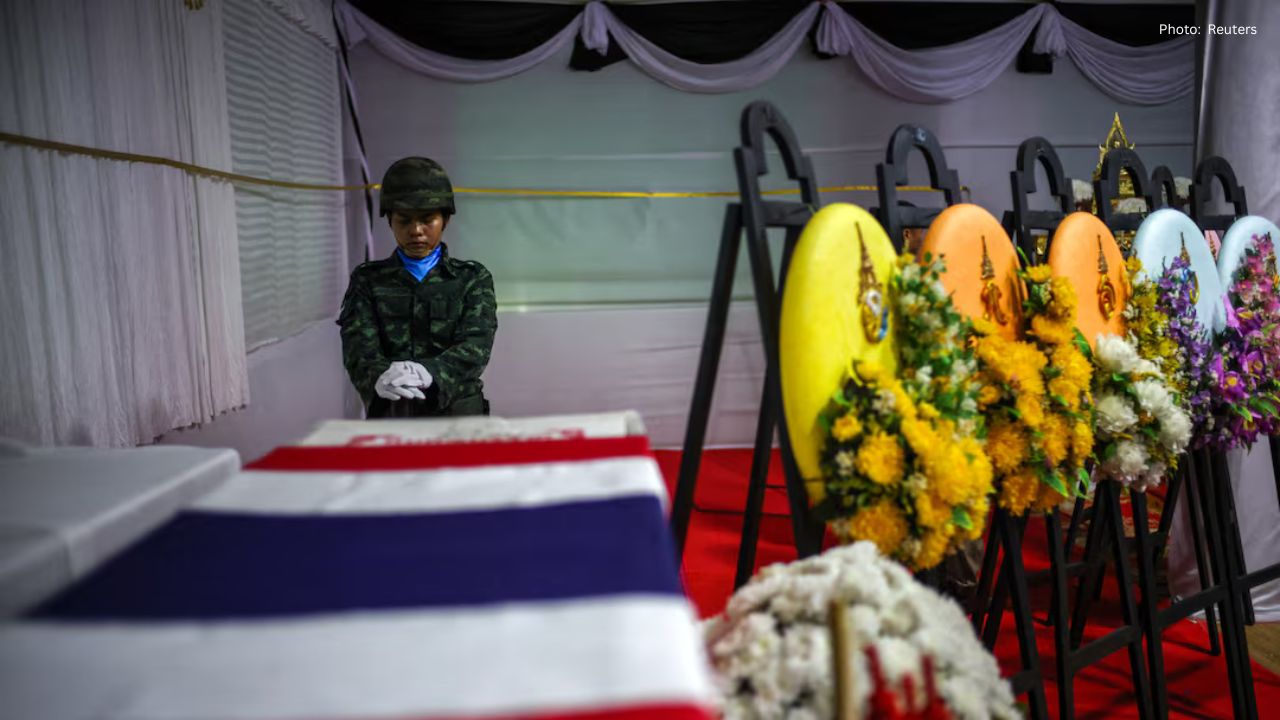
The toll of the conflict was personally felt as the funeral of Sergeant Major Ananda Udon, a soldier killed earlier in the week, took place in Si Sa Ket province, near the contentious border. Scenes of soldiers honoring his memory underscore the profound effects the ongoing conflict has on Thai communities and its military.
Renewed violence can be traced back to a landmine incident last month that left a Thai soldier severely injured. Thailand asserts that the mine was recently deployed by Cambodian forces, a claim vigorously denied by Cambodia. Following the incident, Thailand suspended its prior truce, citing a lack of trust in Cambodia’s actions. Anutin dismissed suggestions that the explosion was accidental, indicating it was deliberated aggression.
The Defence Ministry of Thailand reported clashes across seven border provinces, alleging that Cambodia has used heavy weaponry against them, prompting retaliatory measures. In contrast, Cambodia has accused Thailand of attacking infrastructure and firing heavy artillery from offshore vessels. The escalating blame game has complicated efforts to discern the true catalyst of the recent violence.
Despite the mounting conflict, Cambodian Prime Minister Hun Manet expressed a continuing dedication to achieving a peaceful resolution. He noted Cambodia's commitment to existing agreements focused on de-escalation. Furthermore, he mentioned seeking assistance from the United States and Malaysia to ascertain the origins of the latest offensive, recalling Malaysia's previous role in facilitating talks.
Trump's efforts to position himself as a peacemaker have continued, as he previously claimed credit for quelling clashes back in July and has repeatedly stated he is deserving of the Nobel Peace Prize, even receiving a nomination from Cambodia this year. Yet Thailand’s assertive rejection of a ceasefire casts doubt on the efficacy of his involvement.
This scenario starkly illustrates the fragility of peace endeavors amidst a backdrop of profound mistrust and ambiguous dialogue. Public assertions of truce carry minimal weight unless they are unequivocally acknowledged and adhered to by all parties involved. For communities bordering the conflict, ongoing hostilities manifest in continued anguish and uncertainty.
At this juncture, both Thailand and Cambodia face a pivotal decision. Persistent military actions pose risks of further casualties and enduring damage to bilateral relations, whereas equitable dialogue coupled with independent verification of contentious episodes could pave the way towards pacification. It remains paramount for international mediators to ensure clarity, transparency, and mutual acceptance in any forthcoming peace initiatives. Without such measures, the border remains charged, and the prospect for enduring tranquility hangs precariously in the balance.