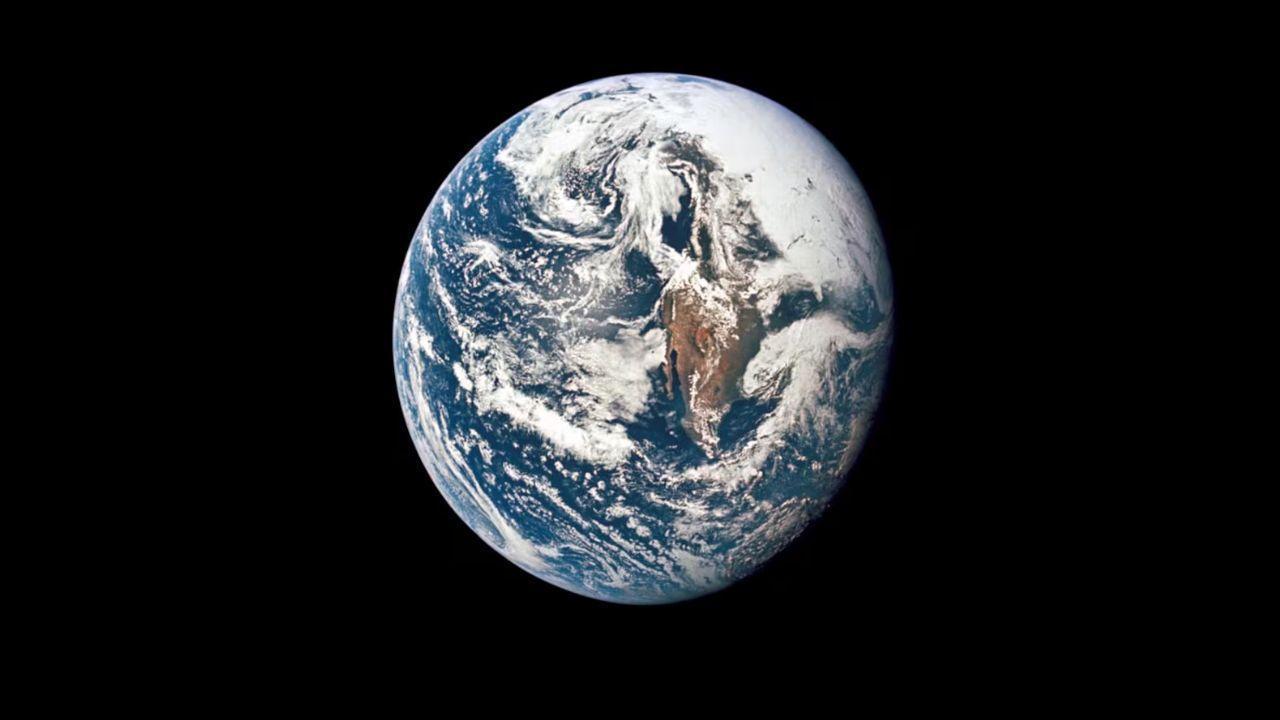
Photo:AP
Earth’s Rotation Is Accelerating—Spinning the Shortest Days on Record
In an unexpected turn in mid‑2025, the planet has begun spinning marginally faster than usual—leading to some of the shortest days ever recorded. On July 9, 2025, Earth completed a full rotation up to 1.5 milliseconds faster than the typical 24‑hour cycle. Similar anomalies are expected again on July 22 and August 5. While negligible for everyday life, these shifts have significant implications for scientific timekeeping, navigation and global systems reliant on highly accurate clocks.
Why Is Earth Spinning Faster? Lunar Clues and Seasonal Mysteries
The most plausible explanation centers on the Moon's extreme orbital positions this summer. As it reaches its furthest point from Earth’s equator—its peak declination near the poles—tidal braking effects weaken, paradoxically boosting Earth’s spin. This celestial geometry resembles a figure skater pulling in her arms to increase spin speed.
These days align with known seasonal patterns. Typically, the shortest days fall in July and August, where cooling at higher latitudes and changing atmospheric circulation subtly alter rotational momentum. Other contributors under investigation include shifts in Earth’s core fluid dynamics, atmospheric mass redistribution, and cryosphere changes.
The Shortest Days in Modern Measurement
Scientific records show July 9 was Earth's fastest day in modern memory, shaving off approximately 1.3 milliseconds. Two comparable days are forecast on July 22 and August 5, with reductions of up to 1.5 milliseconds. While imperceptible to individuals—equivalent to a blink—it marks the fastest annual pace seen since the 1970s.
Why Milliseconds Matter: The Timekeeping Challenge
Modern life depends on extremely precise timing. Coordinated Universal Time (UTC) is maintained globally through networks of atomic clocks accurate to within nanoseconds. Technologies—from GPS and satellites to financial transactions, telecommunications, and power systems—demand synchronization to the billionth of a second. Even tiny rotational discrepancies can induce errors if uncorrected.
Leap Seconds: In Need of a Reverse
Historically, when Earth’s rotation lagged behind atomic clocks, positive leap seconds were added to align UTC. Since 1972, 27 have been added—the last in 2016. This new acceleration may require a negative leap second, subtracting a second once Earth's rotation outpaces atomic time. If this trend continues, timekeepers may need to implement that by as early as 2029—an adjustment never before attempted.
Natural and Anthropogenic Contributors
A range of factors may be behind the acceleration:
-
Lunar gravity anomalies due to high declination
-
Earth's internal processes, including core and mantle mass shifts
-
Atmospheric and oceanic circulation, altering rotational inertia
-
Melting polar ice and glacial rebound, redistributing mass closer to Earth's center—counterintuitively speeding rotation. Climate-related changes are generally expected to slow the speed, but complexities remain.
Past events like the 2011 Japan earthquake also shortened a day by microseconds, demonstrating Earth’s sensitivity to mass redistributions. While those are tiny, accumulated anomalies matter in precision systems.
Public Reaction and Misconceptions
Despite headlines predicting catastrophe, scientists emphasize that these variations are routine and pose no risk to daily life. Social media amplified confusion with dramatic leaps—until experts clarified no catastrophic consequences.
Users on platforms like Reddit speculate wildly about the speed-up—some joking “time speeding up”—but experts caution against misinterpretation: cumulative effects might grow over decades but remain invisible in typical human perception.
Impacts on Technology and Infrastructure
Cyber systems rarely handle leap second insertion gracefully. Past positive leap seconds triggered server failures. Indeed, in 2012, Reddit and other platforms crashed due to scheduling edge cases. A negative leap second—never previously implemented—raises concerns for untested infrastructure. Systems managers face potential complications with timing routines, scheduling, logging, and network protocols.
Navigation and Satellite Systems rely on microsecond-level synchronization. Even a millisecond of time drift can cause positioning errors, data mismatches, or financial transaction misalignment across global networks.
Longer-Term Trends and Earth's Slowing Future
Historically, Earth’s rotation has steadily slowed by ~1.7 milliseconds per century due to tidal friction with the Moon. Climate-induced mass shifts are adding an additional slowdown trend of about 1.3 ms/century, expected to double by 2100. However, these are long-term drifts. Short-term aberrations—like the current acceleration—are normal in geophysical context.
Within centuries to millennia, Earth’s daylength will likely grow longer again. The current pattern may reverse entirely. Scientists stress the present uptick is transient—even if it persists for a few decades. Eventually deceleration trends regain dominance.
Why This Matters: Time at the Edge of Our Precision Future
We may not observe a millisecond of lost time, but industries do. Telecommunications, finance, navigation, power grids, scientific observation, GPS, internet traffic tagging, and GPS-guided transportation all rely on synchronized time across global systems.
NASA, geophysical agencies, and technologists agree: even a sub-millisecond misalignment could cascade in high-frequency systems. Preparing for negative leap seconds and building infrastructure resilience is now a priority.
Cultural and philosophical discussions also emerge: time—even standardized atomic time—is less absolute than we assume. Timekeeping still negotiates between human convenience, celestial motion, and geophysical complexity.
A Tiny Shift—But a Big Reminder
Earth has experienced sub-millisecond rotational acceleration, producing record-short days in July and August 2025. Although imperceptible in daily routines, these changes highlight the tension between natural rhythms and human-engineered time. Monitoring continues, as global institutions brace for potential leaps—both positive and negative—in the chronometry of our shared world.
In the end, the phenomenon is a reminder that our planet remains a dynamic, interconnected system—and precise as our technology grows, so does our need to respect its subtle celestial rhythms.