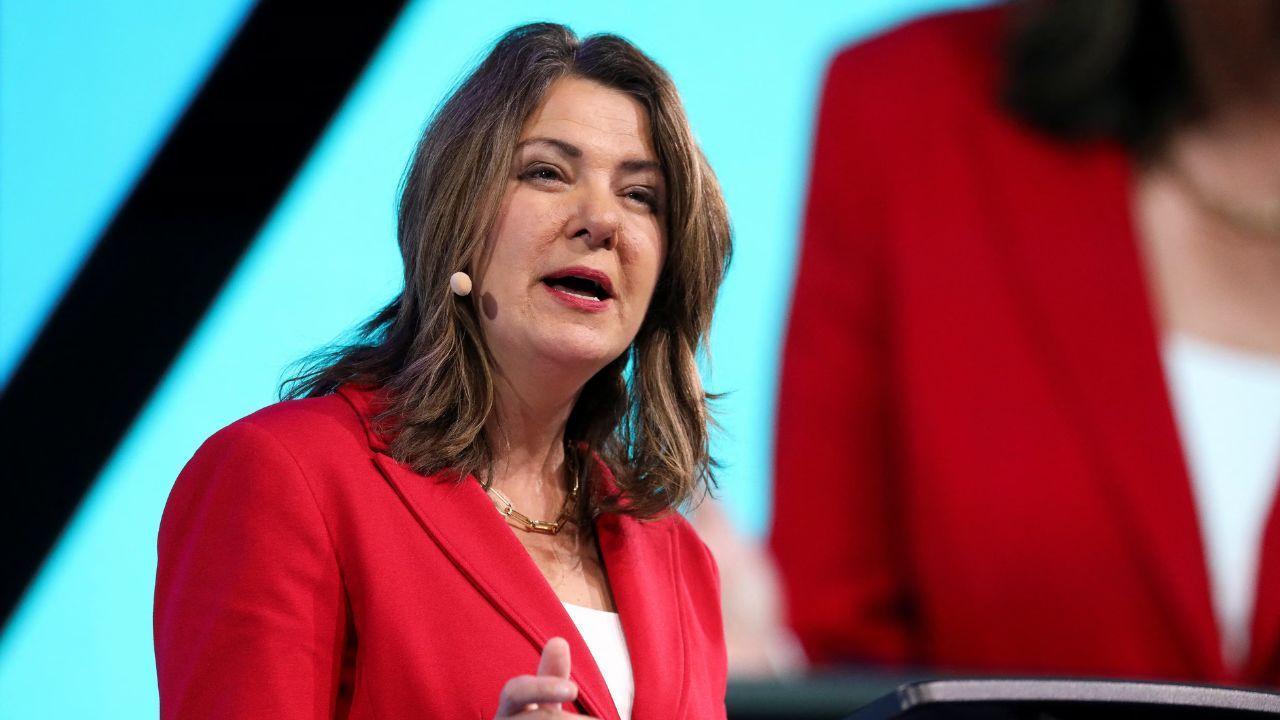
Photo:reuters
A Deep Dive into Political Harassment, Press Freedom, and Online Accountability in Canada
The controversy surrounding Alberta Premier Danielle Smith’s response to an anonymous social media account accused of targeting The Globe and Mail journalist Carrie Tait has stirred a national conversation about the state of political accountability, digital harassment, and the vital need to protect freedom of the press in Canada. What at first appeared to be just another flare-up in the tense relationship between political elites and the media quickly escalated into something far more serious: an examination of how powerful institutions respond to misinformation, anonymous smear campaigns, and the underlying erosion of trust between governments, journalists, and the public.
The incident centers on a string of aggressive, sarcastic, and conspiratorial posts made by a now-deactivated X account known only by its pseudonym. The account published targeted remarks about Carrie Tait, who has reported extensively on the Alberta government’s handling of health services, most notably the Premier’s controversial contact with the head of Alberta Health Services during a time when the RCMP was actively investigating COVID-related enforcement actions. Tait’s reporting, which focused on potential overreach and political interference, placed her directly in the public spotlight—an occupational hazard for investigative journalists. However, what followed wasn't standard critique. It was targeted character assassination, dressed in the language of partisan activism.
Premier Smith’s public condemnation of the account was swift, surprising some political observers who expected a more measured, possibly delayed response. During a public appearance in Edmonton, Smith stated unequivocally that “an anonymous social media account attacking a journalist for doing her job is not acceptable,” emphasizing the importance of press freedom and her government’s commitment to transparency. Her comment, though brief, marked a departure from the typical political calculus that often seeks to avoid taking sides in media disputes. Critics and supporters alike recognized this move as both strategic and symbolic—a Premier attempting to separate herself from the worst elements of online political discourse, even as questions about her office’s conduct remained unresolved.
The power dynamics at play here are worth unpacking. Alberta is no stranger to tense relationships between politicians and journalists, particularly those covering the legislature and the province’s handling of energy policy, Indigenous affairs, and healthcare. Tait, a senior reporter for The Globe and Mail, has been widely respected for her coverage, which is typically characterized by meticulous sourcing and balanced critique. Her reporting on the Premier’s phone call with the AHS CEO—an event many saw as a potential breach of institutional independence—prompted serious questions, including whether political pressure was being applied behind the scenes to influence public health enforcement and criminal investigations.
The anonymous X account that targeted Tait didn't just criticize her reporting—it launched a campaign laced with sarcasm, mischaracterizations, and personal insinuations, including baseless claims about bias and coordination with political opponents. These are familiar tactics in the era of online harassment. What made this incident particularly concerning, however, was the context: the posts appeared timed to discredit her reporting just as the story gained national traction. The account, while anonymous, seemed to have unusually detailed insights into the Premier’s office, leading some to speculate—though without concrete evidence—that it may have been operated by a government insider or partisan actor with privileged access.
That speculation added fuel to an already volatile fire. Political commentators, legal scholars, and media watchdogs began asking difficult questions: Who was behind the account? Was it connected to political operatives? Could it represent an effort to undermine journalistic independence using social media manipulation? And perhaps most critically, what responsibility do elected officials have in preventing or calling out such attacks?
Danielle Smith’s statement, while clear in its condemnation, did not delve into whether her staff had any involvement in the account. Nor did she promise a formal investigation into whether the harassment campaign had roots within the government apparatus. This ambiguity, intentional or not, has kept the story alive and drawn renewed attention to the broader issue of political accountability in the digital age.
At the heart of the controversy is the increasingly hostile environment in which journalists—particularly female reporters—operate. Carrie Tait’s experience is not unique. Across Canada and globally, journalists have faced growing threats to their safety, credibility, and mental health, much of it perpetuated online by anonymous trolls, politically motivated actors, or coordinated misinformation networks. The digital transformation of political discourse has made it easier than ever for bad-faith actors to launch coordinated attacks under the guise of free speech.
Experts in media ethics and cybersecurity point to a worrying trend: the normalization of discrediting journalists rather than engaging with their work. This undermines public trust not only in the media but in democracy itself. When the public is conditioned to believe that every reporter is biased and every investigation is part of a political plot, the ability of the media to perform its watchdog role is diminished. And when governments fail to actively defend journalists from harassment—or worse, appear to enable it—the erosion of civic institutions accelerates.
The broader political implications for Premier Smith are not yet fully understood. Her government has already faced scrutiny over its handling of the health services system, particularly its decisions around COVID-19 enforcement, vaccine policy, and interactions with federal health agencies. The revelation that her office may have influenced or attempted to influence decisions at AHS during a criminal investigation has placed a cloud over her leadership. While her defense—that she was simply inquiring about a public matter—has been accepted by some, many others see the incident as part of a pattern of blurred boundaries between governance and political loyalty.
Tait’s original reporting, which prompted the harassment, was focused on holding those boundaries accountable. Her role in surfacing these concerns placed her squarely in the crosshairs of those who seek to delegitimize institutional journalism in favor of loyalty-driven narratives. It’s no coincidence that her attackers chose not to engage her arguments, but to instead question her motives, her integrity, and her allegiances. It’s a tactic designed to distract from substance, one that is increasingly common in polarized political environments.
The Canadian Association of Journalists, Reporters Without Borders, and several national media organizations have since issued public statements in support of Tait, calling on elected officials across party lines to denounce coordinated online attacks against journalists. They argue that this incident represents a test for Canada’s democratic institutions. Will public leaders defend journalism as an essential pillar of democracy, or will they turn a blind eye to its erosion by digital harassment and anonymous propaganda?
There is also a legal dimension worth considering. While Canada has relatively strong defamation laws and protections for journalists, enforcement remains a challenge—especially when harassment is done anonymously. In the absence of identifiable perpetrators, journalists often have no recourse but public solidarity and institutional support. Some legal scholars have called for reforms to digital identity verification on social platforms and stronger tools for journalists to seek justice when targeted by harmful campaigns. Others warn that such measures could infringe on free speech and be weaponized against legitimate dissent.
Technology platforms, too, bear responsibility. X, the platform where the harassment originated, has repeatedly been criticized for failing to adequately monitor targeted abuse and for allowing anonymous accounts to spread misinformation unchecked. Under Elon Musk’s ownership, the platform has reduced moderation staff and rolled back previous policies meant to protect journalists and marginalized voices. While some argue this promotes free expression, critics point to the growing toxicity and unchecked misinformation that now characterize the platform.
In response to the ColdplayGate scandal and now the Carrie Tait incident, a renewed debate has emerged in Canada about regulating digital platforms, improving online accountability, and safeguarding public discourse. Several MPs, including members from both the Liberal and NDP caucuses, have raised the issue during Question Period, urging the federal government to explore legislative protections for journalists and transparency requirements for anonymous accounts involved in political discourse.
For Carrie Tait personally, the experience marks yet another chapter in the dangerous terrain of frontline journalism. Her courage in continuing to report on difficult and politically sensitive topics, despite coordinated attempts to discredit her, has earned her wide praise across the journalistic community. She has not issued any public statements about the harassment campaign, choosing instead to allow her reporting to speak for itself.
But this silence is powerful. It is an act of resistance in an environment that increasingly demands sensationalism, defensiveness, and counterattacks. In refusing to dignify the harassment with a response, Tait underscores what is truly at stake: not personal reputation, but the public’s right to know.
If the Alberta government wants to signal a real commitment to accountability and transparency, it must go beyond mere condemnation. It must proactively investigate whether anyone in its orbit was involved in the harassment. It must adopt clear policies around digital conduct for government officials and staff. It must work with the media, not against it, to ensure that democratic scrutiny remains intact. And it must model the kind of leadership that puts institutional integrity above partisan gain.
The scandal surrounding the anonymous account may eventually fade from headlines, but the issues it raises will linger. In a time when democratic norms are under attack globally, the health of a society is often measured not by how it handles its triumphs, but by how it responds to its transgressions.
This is more than a dispute between a journalist and a social media account. It is a mirror held up to Alberta—and Canada—asking whether we are willing to protect the people and institutions that keep democracy honest. The answer, ultimately, will come not just from Danielle Smith or Carrie Tait, but from all of us.