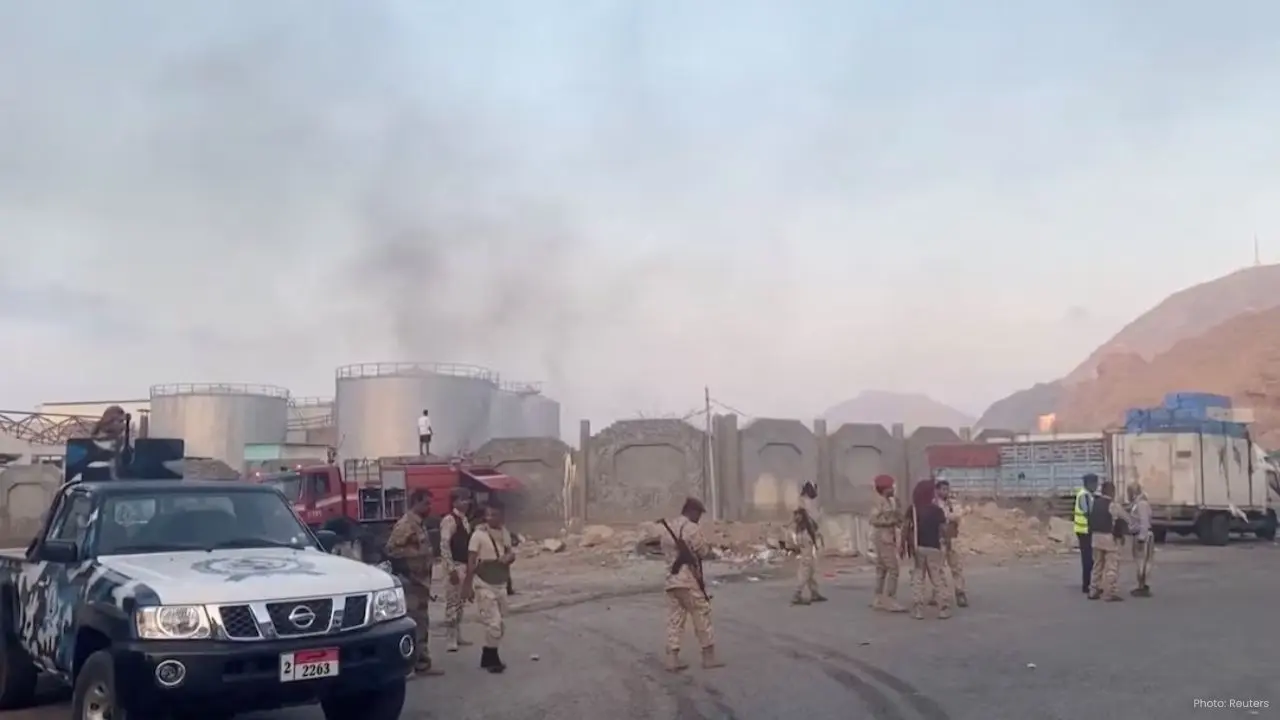
Saudi Arabia has disclosed new information regarding the recent airstrike on Mukalla, a southern port city in Yemen. This operation has significantly strained relations with its Gulf ally, the United Arab Emirates (UAE), pushing Abu Dhabi to declare a complete withdrawal of its military forces from Yemen.
Coalition spokesperson Major-General Turki al-Maliki indicated that the airstrike occurred early Tuesday, based on intelligence suggesting two vessels entering Mukalla port were transporting over 80 vehicles along with containers filled with weapons and ammunition. Riyadh claims this shipment was related to the UAE, intended for Yemen’s separatist Southern Transitional Council (STC).
Al-Maliki noted that Emirati assets were relocated to al-Rayyan airbase without prior coordination with Saudi authorities, labeling this as a breach of coalition protocols. He emphasized that Saudi-led military operations complied with the engagement guidelines and did not result in civilian casualties.
UAE’s Withdrawal from Yemen
Following the airstrike, the UAE's Ministry of Defence announced the cessation of its counterterrorism mission in Yemen. This decision came in the wake of increasing pressure from Yemen's internationally recognized government, which demanded the expedited departure of Emirati forces—support that was openly expressed by Saudi Arabia.
The ministry clarified, "In light of recent events and their potential impact on operational safety and effectiveness, the UAE has chosen to conclude its counterterrorism mission in Yemen." This move was described as voluntary and aimed at the safety of personnel.
Rising Strains Over the STC
The airstrike in Mukalla has laid bare the widening rifts within the Saudi-led coalition, which has aimed to combat Yemen’s Houthi insurgents since 2015. Once supporters of the Saudi-backed government, the STC has recently escalated its campaign for an independent southern state.
Currently, the STC controls significant territories in southern Yemen, such as Hadramout and Mahara provinces, areas that are strategically crucial for Saudi Arabia due to their proximity to its border. Riyadh has accused the UAE of backing and facilitating the STC’s military maneuvers, viewing them as a direct threat to its national security.
Saudi Arabia expressed its "deep disappointment" regarding what it perceives as Emirati-supported actions that jeopardize de-escalation initiatives, cautioning that any implications for its security would be treated as a "red line."
Cancellation of Defence Pact
In light of these developments, Rashad al-Alimi, head of Yemen’s Presidential Leadership Council, has annulled a defense agreement with the UAE and has ordered Emirati forces to depart within 24 hours. Yemeni state media reported the establishment of a temporary no-fly zone along with a 72-hour blockade on sea and land around critical ports.
Despite mounting pressure, the STC has rebuffed calls to relinquish its occupied areas, asserting its intent to protect its positions against any advances.
Reactions at the Regional and International Level
Qatar has welcomed the statements from both Saudi Arabia and the UAE, advocating for calm and underscoring the importance of unity among Gulf Cooperation Council (GCC) members. Concurrently, Saudi Foreign Minister Prince Faisal bin Farhan engaged in talks with U.S. Secretary of State Marco Rubio and Pakistan’s Foreign Minister Ishaq Dar to discuss regional issues.
The escalating situation underscores the delicate nature of alliances within the Yemeni conflict and raises critical questions about the future of collaboration among Gulf nations amid the ongoing turmoil.