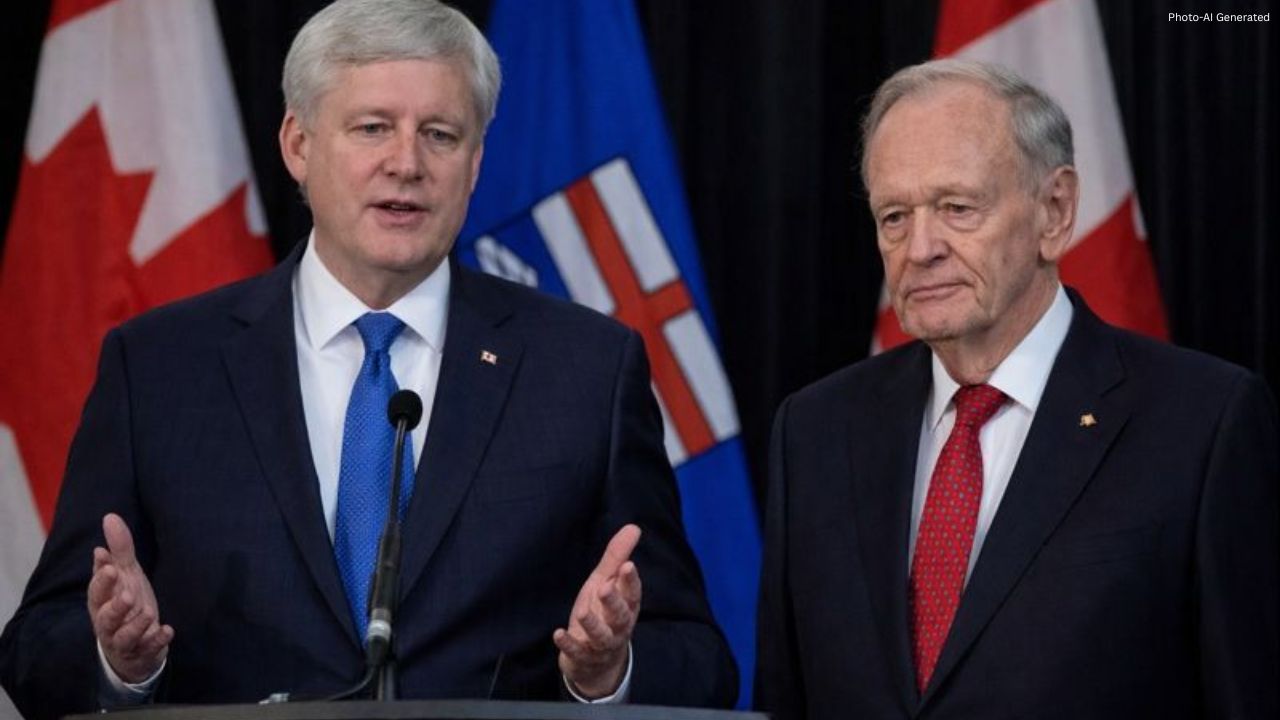
Former prime ministers Stephen Harper and Jean Chrétien addressed the issue of Alberta separatism at a public event in Ottawa, emphasising national unity and urging Canadians to take pride in their country as debates over the province’s future continue. Their comments come amid recent reports that some politicians have been linked to citizen petitions aimed at triggering a referendum on Alberta’s possible departure from Canada — a move that has stirred political discourse across the country.
Harper, speaking at the Royal Canadian Geographical Society alongside Chrétien following a ceremony where he received a gold medal, clarified that he did not sign any petition seeking a referendum on Alberta’s separation. He called for national pride and reaffirmed his belief in Canada’s cohesion, suggesting that Canadians should feel deep respect for their nation even as global nationalism resurges.
Chrétien, meanwhile, touched on broader geopolitical shifts, suggesting that the global balance of power is changing — including the influence of traditional powers such as the United States — but maintained that Canada remains well-positioned. While Chrétien did not focus solely on Alberta’s independence movement, his remarks underscored a shared message with Harper about the importance of unity and resilience within the federation.
The remarks from two of Canada’s longest-serving prime ministers come at a time when separatist sentiment in Alberta has gained attention, with grassroots campaigns collecting signatures to compel a referendum under the province’s Citizen Initiative Act. Supporters of the campaign argue that frustration with federal policies and economic conditions justify asking Albertans whether they should remain part of Canada.
However, critics — including many federal leaders and opponents of secession — contend that talks of separation could harm economic stability and national unity. They note that mechanisms like the Clarity Act require a clear referendum question and robust negotiation before any formal independence talks, reflecting longstanding legal frameworks that govern secession in Canada.
Alberta Premier Danielle Smith has publicly opposed breaking from Canada, instead promoting the idea of a “sovereign Alberta within a united Canada,” a stance that has its critics who see it as vague political positioning. The debate has been further fueled by reports — denied or downplayed by Ottawa — of discussions between separatist groups and officials from the United States, prompting federal leaders to reiterate the importance of respecting Canadian sovereignty.
The joint appearance by Harper and Chrétien highlights that, despite deep philosophical differences across the political spectrum, many of Canada’s senior statesmen are aligned in urging unity and caution against fragmentation as Alberta’s separatism debate continues to evolve.