A Landmark Celebration of Democracy
On January 26, 2026, India will commemorate its 77th Republic Day, marking the day the Constitution was enacted, affirming the nation as a sovereign democratic republic. This significant annual event will feature spectacular parades, cultural showcases, military exhibitions, and nationwide patriotic enthusiasm. Republic Day symbolizes the collective ideals embedded in the Constitution and reflects a steadfast commitment to principles of democracy, justice, liberty, equality, and fraternity.
Distinct from Independence Day, marked on August 15 which signifies liberation from colonial rule, Republic Day celebrates the adoption of the Constitution in 1950 that formed the bedrock of India's governance. Since the inaugural celebration in 1950, this occasion has come to exemplify India's constitutional heritage and its journey as the largest democracy globally.
Understanding the Count for 2026
Clarifying the Year Numbering
Every year sparks discourse regarding whether 2026 is the 77th or 78th Republic Day. Clarity comes from the fact that India has observed Republic Day since January 26, 1950, with that inaugural event being deemed the first Republic Day. Following this logic, by 2026, India will witness its 77th observation.
Confusion often arises from counting from later years instead of starting from the first Republic Day. This straightforward calculation confirms that 2026 marks 77 years since the Constitution was enacted, thus validating it as the 77th Republic Day.
Historical Significance of Republic Day
Constitutional Foundations from Independence
The roots of India’s Republic Day stretch back through years of evolution. Following Independence on August 15, 1947, the country operated without a permanent Constitution, relying on the Government of India Act, 1935 until a new framework was established.
This led to the formation of a Constituent Assembly under the leadership of Dr. B.R. Ambedkar, which dedicated nearly three years to crafting a Constitution that captured the diverse aspirations of the populace.
On November 26, 1949, the Constitution was formally adopted, yet it came into full effect on January 26, 1950, intentionally chosen to honor the Purna Swaraj Declaration of 1930 — a pivotal moment in the quest for complete independence.
Transitional Milestone to Constitutionalism
On that significant day, India transformed from a dominion within the British Commonwealth to a sovereign republic, adjoined by its own Constitution. Key occurrences included:
Dr. Rajendra Prasad assumed the role of the first President of India.
The Constituent Assembly was established as the sovereign Legislature, functioning as the Parliament of India.
The Constitution replaced the colonial Government of India Act, 1935, marking a watershed moment for democratic governance.
Hence, Republic Day is more than a mere date in the calendar; it honors India’s formal constitutional identity and its democratic progression.
Thematic Insights for Republic Day 2026
Unity, Diversity, and Vision for Progress
The themes for Republic Day often mirror the current aspirations and national goals. In 2026, with an emphasis on 'Vande Mataram' and 'Aatmanirbhar Bharat' (self-reliant India), broader ideas of national unity, economic resilience, technological advancement, and cultural diversity will be central to the celebrations.
This day also showcases India’s advancements in defense, space exploration, infrastructure development, digital innovation, and social welfare, blending tradition with a commitment to a future characterized by sustainability and widespread equity.
Diplomatic Implications
Republic Day’s significance extends internationally as well; in 2026, distinguished guests such as the President of the European Council and the President of the European Commission are expected to attend, symbolizing India’s ever-strengthening global partnerships.
This illustrates the occasion's role not just within national parameters but also as a showcase of India’s international interactions and collaborative progress.
Parade Highlights: A Celebration of National Pride
The Evolution of Kartavya Path
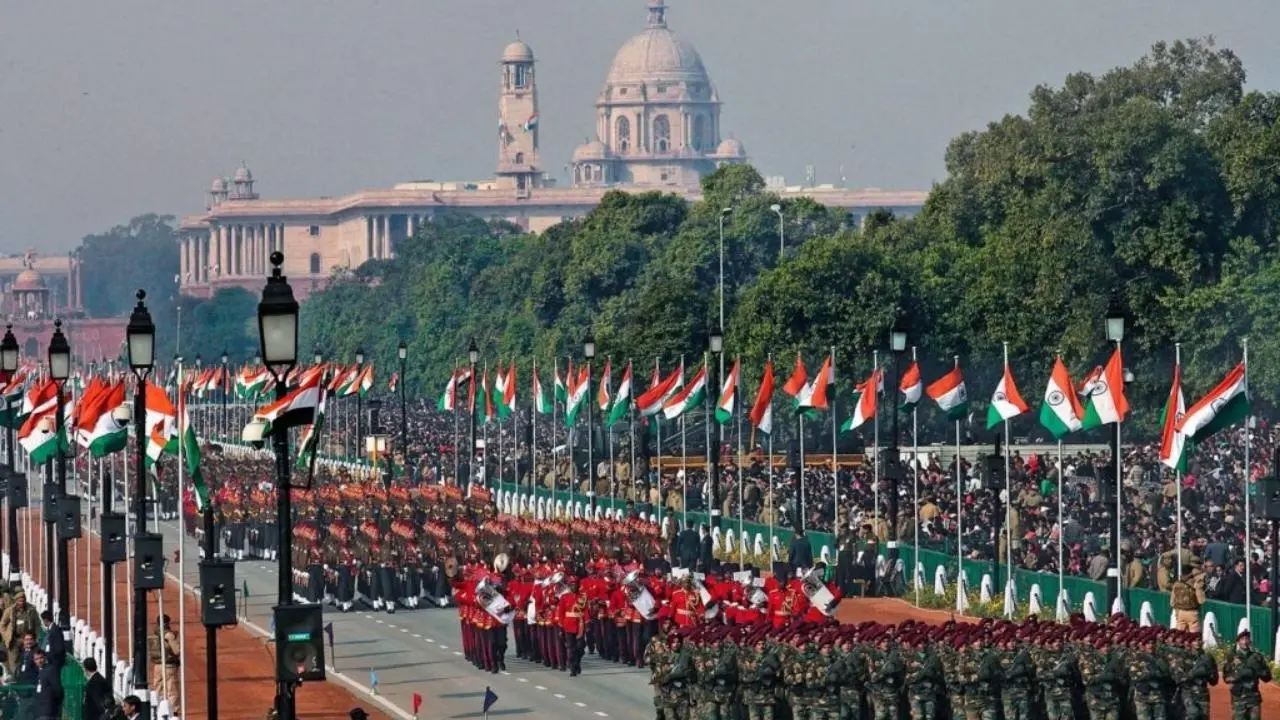
The Republic Day Parade serves as the quintessential highlight of the festivities. Taking place at Kartavya Path (previously Rajpath) in New Delhi, it extends from Rashtrapati Bhavan through India Gate to the Red Fort.
Each parade is intricately planned, featuring:
Military contingents showcasing the armed forces
Cultural tableaux illustrating the richness of states and ministries
Marching bands and aerial spectacles
Performances reflecting India’s heritage and advancements
Key Parade Components
Tri-Colour Flag Hoisting and Presidential Address:
The President of India raises the Tricolour while addressing the nation, evoking the spirit of the Constitution and promoting unity.
Military Display:
Featuring battalions from the Army, Navy, and Air Force, the parade exhibits weapons and equipment, showcasing India’s defense capabilities.
Cultural Tableaux:
States present artistic displays representing their cultural heritage, technologies, and social values, narrating a story of unity in diversity.
Aerial Show:
The Indian Air Force executes precision flying, often presenting formations in the national flag colors.
Awards and Recognitions:
The day honors distinguished individuals with Padma Awards and other recognitions for their contributions.
The parade concludes with a commemoration of Indian identity, reinforcing the democratic tenets that guide the nation.
Nationwide Observances and Public Engagements
Flag Hoisting and Ceremonial Events
Beyond the capital, Republic Day is celebrated throughout India with flag-hoisting ceremonies in educational institutions, municipalities, and other venues. Citizens salute the national flag amidst the playing of the national anthem, with events honoring the sacrifices of freedom fighters.
Cultural Celebrations and Programs
This day is also marked by cultural programs promoting patriotism, social harmony, and civic awareness. Many schools organize debates, quizzes, and performances that reinforce constitutional values among the youth.
In various regions, local authorities and community organizations arrange events that reflect regional heritage, while aligning with the national ethos of unity in diversity.
Security and Travel Notices for 2026
Robust Security Measures
Given the magnitude of Republic Day celebrations, comprehensive security protocols are in place to ensure public safety and the smooth conduct of events. Police agencies implement multi-tiered security, including surveillance via CCTV, crowd control measures, and emergency response strategies.
Travel Guidance
With anticipated large crowds in the capital and other key observance locations, authorities are expected to issue travel advisories — particularly around Indira Gandhi International Airport, where temporary flight disruptions or airspace restrictions may occur in conjunction with the parades.
Public cooperation is encouraged to follow guidelines, arrive early for events, and adhere to safety measures, ensuring a dignified and harmonious celebration.
The Cultural Impact of Republic Day
Republic Day resonates well beyond formal observances, thriving within popular culture and online spaces. Social media channels flood with patriotic messages, historical reflections, iconic images from parades, and tales of national heroes. Quotes, poems, and insights find their way into daily conversations, knitting together a shared memory and national pride.
Across the diverse linguistic and regional landscape of India, tributes to Republic Day encompass a wide array of expressions that embody love for the nation, transforming January 26 into a collective cultural experience.
Final Thoughts on the 77th Republic Day
Republic Day 2026 represents a significant milestone as India marks the 77th anniversary of its Constitution. It signifies the evolution of nearly eight decades of constitutional governance, shaping India’s transition from colonial rule towards a resilient modern republic. The celebrations encapsulate the essence of democratic values, cultural vibrancy, unity, and the collective drive for progress.
As the Tricolour unfurls and majestic parades unfold, engaging cultural reflections take place, turning Republic Day into a living testament of India’s enduring spirit — a celebration anchored in the promise of liberty, justice, and equality for every citizen.
Disclaimer:
The content presented above serves as an in-depth analysis of India’s Republic Day 2026, created from current information and historical context. It aims for informational and educational purposes only, and should not be considered as official government communication.