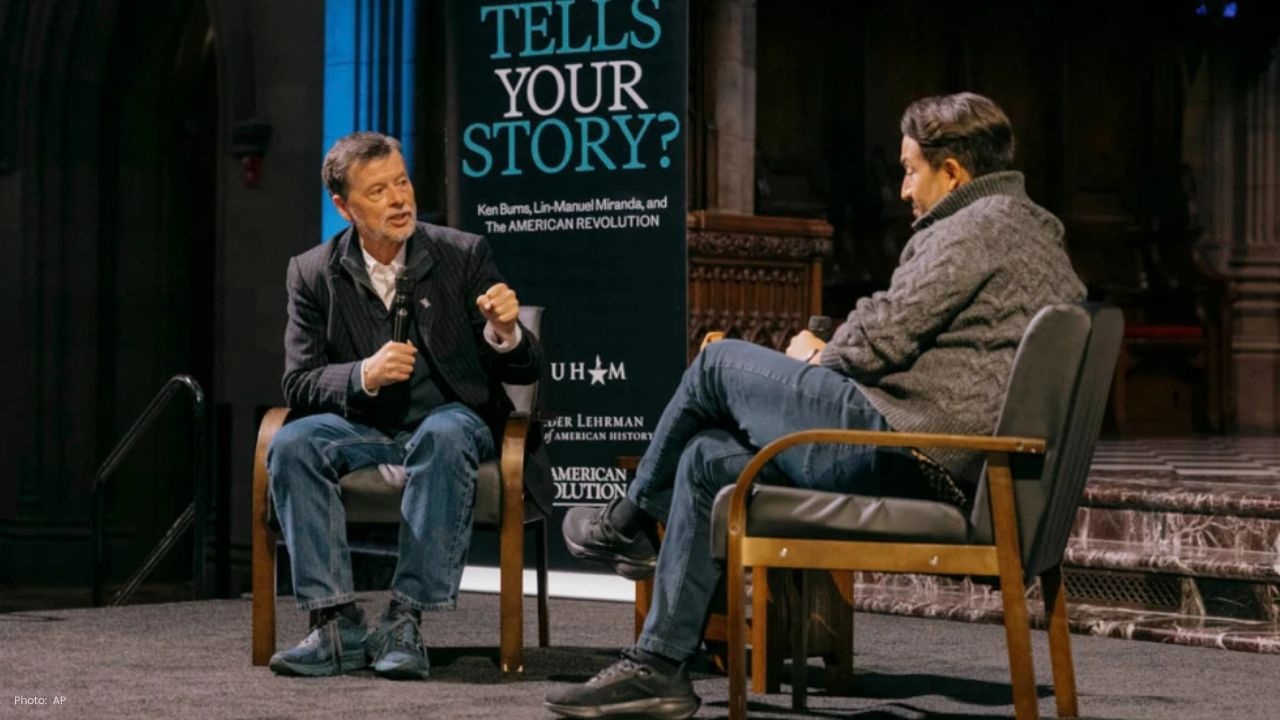
On a brisk afternoon in New York City, Trinity Church welcomed hundreds of high school students eager to ponder a profound question: “Who tells your story?” The esteemed guest speakers were filmmaker Ken Burns, known for his historical documentaries, and Lin-Manuel Miranda, the creator of Hamilton.
This event served as a precursor to Burns’ expansive new endeavor, The American Revolution, a six-part, 12-hour documentary debuting Sunday. The historic church, the final resting place of Alexander Hamilton and Eliza Hamilton, created a poignant atmosphere for this important dialogue.
“We’re in the storytelling business,” Burns remarked alongside Miranda under the church’s soaring vaulted ceiling. “I focus on facts, while Lin-Manuel spins imaginative narratives. The essential question, ‘Who shares your story?’ challenges us to include diverse perspectives in our histories.”
The documentary, co-directed by Sarah Botstein and David Schmidt and featuring a companion book with Geoffrey Ward, delves into extensive historical research. Its narration includes a cast of notable figures like Tom Hanks, Meryl Streep, Morgan Freeman, and Laura Linney, with insights from historians spanning various fields.
Students were not mere spectators; they engaged enthusiastically. Following a screening of a segment detailing the harsh winter at Valley Forge, students Shacoy Moodie and Arianna Richards from Equality Charter High School presented a rap tribute to John Laurens, a revolutionary advocating for enslaved Black rights. “They deserve it all/each and every one/they deserve it all,” resonated through the church, garnering applause from Burns and Miranda.
The camaraderie between Burns and Miranda spans nearly a decade, beginning when Burns visited Miranda after a Hamilton show. Despite their age gap—Burns at 72 and Miranda at 45—they share a commitment to education via storytelling. Burns’ documentaries are integrated into school programs, while Miranda cherishes the numerous school renditions of Hamilton.
“It was a privilege for Lin-Manuel to join me at Trinity,” Burns commented, recognizing the surge of interest in the Revolution spurred by Hamilton’s success. Miranda simply stated, “When Ken Burns calls, you say, ‘Yes.’”
Burns urged the audience to grasp history's complexities, encouraging them to transcend simplistic narratives while acknowledging the founders' accomplishments. In discussing George Washington, he remarked, “He possessed significant flaws; he owned many people and recognized slavery's wrongness but only freed them late in life… Still, we owe the existence of our nation to him.”
The documentary arrives less than eight months before the U.S. marks its 250th anniversary, amid ongoing debates over the Revolution's legacy. Burns aims for a comprehensive narrative that foregrounds the roles of women, the consequences of slavery, and Indigenous suffering alongside the founding fathers’ stories.
A student raised questions about connections between past and present political dynamics. Burns clarified that The American Revolution maintains an impartial perspective, covering a range of administrations from Obama to Biden. The film portrays the U.S. as a “dynamic and evolving entity, both inspiring and flawed,” calling for lessons from history to inform the future.
Miranda supported this notion, referencing Hamilton: “I discovered that the contradictions from our founding remain today, similar to the disputes among family members.” Together, Burns and Miranda provided students with a powerful reminder: history is intricate, ever-evolving, and always in need of fresh narratives.