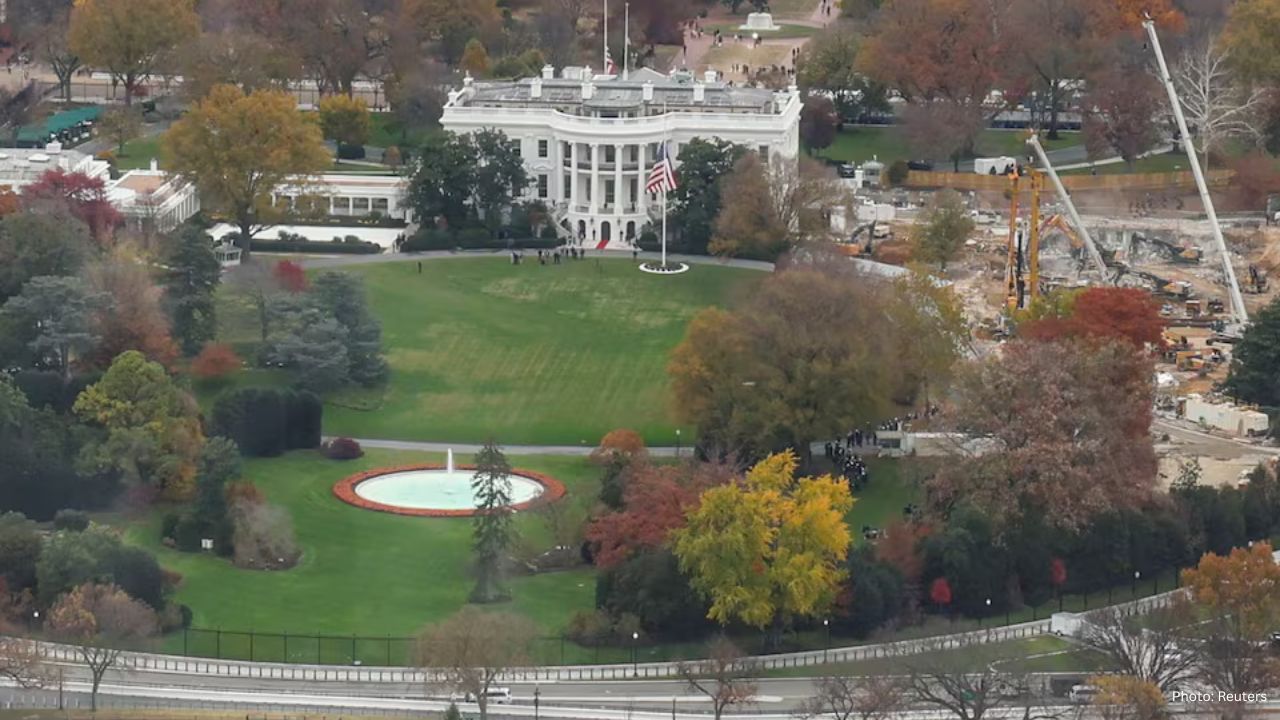
The White House is gearing up for an early January briefing on President Donald Trump’s ambitious plans for the East Wing ballroom, a project that has ignited legal controversies and political pushback. A federal planning agency has scheduled a public hearing for January 8 to discuss the project.
This initiative aims to reconstruct the East Wing of the White House, adding a sprawling ballroom estimated to cost around $400 million. Trump claims the new venue will be significantly larger than the current historic White House, designed to accommodate grand events and celebrations.
The National Capital Planning Commission, tasked with monitoring federal land developments in the Washington area, confirmed that the White House will provide relevant information during its upcoming session. The commission plays a crucial role in assessing how significant construction affects public spaces and historic districts.
The proposal has garnered intense scrutiny. Advocacy groups for preservation have taken legal action, contending that the ballroom would overshadow the White House's rich history and fundamentally alter its appearance. Lawmakers from the Democratic Party have raised alarms, deeming the initiative an overreach of presidential authority and questioning the funding behind it.
Thus far, the planning commission has yet to formally assess the demolition of the East Wing or the preparatory activities undertaken at the site. Critics believe this oversight is unusual, given that these modifications would represent some of the most extensive alterations to the White House in decades.
In an effort to halt the renovation, the National Trust for Historic Preservation has filed a lawsuit, arguing that the intended ballroom, potentially spanning 90,000 square feet, exceeds the dimensions of the current White House. A judge has temporarily allowed construction to proceed, stating that the final design details remain unapproved, with another court session anticipated next month.
President Trump, leveraging his real estate experience, is directly involved in transforming various aspects of the White House and D.C. He asserts these changes are aimed at preparing the capital for significant events in 2026, marking 250 years since the Declaration of Independence was signed.
Beyond the ballroom, Trump has proposed other modifications in the city, such as a grand arch near major Washington sites. Within the White House, he has initiated extensive aesthetic alterations, featuring gold designs and displays that reflect his interpretations of previous presidents.
The demolition of the East Wing commenced in October with minimal public notification, escalating controversies surrounding the project. Opponents argue that such an impactful alteration to a historic structure demands broader consultation and transparency.
The planning commission has announced a full review of the project slated for the spring, which will evaluate its impact on public view sheds, open spaces, and surrounding landscapes. Residents will be invited to voice their opinions and provide testimony during this review.
As the January briefing nears, discussions about the East Wing ballroom are expected to intensify. While proponents view it as a necessary enhancement, critics are concerned about its scale, financial implications, and potential effects on one of America's most significant historical structures.