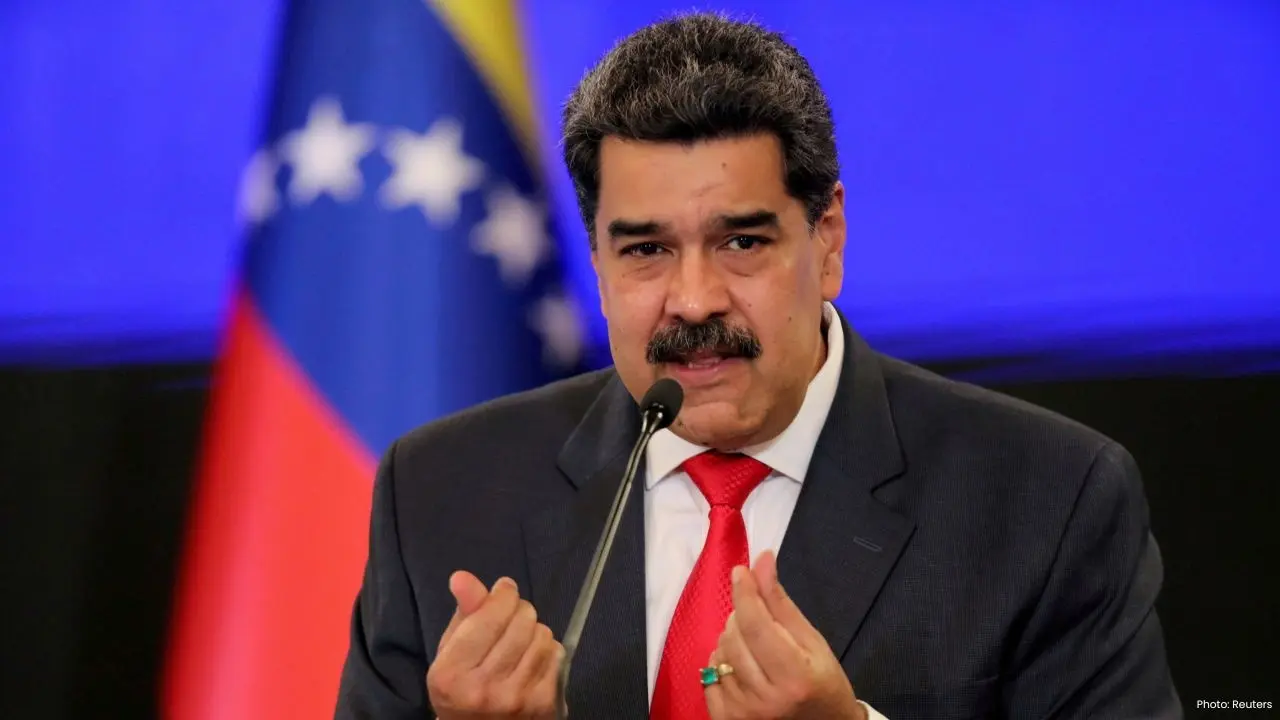
The United States Treasury Department has announced a new wave of sanctions targeting several family members and associates of Venezuelan President Nicolas Maduro, signaling a significant escalation in pressure on the government in Caracas. These sanctions come at a time when the US has also ramped up its military presence near Venezuelan waters, following a series of aggressive operations off the country’s coast. Recent US military actions have included strikes on vessels that reportedly resulted in over 100 fatalities, the seizure of a Venezuelan oil tanker, and the imposition of a naval blockade on ports under US sanctions.
According to the Treasury Department, the new sanctions are aimed at seven individuals connected to Maduro’s nephew, Malpica Flores, who has been previously referred to as one of the so-called “narco-nephews” of the Venezuelan leader. The list also includes Panamanian businessman Ramon Carretero. Washington asserts that these measures are designed to dismantle the networks that, in its view, sustain Maduro’s “illegitimate dictatorship.” The US government has long maintained that it is targeting corruption and drug trafficking as part of its broader campaign against the Venezuelan administration.
Despite the US citing drug trafficking as the primary rationale for its military and economic actions, critics argue that the strategy is increasingly focused on Venezuela’s vast oil reserves—the largest in the world. Homeland Security adviser Stephen Miller, a key aide to the Trump administration, has made explicit claims that Venezuela’s oil “belongs to Washington,” describing previous nationalizations of the oil industry as “the largest theft of American wealth and property.” These remarks have fueled debates over whether the US is motivated more by control of natural resources than by anti-drug efforts.
President Maduro has strongly condemned the sanctions and the US military activity, labeling the actions as attempts at regime change and efforts to seize Venezuela’s oil. Maduro maintains that the United States is fabricating a pretext to justify an expanded intervention in the country. He accused the Trump administration of orchestrating an “eternal war” against Venezuela in order to undermine his government and its sovereignty over national resources.
Meanwhile, the European Union has also continued its policy of targeted sanctions against Venezuela, extending measures originally imposed in 2017 through 2027. These sanctions include travel bans, asset freezes, and an embargo on arms shipments to the country, aimed at curbing human rights violations and state repression.
The new US sanctions mark a further intensification of international pressure on Maduro’s government, which has been facing severe economic crises, social unrest, and growing discontent within Venezuela. With military operations ongoing and diplomatic tensions escalating, the situation underscores the complex interplay between geopolitical interests, economic resources, and humanitarian concerns in the region.