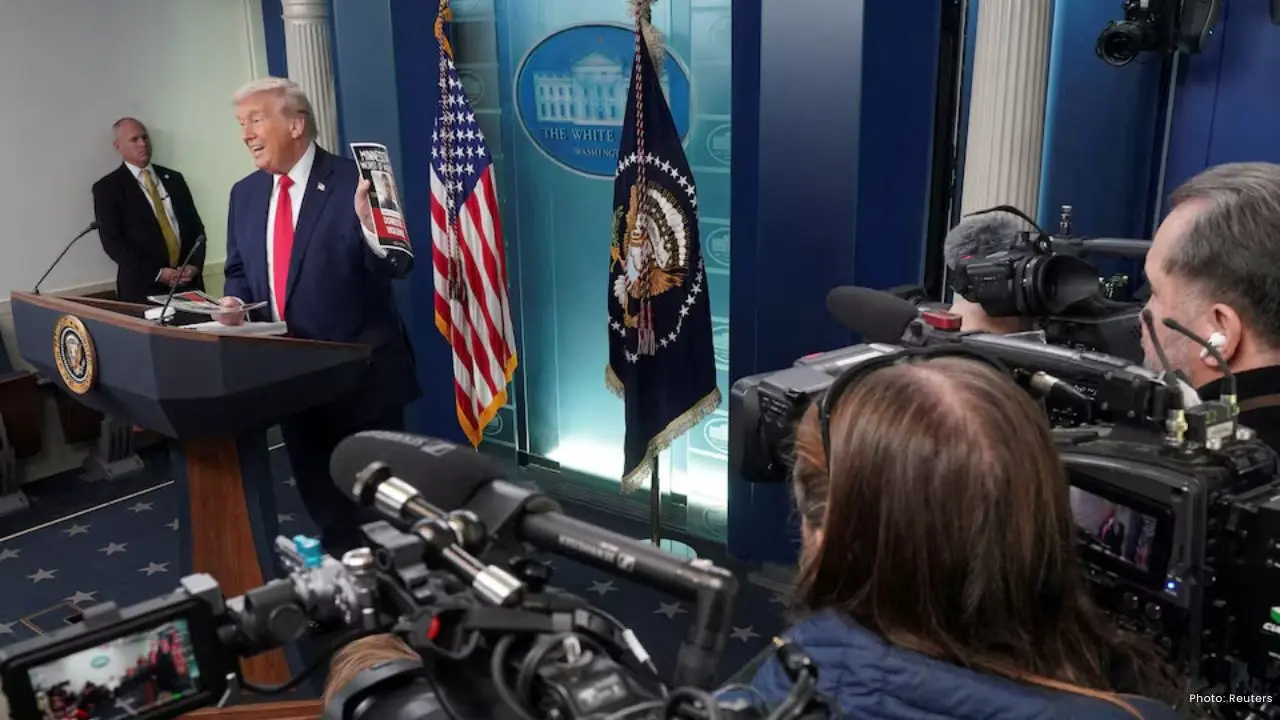
U.S. President Donald Trump celebrated the one-year anniversary of his return to the White House with an extensive and expressive session before journalists, which garnered attention due to its style, content, and contentious statements. Occurring shortly before his departure for the World Economic Forum in Davos, the event was intended to showcase his administration's milestones. However, it evolved into a lengthy, meandering discourse that intertwined self-praise with pointed attacks, humor, and unverified assertions.
Trump's remarks extended for nearly two hours, starting with an 81-minute introductory statement, followed by questions from the press. Throughout the address, he transitioned between various subjects, often without a cohesive thread. Topics included crime, immigration enforcement actions, foreign relations, biker culture, and even geographical references, such as his comment about potentially renaming the Gulf of Mexico.
A significant portion of Trump's address centered on immigration and crime, where he hailed U.S. Immigration and Customs Enforcement (ICE) agents, particularly those involved in recent raids in Minnesota, referring to them as heroes. He accused demonstrators opposing these raids of being remunerated instigators. His remarks followed an incident in Minnesota where a federal officer fatally shot a U.S. citizen, raising alarming concerns.
Defending his deployment of military resources in urban areas, Trump noted the National Guard's presence in multiple Democratic-led cities, signaling he might consider using regular military forces in Minnesota as well. These actions have sparked considerable pushback from local authorities. He asserted that cities appear more secure with troops present, citing a drop in crime rates in Washington, D.C., post-Guard deployment, although he provided no supporting data.
Throughout the engagement, Trump reiterated assertions from prior campaigns, including his false claim that he was wrongfully deprived of victory in the 2020 presidential election. He criticized ex-President Joe Biden and lamented that he had not received ample acknowledgment for his term's accomplishments.
During the session, he showcased a binder labeled “365 Wins in 365 Days,” compiling what his administration termed daily achievements since his return to the presidency in January 2025. These encompassed topics from curbing illegal immigration to alterations in household amenities like showerheads and toilets. At one juncture, Trump humorously highlighted a large binder clip, insinuating it could have been a source of injury.
Among the most controversial aspects of his address was when Trump exhibited mugshots of individuals he claimed were undocumented immigrants apprehended for grave offenses in Minnesota, dramatically tossing them to the ground. He followed with derogatory comments about Somali immigrants, describing them as “very low IQ individuals,” and falsely asserted that Somalia was nonexistent. These remarks, reminiscent of earlier statements from his 2024 campaign, were widely condemned as racially insensitive.
In defending his immigration policies in Minnesota, Trump linked them to fraud related to federal food assistance programs and organizations associated with the Somali community. Critics, however, argue that his rhetoric unjustly stigmatizes an entire population.
Trump reiterated his assertion that he was instrumental in concluding eight foreign military engagements and claimed he deserved the Nobel Peace Prize, which eluded him. He expressed skepticism toward the notion that the Norwegian government does not control the Nobel Foundation, deeming the decision to withhold the prize unjust.
Overall, this anniversary gathering shone a light on Trump's distinctive communication approach rather than his policy victories. While some of his followers might regard his comments as bold and straightforward, critics contend that the address revealed a lack of coherence and decorum, especially towards immigrant and minority communities.
As Trump embarks on his second year back in office, the event underscored that his presidency remains defined by forceful rhetoric, simultaneous controversies, and stark political divisions. What was meant to be a celebration of achievements ultimately reignited discussions on leadership, transparency, and the tenor of discourse at the highest echelons of government.