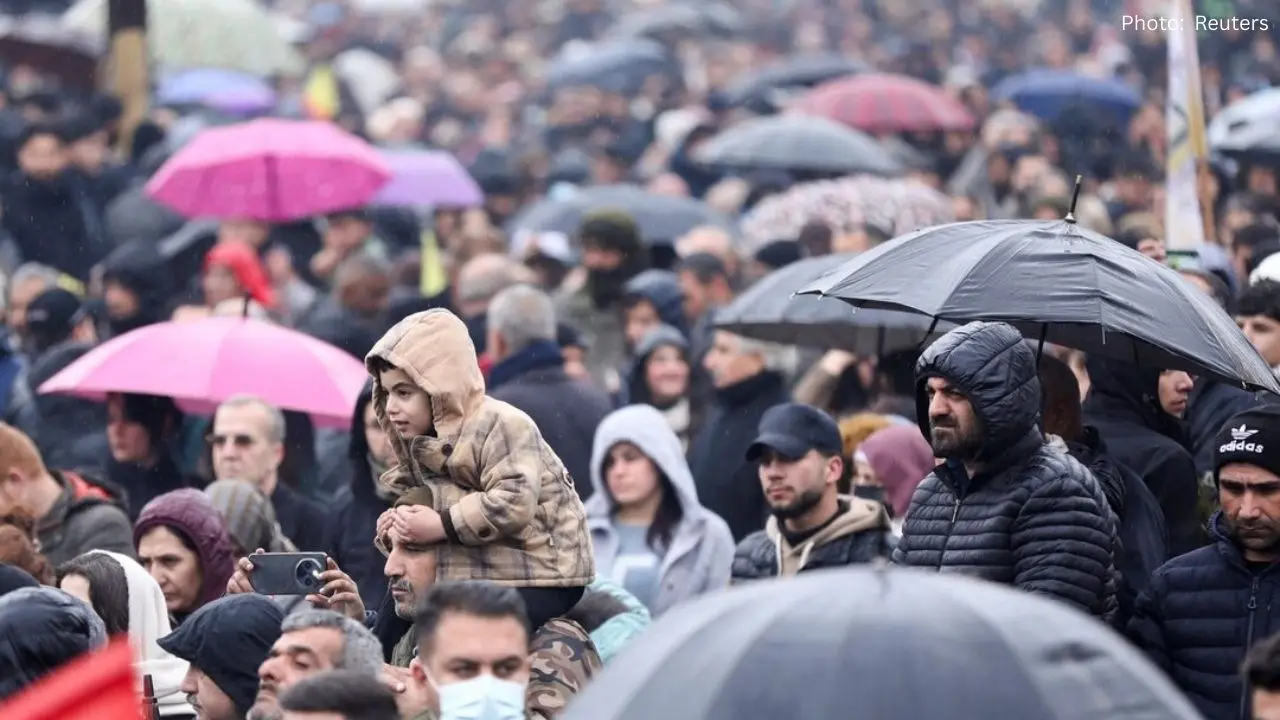
This week, thousands of Syrian Kurds took to the streets of Qamishli to voice their outrage over the recent violence in Aleppo, raising alarms about a potential return to unrest in Syria. Despite heavy rains, protesters gathered to express their anger, grief, and anxiety regarding the unfolding situation.
The demonstrations came in the wake of deadly clashes in Aleppo that prompted Kurdish fighters to retreat from territories they had defended for more than a decade. Many participants carried portraits of fallen Kurdish fighters, while others displayed banners adorned with Kurdish symbols demanding justice and the safeguarding of Kurdish rights. For numerous families, the march was not solely about Aleppo, but also about their uncertain future in Syria.
The Aleppo violence spanned nearly five days and resulted in numerous fatalities, according to reports from both Syrian authorities and Kurdish officials. Thousands of residents were compelled to flee their homes in Kurdish-majority neighborhoods such as Sheikh Maksoud and Ashrafiya, caught in the crossfire and shelling as they sought safety.
Following a ceasefire, the last remnants of the Kurdish-led Syrian Democratic Forces exited Aleppo on January 11, signaling the end of Kurdish governance in those areas, which they had maintained since the onset of the Syrian conflict in 2011. Although the ceasefire has quelled immediate violence, concerns persist within the Kurdish community.
Many Kurds interpret the events in Aleppo as a stark reminder of how tenuous peace is in Syria. President Ahmed al-Sharaa, who took office after Bashar al-Assad was ousted in late 2024, has vowed to unify the nation after years of turmoil. Nevertheless, Kurdish leaders approach this promise with skepticism, particularly after witnessing recent bloodshed.
The Kurdish population governs a semi-autonomous region in northeastern Syria, continually advocating for recognition of their political and cultural rights. A March 2025 agreement aimed to integrate Kurdish governance within the central government, but progress has been sluggish. Following the Aleppo confrontations, Kurdish official Ilham Ahmad cautioned that continued military actions against Kurdish territories could jeopardize the agreement.
Emotions ran high during the protests. Some signs depicted images of Syria’s president and Turkey’s foreign minister marked through, holding them accountable for Kurdish suffering. Turkey has long asserted that the Syrian Democratic Forces are linked to banned entities, a claim that Kurdish leaders vehemently dispute.
Protesters expressed that the violence in Aleppo has intensified their distrust of the new government. They fear that without explicit legal protections, Kurdish communities may face further aggressions. Community leaders emphasized that true unity in Syria is unattainable unless Kurdish rights are unequivocally enshrined in the constitution.
Tensions remain elevated as Syria’s defense ministry declared parts of eastern Aleppo a closed military zone, ordering armed groups to withdraw eastward. This declaration has heightened fears that conflict could expand into other Kurdish-controlled areas.
For countless Kurds, the recent violence evokes haunting memories of previous assaults on minority groups in Syria. Some protesters likened the current crisis to earlier violence against Alawite and Druze communities, warning against repeating historical tragedies.
Residents present at the protest cautioned that a full-scale war would only result in more suffering for ordinary people. They voiced concerns that another round of conflict might deepen societal fractures, rendering peaceful coexistence increasingly challenging.
International advocates have called for de-escalation. The head of U.S. Central Command stressed that all parties must exercise restraint and return to negotiations, underscoring the importance of dialogue over conflict. These appeals indicate a growing global anxiety regarding Syria's fragile stability.
Life remains uncertain for families displaced by the recent clashes. Many have lost their homes, livelihoods, and access to education, with children particularly grappling with fear as parents seek safety.
At this pivotal juncture, after over a decade of war, there was hope that Syria was inching towards peace. However, the clashes in Aleppo illustrate how quickly tensions can resurface if trust erodes.
The protests from Syrian Kurds deliver a compelling message: they seek safety, dignity, and an influential role in crafting Syria’s future. The path towards peace or a relapse into conflict hinges on choices made in the upcoming days. Only through dialogue, respect for minority rights, and restraint can sustainable stability be pursued.