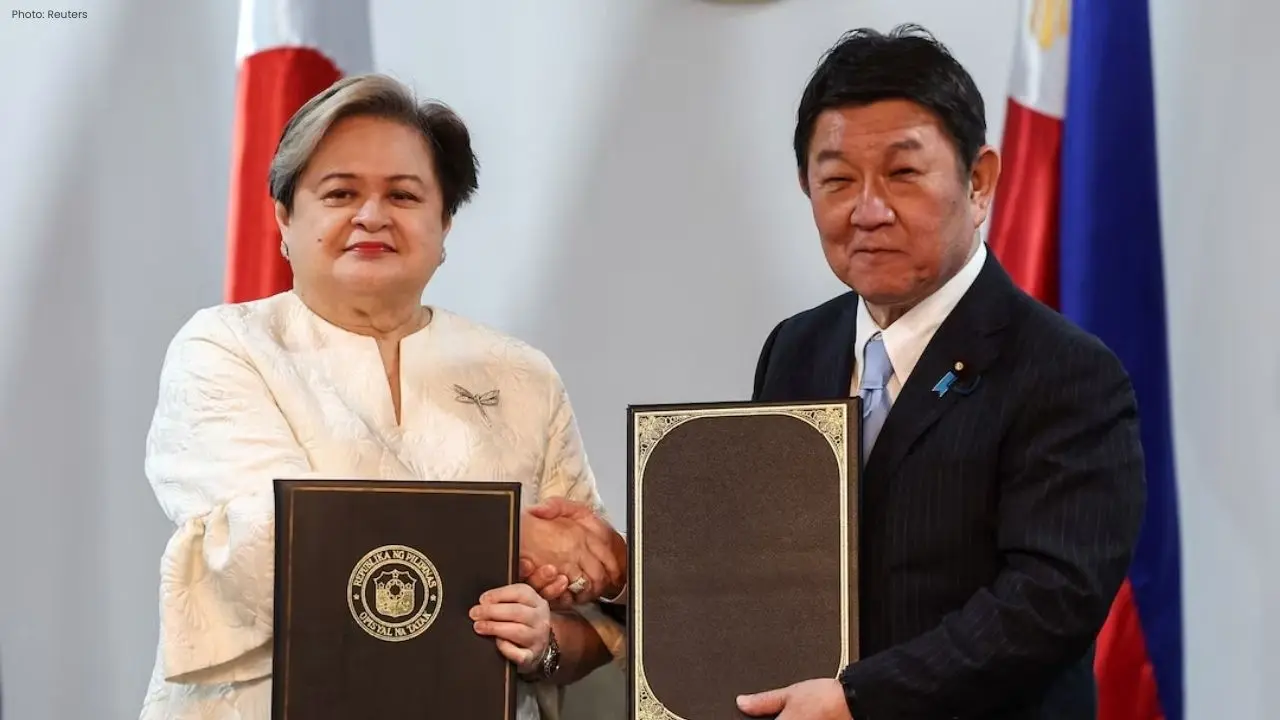
In a significant move to bolster their military partnership, the Philippines and Japan have signed two crucial defense agreements on Thursday. This includes a pact for swift exchange of military supplies and services to enhance operational teamwork amidst escalating regional security challenges.
The Acquisition and Cross-Servicing Agreement (ACSA) comes shortly after the implementation of a landmark Reciprocal Access Agreement between the two U.S. allies, advancing their defense collaboration in an increasingly tense region.
Japanese Foreign Minister Toshimitsu Motegi, during his nine-day tour of the Middle East and Asia, signed these agreements in Manila, marking Japan's growing strategic footprint in the region, which included visits to Israel, Palestinian territories, Qatar, and India.
Motegi and Philippine Defense Secretary Theresa Lazaro also confirmed $6 million in Official Security Assistance from Japan, aimed at the construction of facilities for rigid-hulled inflatable boats provided by Japan, thus enhancing the naval capabilities of the Philippines.
Japan has voiced concerns regarding rising maritime disputes in East Asia, firmly opposing any unilateral attempts to change the status quo. The significance of Philippine maritime security has been emphasized within a trilateral framework, including the United States.
“The Secretary and I confirmed the importance of Japan-Philippines-U.S. cooperation in today’s increasingly challenging strategic environment,” Motegi stated in a joint press conference with Lazaro.
Japan has supported the 2016 ruling by the Permanent Court of Arbitration in The Hague, which invalidated broad Chinese claims in the South China Sea, a decision that Beijing has rejected. Lazaro noted that both nations are committed to upholding the rule of law, which includes freedom of navigation and overflight, marking Japan as a crucial strategic ally.
Motegi’s visit aligns with the Philippines chairing the Association of Southeast Asian Nations, against a backdrop of rising tensions in the Taiwan Strait. Japan has underscored that peace and stability around Taiwan are essential for global security. Last November, Japanese Prime Minister Sanae Takaichi cautioned that a Chinese attack on Taiwan could provoke a military response from Japan, leading to strong backlash from Beijing, which included travel restrictions and export bans on specific dual-use items.
China maintains claims over Taiwan, a mere 100 kilometers from Japanese shores, having not ruled out the use of force to assert control. Taiwan asserts that only its people can determine the island's fate.
In light of these regional developments, Japan is undertaking a significant military buildup to counter the burgeoning power of China while furthering alliances across East Asia.