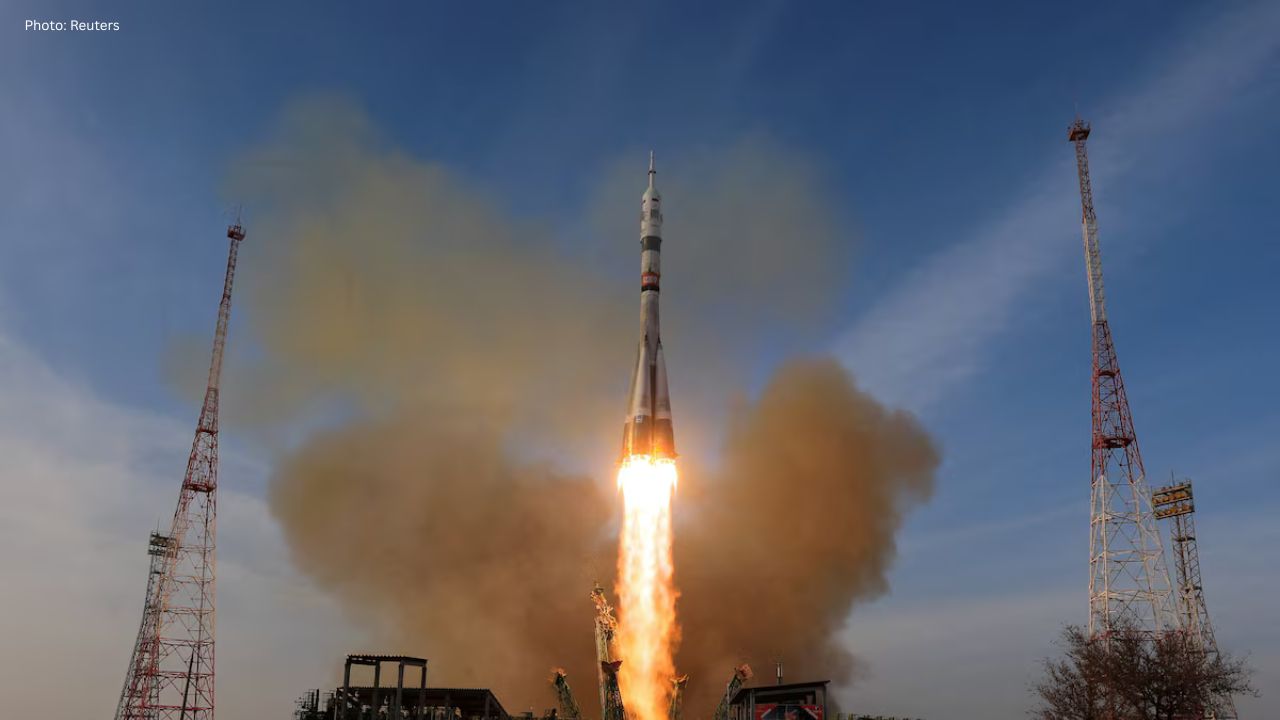
A Russian Soyuz spacecraft embarked on its mission to the International Space Station (ISS) on Thursday, carrying a combined crew of Russian and American astronauts. This successful launch showcased a unique moment of collaboration in space amidst the ongoing tensions between Moscow and Washington on the ground.
The Soyuz MS-28 launched at 12:28 p.m. Moscow time from the Baikonur Cosmodrome in Kazakhstan. Live broadcasts captured the Soyuz 2.1a rocket as it ascended into the sky, heading for its destined orbit. Baikonur remains a pivotal site in the history of human spaceflight, being one of the oldest spaceports globally.
On board were three crew members: Russian commander Sergei Kud-Sverchkov, fellow cosmonaut Sergei Mikayev, and NASA astronaut Christopher Williams. While Kud-Sverchkov embarks on his second mission, both Mikayev and Williams are taking their inaugural journeys beyond our planet. Their collaboration exemplifies the enduring spirit of international work aboard the ISS.
Following the launch, the spacecraft is set to circle Earth twice before executing an automated docking with the ISS at 12:38 GMT, only a few hours post-liftoff. Once connected to the Rassvet module, the crew will join the existing astronauts already aboard the station.
The astronauts are expected to spend around eight months in orbit, engaging in scientific research, maintaining station operations, and aiding ongoing collaborative international studies. Their mission is slated to conclude in late July 2026, when they will return home aboard a Soyuz capsule.
The ISS has historically embodied cooperation among nations, even amidst political discord. This joint mission serves as a reminder that the pursuit of space exploration can bring countries together for shared scientific ambitions. As the new crew acclimates to their roles, their research will advance understandings of human health, climate change, technology, and the long-term issues of space habitation.
This launch further cements the Soyuz program’s reliability, as it has safely transported astronauts for decades, establishing itself as one of the most dependable systems in the annals of spaceflight.
While the upcoming months will pose challenges, they promise opportunities for groundbreaking discoveries. This journey marks yet another milestone in humanity's exploration of the cosmos.