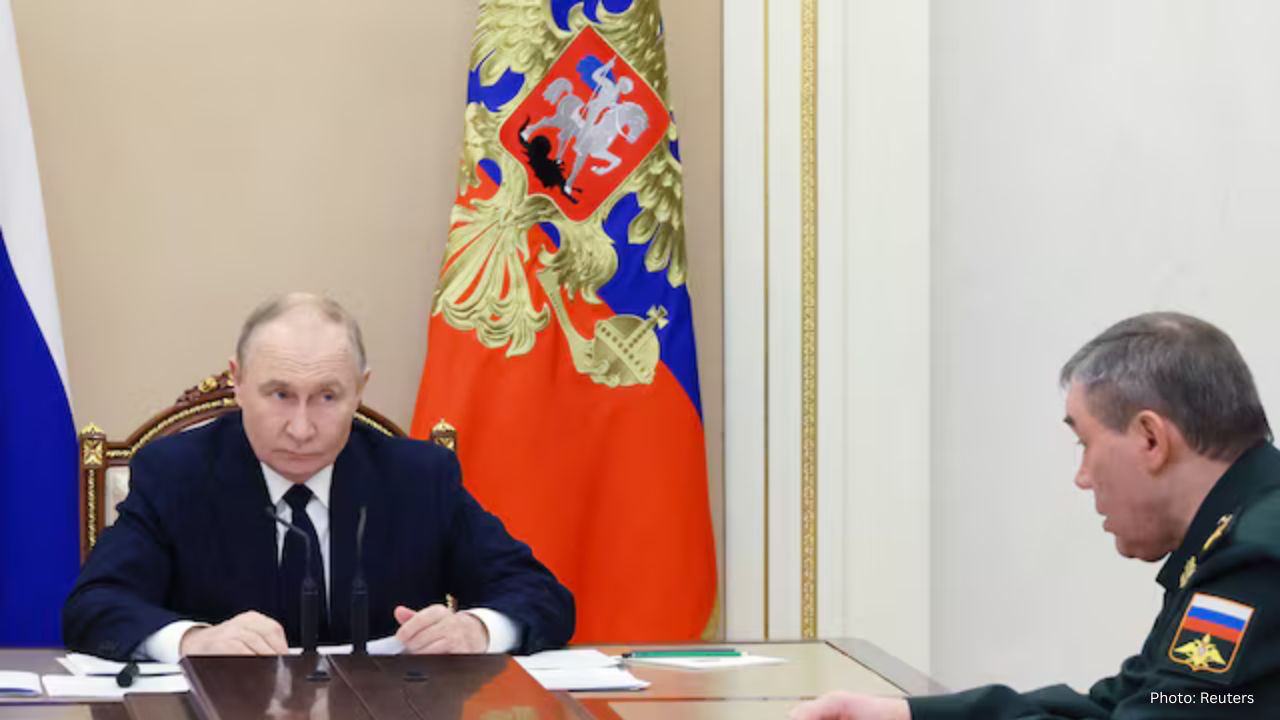
Russia has indicated an expansion of its military objectives in Ukraine, as its chief general announced that President Vladimir Putin has ordered an extension of the buffer zone in the Sumy and Kharkiv areas for 2026. This statement emerges amidst ongoing clashes and heightened tensions along Ukraine's northeastern border.
Valery Gerasimov, Chief of the General Staff of the Russian Armed Forces, revealed that Russian troops are advancing into Ukrainian positions. His comments were made during a visit to the so-called “North” group of Russian forces stationed in northeastern Ukraine since early 2024.
A buffer zone, essentially, is created to separate conflicting sides. Russia argues that such areas are necessary to safeguard its borders against potential Ukrainian assaults. Conversely, Ukraine and its allies perceive these actions as further encroachment on Ukrainian territory, indicating Russia's intention to continue fighting rather than pursue peace.
The Sumy and Kharkiv regions, located close to the Russian border, have faced hostilities since the war's inception. As Ukraine's second-largest city, Kharkiv has endured repeated missile and drone strikes, while Sumy frequently experiences shelling due to its proximity to the border. Any enlargement of the buffer zone in these regions is likely to result in heightened conflict and increase risks for civilians caught in the crossfire.
The “North” troop contingent was established for operations in this area, intending to push Ukrainian forces back from the border and make way for additional advances. Gerasimov's remarks raise alarms about Russia not only considering immediate actions but also formulating a long-term military strategy extending into 2026.
These statements evoke serious apprehensions regarding the trajectory of the war. A focus on 2026 indicates that Russia is gearing up for a protracted conflict rather than imminent peace negotiations. Such a perspective diminishes the potential for rapid settlements, leading to fears of ongoing casualties and devastation.
For Ukraine, the prospect of a broader buffer zone is deeply alarming, suggesting further territorial losses and escalating military pressure. Civilians in these regions may face heightened displacement, property damage, and disruptions in daily life.
Internationally, these developments are likely to attract scrutiny from Western nations supporting Ukraine. Any indication of Russia's expanded ambitions could influence military support, sanctions, and diplomatic strategies. Moreover, it raises concerns about the conflict degenerating into a protracted stalemate without a clear resolution.
In summary, Gerasimov's remarks regarding Putin's directive to expand the buffer zone in Sumy and Kharkiv signal a potentially new chapter in the overarching conflict. As fighting persists, discussions surrounding 2026 illustrate the entrenched nature of this war. For both the region and the global community, it serves as a stark reminder of the distant prospect of peace and the continuous toll on human lives.