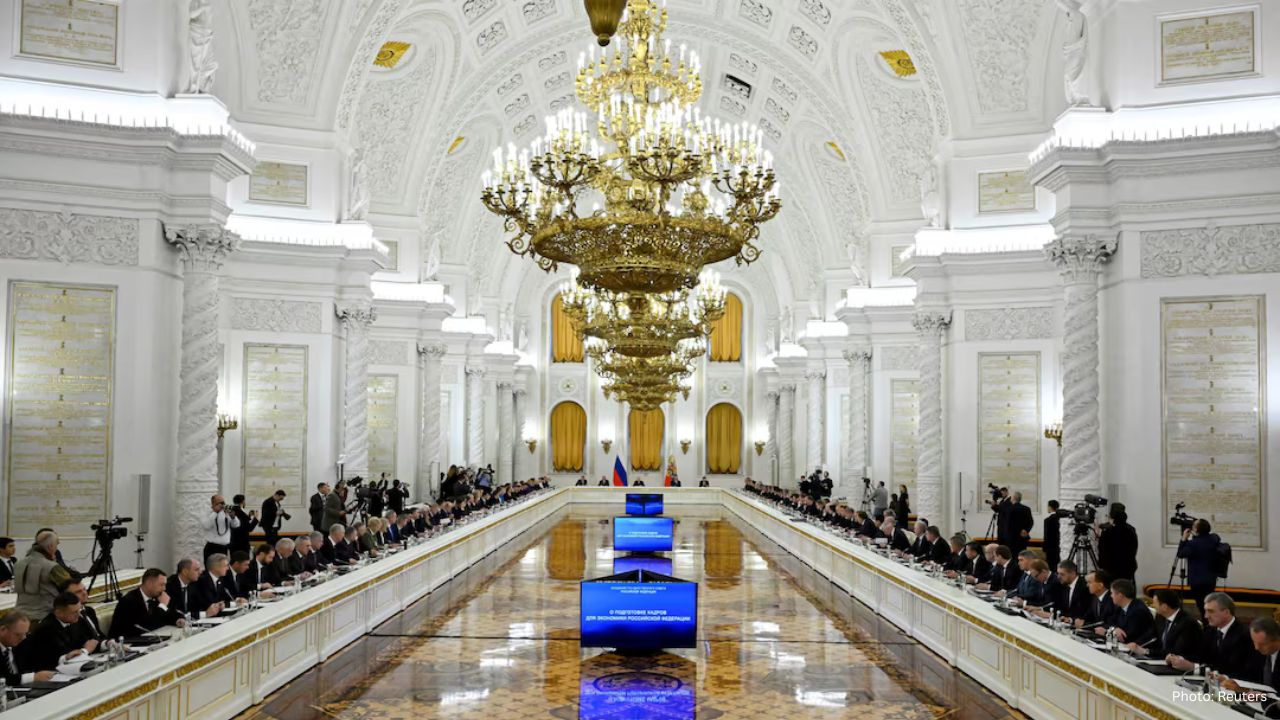
In a recent briefing, Russian President Vladimir Putin expressed that Russia might be amenable to limited territory exchanges as part of a peace resolution with Ukraine, contingent upon securing total control over the Donbas region. This insight comes from a report by the Russian newspaper Kommersant, outlining Putin's discussion with influential business leaders during a meeting at the Kremlin on December 24.
Putin articulated his thoughts regarding the future of the conflict in Ukraine, signaling a readiness to explore compromises. However, he emphasized that the Donbas region remains off the table. The Donbas, comprising the Donetsk and Luhansk areas, has been the focal point of the ongoing conflict and holds significant strategic significance for Russia.
As reported by Kremlin correspondent Andrei Kolesnikov, Putin communicated to the businessmen that Russia is willing to consider certain concessions, paralleling those previously discussed with the U.S. Yet, he clarified that giving up any part of Donbas is out of the question. He indicated that while discussion about territories outside of Donbas could occur, Russia's claim to the entire region is steadfast.
This stance presents a direct challenge to Ukraine's position. Ukrainian President Volodymyr Zelenskiy firmly stated that Ukraine will not relinquish land recognized as part of its territory. In remarks made by his office, Zelenskiy noted that improvements have been made toward a potential 20-point peace plan during recent discussions in Miami, although he highlighted that no consensus on Russia's demands regarding Donbas has yet been reached.
Zelenskiy further mentioned the lack of a shared understanding regarding the future of the Zaporizhzhia nuclear power plant, currently under Russian control. As Europe's largest nuclear facility, it remains a major concern for both Ukraine and the global community due to safety issues amid the conflict.
The U.S. has taken on a crucial role in the dialogues, with President Donald Trump advocating for an end to what he termed the deadliest war in Europe since World War II. Notably, the Trump administration has been quietly mediating, with envoy Steve Witkoff and Trump's son-in-law Jared Kushner engaging in discussions with stakeholders from Russia, Ukraine, and Europe. While full details of the U.S. proposals remain under wraps, Russian officials have acknowledged certain “understandings” reached during Putin and Trump's meeting in Anchorage, Alaska, in August.
Currently, Russia's territorial hold in Ukraine is broad, with Moscow claiming all of Crimea since its annexation in 2014, about 90% of Donbas, and significant portions of the Zaporizhzhia and Kherson regions, along with smaller areas in Kharkiv, Sumy, Mykolaiv, and Dnipropetrovsk. Putin has stated that any sustainable peace arrangement must adhere to earlier conditions he laid out, which include Ukraine's withdrawal from the territories claimed by Russia and an official renunciation of its NATO aspirations.
During the assembly with business leaders, Putin elaborated on the Zaporizhzhia nuclear power station, indicating discussions around a potential joint Russian-U.S. management. He also referenced U.S. interest in crypto mining initiatives close to the plant and mentioned that the electricity generated there should partially supply Ukraine. These statements imply that Russia may view the nuclear plant not only as a strategic asset but also as leverage in negotiations.
Since launching a full-scale invasion of Ukraine in February 2022, which was termed a “special military operation,” the ongoing war has resulted in extensive destruction, displacing millions and altering global geopolitics. Although discussions surrounding territory exchanges and negotiations might indicate a move towards diplomacy, deep-seated disagreements over land, security, and sovereignty signal the challenges in reaching a peaceful resolution.
Putin’s assertions, as detailed by Kommersant, underscore a limited scope for compromise. By insisting on total control of Donbas while permitting flexibility on other territories, Russia seems to be gauging whether Ukraine and its allies are prepared to accept painful territorial concessions to achieve peace. For Ukraine, acquiescing to such conditions could be politically and emotionally devastating, while rejecting them might result in the continuation of a brutal conflict. As diplomatic talks progress, the coming weeks will likely clarify whether these overtures lead to substantive advancements or merely extend the ongoing strife.