A Transformative Era in Scientific Collaboration
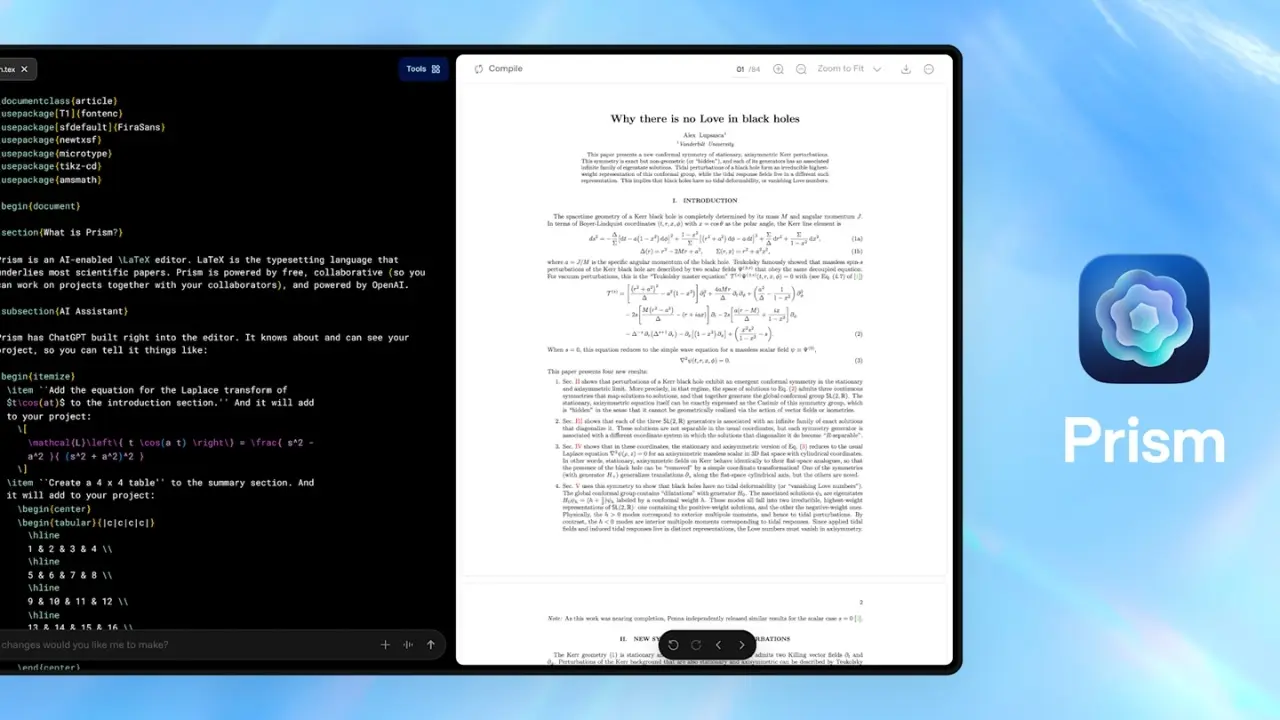
OpenAI has launched Prism, an innovative AI workspace crafted for scientific writing and collaboration. As an AI-native platform, Prism signifies a groundbreaking shift in how researchers compose, edit, and manage scholarly content such as academic manuscripts and research papers. Powered by the advanced capabilities of OpenAI’s GPT-5.2 model, this tool offers advanced reasoning alongside seamless LaTeX integration, the benchmark for academic formatting. With the potential to redefine scientific workflows, Prism consolidates writing, citation management, real-time collaboration, and sophisticated AI assistance into a single, accessible environment.
In contrast to conventional research tools that focus on separate steps like writing or citation, Prism streamlines these tasks within a cloud-based workspace, allowing researchers to access resources from any location. By minimizing the inefficiencies associated with switching platforms and manual formatting, it aims to accelerate the scientific writing process. Accessible now to anyone possessing a personal ChatGPT account, and later for institutional users on enterprise plans, Prism is offered free with unlimited co-authors and projects, making it ideal for all scientists, regardless of career stage.
Addressing Challenges in Scientific Writing
Scientific research processes have long been fragmented. Many researchers report that they invest more time on citation management and document formatting than on actual scientific discovery. Drafting research articles often means juggling various tools, including version control systems, reference managers, and text editors. Even when specialized tools exist, their lack of integration results in increased cognitive burden and diminished efficiency for research teams.
Typically, a research article undergoes numerous revisions and edits involving collaborators spread across various institutions and time zones. Persistent issues like real-time co-editing, tracking changes, and managing different document versions pose ongoing challenges. Moreover, creating intricate content like equations, tables, and citations through standard tools often leads to additional manual hours of formatting burdens for time-strapped researchers. This backdrop has paved the way for solutions like Prism, aimed at streamlining critical components of scientific workflows.
Understanding Prism's Functionality
Prism is essentially a cloud-based LaTeX workspace that artfully merges advanced AI technology with the familiar document structures of scientific writing. LaTeX is widely recognized in STEM fields for its strong capabilities in managing equations, tables, and rigorous formatting, making it a preferred choice for writing academic papers. Prism allows users to harness this cloud-based environment adorned with AI functionalities that comprehend the entire context of their active manuscripts.
One of Prism’s standout features is its AI-assisted drafting and revision capabilities. Utilizing GPT-5.2, the platform aids users in various tasks like summarizing sections, sharpening language for clarity, identifying areas needing citation, transforming sketches into LaTeX code, and recommending structural enhancements. The AI also aids in brainstorming ideas and navigating intricate problems, adapting content based on user feedback seamlessly.
Prism’s project-aware AI tracks the entire history of a document, including past drafts and modifications, leading to more coherent suggestions and context-focused editing. For example, when refining a discussion, the AI can pull references from earlier sections, enhancing consistency throughout the manuscript.
Unlimited Collaboration: A Game Changer
One unique aspect of Prism is its facilitation of unlimited collaborators, enabling any size of research team to work in real-time without any limits or fees. This feature targets a fundamental bottleneck in collaborative research where conventional edit-share models restrict access and create version conflicts. With Prism, all collaborators can witness edits, comments, and annotations live, reducing miscommunication and ensuring everyone engages with the latest version of the document simultaneously.
The lack of limits on projects and collaborators opens possibilities for flexibility among teams that traverse institutions, disciplines, and geographic boundaries. Graduate students, advisors, co-authors, and external reviewers can engage in the writing process without encountering the usual licensing issues found in paid platforms. By lowering these hurdles, Prism aims to democratize access to elite research tools, promoting inclusive collaboration.
Seamless LaTeX Integration
LaTeX is renowned for its precision in scientific typesetting and its adeptness with complex mathematical formulas. Prism’s comprehensive integration with LaTeX directly into the workspace ensures that researchers do not need separate installations or offline editors. The platform automates the compilation, formatting, and previewing of documents, delivering instant rendering without the lag associated with traditional LaTeX workflows.
Beyond basic LaTeX support, Prism also includes features like citation management, equation conversion, and automated error-detection, significantly minimizing manual work. The AI helps identify and rectify formatting discrepancies during the drafting process, maintaining the integrity of LaTeX formatting while greatly enhancing usability for those less experienced with LaTeX.
More Than Just Editing: Cultivating Research Insight
While Prism's primary objective lies in drafting and formatting scientific material, its AI-driven reasoning capabilities extend its applicability beyond mere text editing. Researchers can utilize the platform to elucidate complex arguments, refine hypotheses, validate logical continuity, or search for and incorporate relevant prior research. Unlike traditional text editors, Prism’s AI comprehends the semantic context of scientific assertions, granting suggestions that resonate within the larger narrative of the document.
The platform also simplifies literature searches, allowing users to find and incorporate citations without needing to switch tools frequently, streamlining the often tedious reference formatting task. Additionally, Prism's reasoning abilities facilitate scientists in exploring ideas and assessing conceptual relationships, such as juxtaposing competing models or verifying logical flow between hypotheses and conclusions.
Making Research Tools Accessible
OpenAI has made Prism accessible for students, independent researchers, and established scientists alike, requiring only a personal ChatGPT account for basic access. This initiative dismantles barriers often associated with paywalls, subscriptions, and institutional licenses. Prompt access positions Prism as a potential equalizer in academia, allowing underfunded teams to access high-quality writing and collaboration tools typically reserved for those with paid access.
The organization has also indicated that expanded access, including enterprise, educational, and business plans, will be made available to broader cohorts, facilitating institutional adaptation of Prism’s innovative features on a larger scale. By catering to both individual creativity and collaboration among larger teams, the platform is crafted to support the entire spectrum of academic users and research professionals.
The Future of Scientific Inquiry and Collaboration
Prism arrives at a critical juncture where AI-empowered tools increasingly shape scientific research, publication speed, and interdisciplinary collaborations. As global research output surges, the demand for streamlined tools that alleviate manuscript preparation and enhance teamwork is heightened. Academic publishers, institutions, and individual scientists stand to benefit from the unified workspace that Prism offers, particularly as it eliminates the need to juggle between disparate software and data management systems.
In addition to helping in manuscript writing, Prism’s reasoning capabilities may bolster iterative development and hypothesis testing, potentially speeding up the time it takes from experimentation to publication. By streamlining redundant administrative tasks, scientists can concentrate on more vital intellectual pursuits, creativity, and innovation.
Contemplations on Future Development
As with any revolutionary tool, Prism faces its share of critique. Some experts mention that while Prism efficiently aids writing and formatting, it does not replace in-depth, domain-specific analytical processes integral to scientific discovery. Researchers must still perform experiments, analyze data, and use critical judgment—elements that AI can assist but not autonomously handle.
Looking forward, future iterations of Prism might incorporate more advanced functionalities like automated data visualization, in-depth semantic searches across scientific literature, or integration with experimental design software. Such prospects hint at continued evolution toward comprehensive research platforms that nurture the full cycle of scientific discovery, beyond mere drafting and formatting.
Final Thoughts: A New Chapter for AI in Scientific Writing
OpenAI’s introduction of Prism marks a pivotal advancement in combining AI with scientific research practices. By offering an integrated space for writing, collaboration, formatting, citation management, and advanced AI support—all enhanced by GPT-5.2—Prism presents a transformative alternative to traditional research tools. Its free accessibility and model that promotes unlimited collaboration democratize quality research resources, empowering a wider array of global researchers in their scientific endeavors.
With Prism, OpenAI is not merely launching a product; it aims to redefine how scientific thoughts are structured, honed, and disseminated. As adoption expands, Prism may indeed change the landscape of scientific writing, interdisciplinary cooperation, and innovation across multiple fields.
Disclaimer: This article is based on current information available from public reporting and official announcements at the time of writing. It is provided for informational purposes only and does not constitute technical or professional advice.