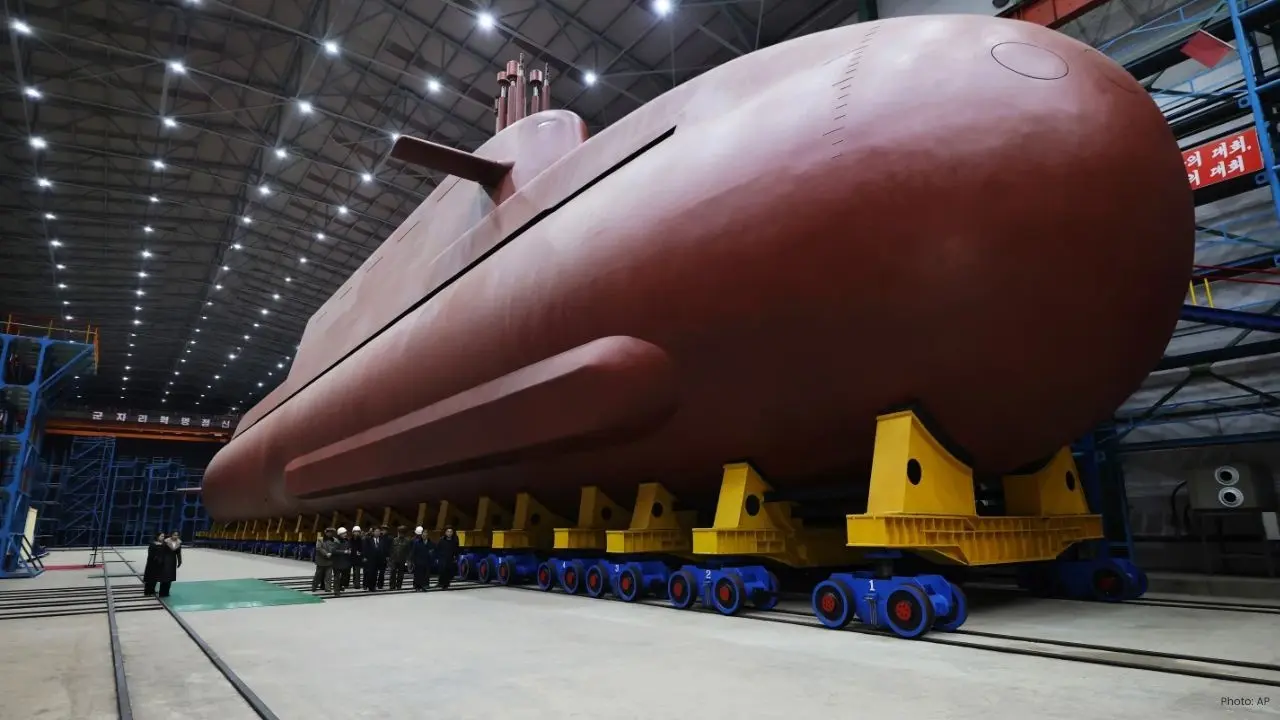
North Korea has unveiled noteworthy advancements in the construction of its inaugural nuclear-powered submarine, a development poised to escalate tensions on the Korean Peninsula.
State media reported that leader Kim Jong Un visited a prominent shipyard to oversee the development of an 8,700-ton-class submarine, heralded as essential to Pyongyang's naval modernization efforts. Images released by the Korean Central News Agency depicted a largely finished hull, providing the most comprehensive public view of the vessel thus far.
The reported submarine is engineered to transport nuclear arms and is designated a “strategic guided missile submarine,” highlighting its role in enhancing North Korea’s nuclear deterrent capabilities. During his visit, Kim vehemently criticized South Korea for pursuing its own submarine program, labeling it an “offensive act” that threatens the North’s national security.
Kim contended that Seoul’s ambitions further necessitate North Korea's acceleration of its nuclear naval capabilities, asserting that the submarine’s completion would signify a significant enhancement in counteracting what he termed as adversarial threats.
Although the specific date of Kim's inspection remains undisclosed, analysts suggest that the released photographs indicate substantial progress on the project. Submarine expert Moon Keun-sik from Hanyang University indicated that conventional construction methods suggest core systems, including engines and possibly the reactor, might have already been integrated.
“The unveiling of the complete hull suggests that the vessel could be on the verge of launch readiness,” Moon remarked, pointing out that sea trials might commence in a few months if construction advances as anticipated.
A nuclear-powered submarine has long been a key military objective for Kim, featuring prominently in a defense strategy unveiled in 2021 that also outlined advancements in solid-fuel intercontinental ballistic missiles and hypersonic technology. North Korea has steadily developed various military capabilities since then and recently introduced a new naval destroyer, which Kim recognized as enhancing the operational reach of the nation’s nuclear arsenal.
Both regional and global observers express skepticism over North Korea’s ability to surmount technical and financial challenges amid stringent sanctions. Some experts speculate that strengthened ties with Russia, particularly in light of its military activities in Ukraine, may have facilitated limited technical aid. Others believe that the reactor design may have stemmed from domestic innovations, potentially supported by foreign assistance.
In parallel, South Korea is pushing forward with its nuclear sub ambitions. President Lee Jae Myung recently sought American support for a nuclear vessel during diplomatic discussions, a venture that has received public backing from U.S. President Donald Trump. Nonetheless, uncertainties linger over the locations for construction and the safeguarding of sensitive reactor technology.
Additionally, North Korean media disclosed that Kim supervised tests of new anti-aircraft missiles, which were subsequently tracked by South Korea’s military. These developments occur amidst deteriorating relations on the peninsula, with Pyongyang continuously rebuffing calls from Seoul and Washington to rekindle stalled denuclearization negotiations.
As both North and South Korea pursue nuclear-powered submarines, experts caution that the strategic equilibrium in Northeast Asia could be entering a precarious new chapter.