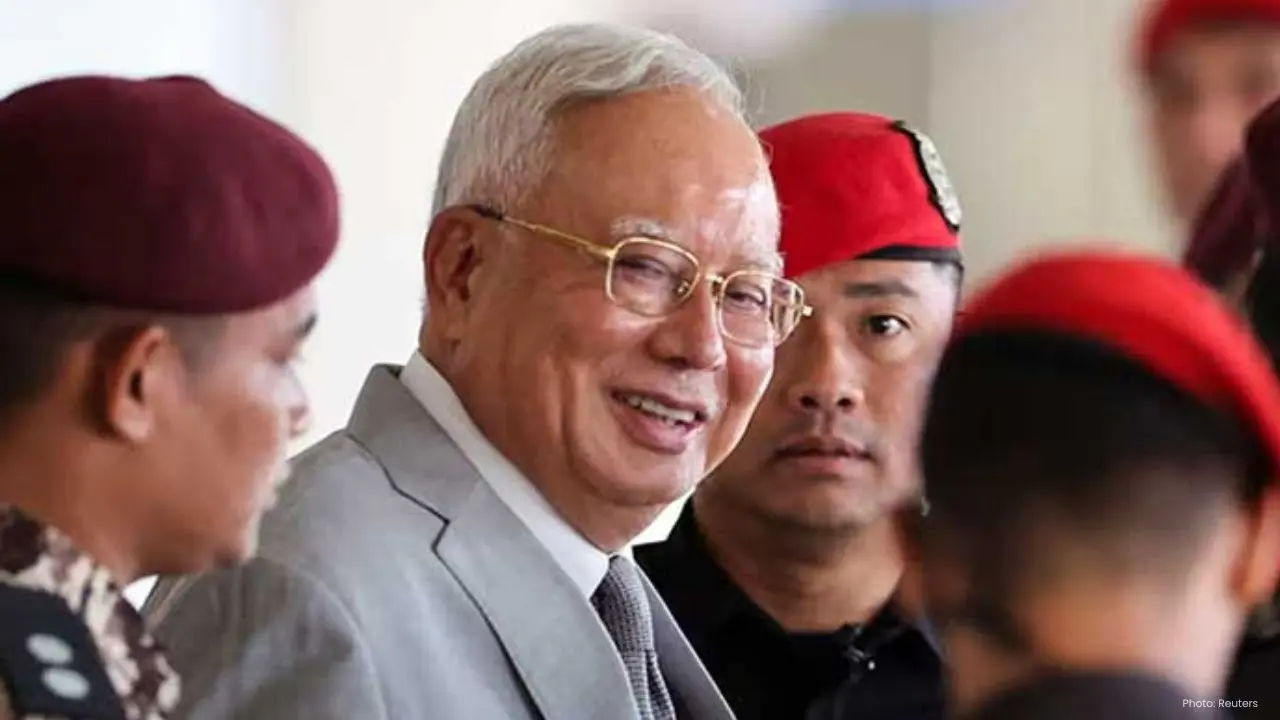
Former Prime Minister of Malaysia, Najib Razak, has been sentenced to a 15-year prison term after being found guilty of abuse of power and money laundering in a high-profile trial associated with the 1Malaysia Development Berhad (1MDB) scandal.
The High Court in Putrajaya delivered the verdict on Friday, concluding a nearly seven-year legal battle that stands as one of Malaysia’s most significant corruption cases ever.
Court Convicts Najib on Multiple Charges
At 72 years old, Najib was convicted on four charges of abuse of power and 21 counts of money laundering. Prosecutors alleged that approximately 2.3 billion Malaysian ringgit (around $569 million) had been illegally transferred from 1MDB into his personal accounts.
His sentence comprises four separate 15-year terms for the abuse of power, alongside an additional five years for each money laundering charge; however, he will serve a total of 15 years concurrently due to Malaysian law.
Najib is currently serving a previous sentence from another related case and has been incarcerated since 2022, marking another significant setback for the former leader.
Legal Proceedings Conclude
The verdict followed a meticulous trial that featured 76 witnesses. Prosecutors illustrated how funds designated for national development were illicitly diverted to private accounts, while the defense maintained that advisors misled Najib into believing the funds were political donations.
Defense attorneys argued that the main culprit behind the fund movement was fugitive financier Jho Low, who has continuously denied any wrongdoing and remains at large.
Nevertheless, the court dismissed these defenses, concluding that Najib, who held the dual roles of prime minister and finance minister, abused his power knowingly.
Request for House Arrest Denied
Earlier this week, Najib’s plea to serve the remainder of his sentence under house arrest was rejected, igniting further agitation among his supporters. On the day of the ruling, crowds gathered outside the courthouse in Putrajaya with placards calling for his release, insisting that his treatment is politically motivated.
Despite these public demonstrations, the court stood firm, emphasizing that the severity of the offenses warranted no leniency.
A Scandal with Global Repercussions
The 1MDB scandal, which emerged over a decade ago, spiraled into a worldwide debacle with estimated losses of $4.5 billion through intricate transactions and shell companies.
International banks, celebrities, and entities like Goldman Sachs became embroiled in the scandal, leading to investigations across various nations. Najib has continually denied personal allegations of receiving hundreds of millions of dollars.
In a separate case in 2020, he was found guilty of 42 million ringgit connected to SRC International, a unit of 1MDB, and sentenced to 12 years—though that term was later reduced.
This current conviction involves an even larger amount reportedly received in 2013. Najib claimed these funds were a donation from the deceased Saudi King Abdullah, a defense ultimately deemed unsubstantiated by the court.
Political Consequences Endure
The fallout from the 1MDB scandal was monumental, resulting in the unexpected defeat of Najib's Barisan Nasional coalition in 2018, thereby ending a 61-year uninterrupted rule post-Malaysia’s independence.
The latest ruling again highlights divisions within Malaysia’s ruling coalition, with Najib’s party, the United Malays National Organisation (UMNO), seeing mixed reactions—some members stand firmly with him while others applaud the court’s accountability measures.
Prime Minister Anwar Ibrahim urged all parties to respect the judiciary and avoid politicizing the ruling, emphasizing the importance of the rule of law.
Diverse Reactions from Society
Anti-corruption advocates heralded the verdict as a significant message to those in authoritative positions. Former lawmaker Tony Pua stated that this decision signals accountability for even the highest-ranking officials.
Conversely, some activists pointed out that Malaysia has much work to do, with systemic reforms lagging and public institutions remaining susceptible. Cynthia Gabriel, head of the Centre to Combat Corruption and Cronyism, noted that issues of grand corruption persist in various forms.
A Key Moment in Malaysian History
With Friday’s ruling, a significant chapter in one of Malaysia’s largest corruption cases has unfolded. While Najib holds on to a loyal following, the continual judicial decisions against him reinforce that power abuse will be met with consequences.
As Malaysia continues to navigate the implications of the 1MDB scandal, this verdict serves as a lasting reminder of its profound effects on the nation's political landscape, institutional integrity, and public faith.