Photo:AFP
Israeli Far‑Right Advocates Vision for a "Gaza Riviera" Amid War and Displacement
A controversial political conference held at the Israeli Knesset in July 2025 sparked international outcry and renewed concern over far-right territorial ambitions. Prominent members of Israel’s far-right coalition, including senior officials and religious nationalists, gathered under the banner "The Riviera in Gaza: From Vision to Reality." Their goal: to advance the idea of turning the Gaza Strip into a luxury coastal enclave exclusively for Jewish settlers. Framed as a bold redevelopment plan, the proposal includes housing, tourism zones, agriculture, and industry—all on land currently home to over two million Palestinians enduring an unrelenting humanitarian catastrophe.
This controversial proposal builds on an earlier vision floated by former U.S. President Donald Trump, who in early 2025 suggested that the Gaza Strip be seized, cleared of its population, and rebuilt as a luxurious seaside resort under U.S. supervision. Trump’s rhetoric served as an accelerant, reigniting long-held ambitions among Israel’s settler movement to reclaim Gaza, which was vacated by Israel during the 2005 disengagement. Now, amid war, chaos, and population displacement in Gaza, members of Israel’s far-right see an opportunity to make that vision reality.
Details of the Proposed Redevelopment Plan
At the core of the “Gaza Riviera” initiative is a redevelopment blueprint designed by Daniella Weiss, a key figure in the Israeli settler movement and former mayor of Kedumim, a West Bank settlement. The plan outlines the construction of massive residential communities intended to house up to 1.2 million Israeli Jews, sprawling tourist resorts along the Mediterranean coastline, agriculture zones, and high-tech industrial areas.
Weiss and her allies claim the plan is not just about development—it is a spiritual and historical reclamation. They argue that Jewish history in the area predates Palestinian claims and that Israel’s 2005 withdrawal from Gaza was a historical mistake. With Gaza in ruins and a large portion of its civilian population displaced internally or trapped in the southern border city of Rafah, these proponents see an opening for irreversible demographic change.
Speakers at the Knesset conference stressed the idea that Gaza must never again be a base for attacks against Israel, referencing the October 7, 2023, Hamas incursion that resulted in a devastating Israeli military campaign. They believe permanent Israeli control and Jewish settlement are the only guarantees of security.
The Trump Influence: Ideological and Tactical Inspiration
Donald Trump’s off-the-cuff comments in early 2025 about Gaza being transformed into a Riviera with luxury hotels, palm trees, and golf courses initially drew ridicule. However, for Israel’s hardliners, the idea was more than a quip. Trump proposed that the U.S. could administer Gaza temporarily, remove its residents to neighboring Arab countries, and rebuild it for “economic opportunity.”
Though condemned by international human rights organizations as ethnic cleansing, Trump’s suggestion was rapidly adopted by elements of the Israeli far-right, who saw in it both strategic legitimacy and global attention. The “Riviera in Gaza” event explicitly cited Trump’s concept, with posters, speeches, and presentations borrowing from his language.
In the context of Israeli domestic politics, Trump’s popularity among nationalist voters adds weight to his statements. Israeli politicians often invoke his name when promoting controversial policies, using his rhetoric to broaden the Overton window and legitimize what were once fringe positions.
Settler Movement Resurgence and Expansionist Ideology
The idea of reestablishing Jewish settlements in Gaza is not new. Before Israel’s disengagement in 2005, over 8,000 Jewish settlers lived in 21 settlements within the strip. The withdrawal, implemented under then-Prime Minister Ariel Sharon, was met with fierce resistance from the settler movement, which viewed it as a betrayal of Jewish sovereignty.
Since the October 2023 Hamas attacks and subsequent military escalation, the settler movement has been reinvigorated. Leaders now argue that the devastation of Gaza presents a once-in-a-lifetime chance to “correct” the disengagement and restore Jewish life there. Some have even declared Gaza to be “liberated land,” echoing language typically reserved for contested territories in the West Bank.
This ideological framework is grounded in a vision of Greater Israel—a theological and nationalist belief that all land between the Jordan River and the Mediterranean belongs to the Jewish people. Proponents often quote Biblical scripture to justify settlement, claiming divine mandate overrides international law or Palestinian claims.
A Plan Igniting Domestic and Global Controversy
The Knesset conference drew harsh criticism from Israel’s opposition leaders, civil society organizations, and international observers. Critics labeled the proposed Gaza Riviera project a blatant attempt at ethnic cleansing and settler colonialism. The idea of replacing a war-torn Palestinian society with luxury hotels and Jewish-only residential areas was seen by many as morally repugnant and legally indefensible.
Human rights groups accused the organizers of promoting war crimes under the Geneva Conventions, specifically the forced displacement of civilians and the transfer of an occupying power’s population into occupied territory. Palestinian officials described the plan as a “declaration of annihilation,” accusing Israel of exploiting the war to erase the Palestinian national presence in Gaza permanently.
The proposal also triggered concerns in Washington and European capitals. Though Trump is no longer in office, his endorsement of the idea complicated U.S. diplomatic messaging, especially among Arab allies. Several members of the U.S. Congress condemned the proposal and warned that any such moves would jeopardize peace prospects, fuel regional instability, and violate international law.
Israeli Government Ambiguity and Mixed Messaging
While figures like Bezalel Smotrich and National Security Minister Itamar Ben-Gvir vocally supported the vision of Israeli redevelopment in Gaza, Prime Minister Benjamin Netanyahu maintained ambiguity. Although he did not attend the conference, he has made statements in recent months suggesting that Gaza should never again be allowed to govern itself. His repeated declarations that “there is no partner for peace” and that “Gaza must be demilitarized and neutralized” hint at openness to long-term Israeli control, even if not explicitly supporting settlement.
Netanyahu’s reluctance to endorse the full Gaza Riviera plan may stem from international pressure and fear of diplomatic fallout. Still, critics argue that his government, which includes the very ministers advocating settlement, is enabling these ideas to proliferate unchecked.
Evictions, Displacement, and the Ground Reality in Gaza
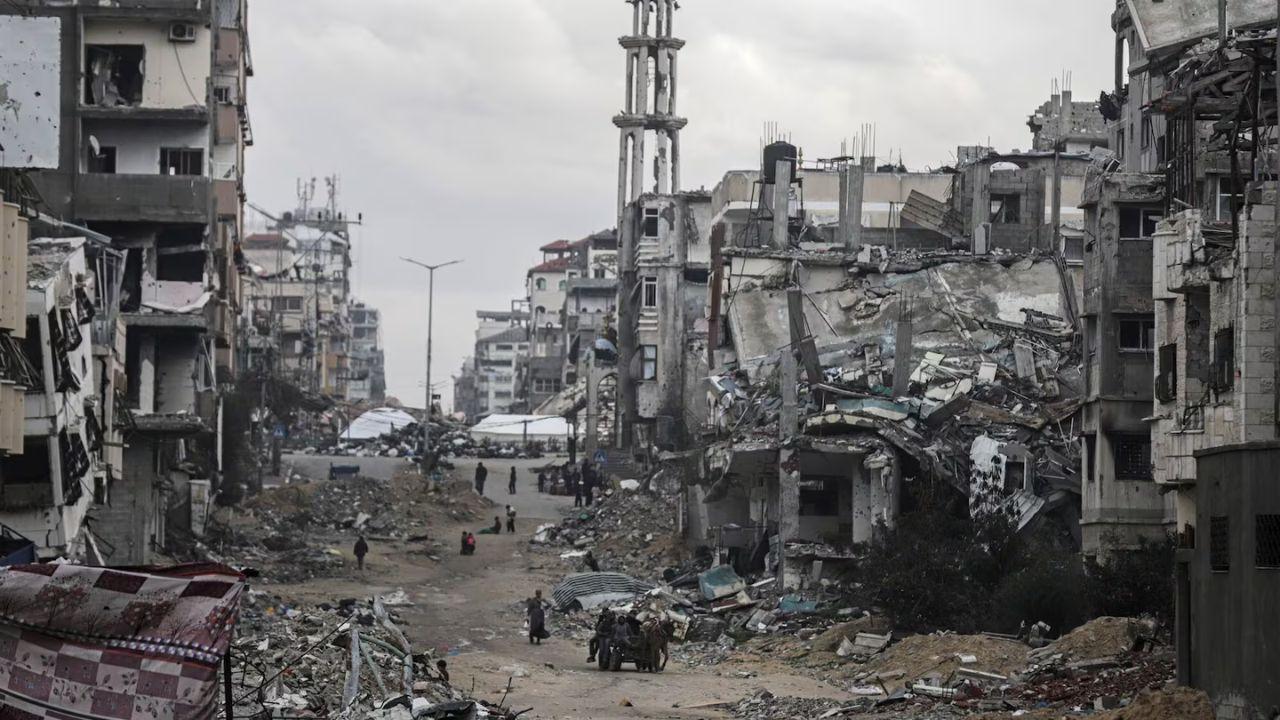
On the ground, Gaza continues to endure one of the most intense humanitarian crises in modern history. More than two million Palestinians remain trapped, displaced, or injured in the aftermath of months of Israeli bombardment and siege. Access to food, water, fuel, and medical aid remains critically low. Tens of thousands of civilians have been killed, and large swaths of Gaza City, Khan Younis, and Rafah have been reduced to rubble.
In this context, a plan to construct high-end resorts, upscale housing, and tourist beaches appears not only surreal but deeply provocative. Observers say the timing of the announcement—amid war and starvation—suggests the plan may serve as psychological warfare or propaganda to demoralize Palestinians and signal the erasure of their homeland.
Several displaced Palestinians have responded with despair, saying that the idea of Israelis living in luxury on the ruins of their homes would be the final insult in a long line of dispossessions.
A Colonial Playbook or Economic Promise?
Proponents of the Gaza Riviera argue that the redevelopment plan could bring stability, economic growth, and long-term peace. They compare it to the development of Tel Aviv or Eilat, claiming that once Gaza is cleared of Hamas and “reconstructed properly,” it can become an economic engine for the region. These arguments echo settler claims in the West Bank that Israeli presence improves security and infrastructure.
Critics call this the colonial playbook repackaged in modern language. They point to similar tactics used historically: destruction followed by reconstruction under the auspices of the occupying power, leading to permanent displacement of the native population. The use of economic incentives, critics say, does not negate the illegality of population transfer or the violation of human rights.
International experts stress that true reconstruction cannot happen without justice and consent. Rebuilding Gaza as a Riviera for another people, while denying return to its indigenous population, is not peace—it’s appropriation.
Global Response and the Risks Ahead
The plan has triggered reactions from across the globe. United Nations representatives expressed alarm, reiterating that any attempt to transfer populations or annex occupied territory is a breach of international law. Arab nations warned that such ambitions would lead to uncontrollable regional unrest and push peace further out of reach.
Egypt and Jordan, long considered intermediaries in Israeli-Palestinian relations, expressed deep concern about the signals such conferences send. Turkish and Iranian officials condemned the idea as “genocidal.” Even some of Israel’s Western allies privately expressed anxiety that the plan could backfire diplomatically and deepen Israel’s isolation.
Analysts warn that these ambitions, even if not implemented immediately, reflect the growing normalization of radical ideas in Israeli policymaking circles. By allowing such discussions to occur in the national legislature, the Israeli state risks legitimizing what were once considered extremist positions.
Between Vision and Violation
The “Riviera in Gaza” plan reflects a broader shift in Israeli political discourse—away from peace negotiations and toward unilateral domination. It repackages colonial expansion in the language of economic development and security while ignoring the rights and humanity of those already living on the land.
Whether the plan is symbolic or actionable remains to be seen. But the fact that it is being debated at the highest levels of Israeli politics, while Gaza’s residents continue to suffer, marks a dangerous new phase in the conflict.
For many Palestinians and their supporters, the message is clear: this is not about coexistence—it is about replacement. The dream of a “Gaza Riviera” may one day be remembered not as an urban development plan, but as a symbol of erasure.