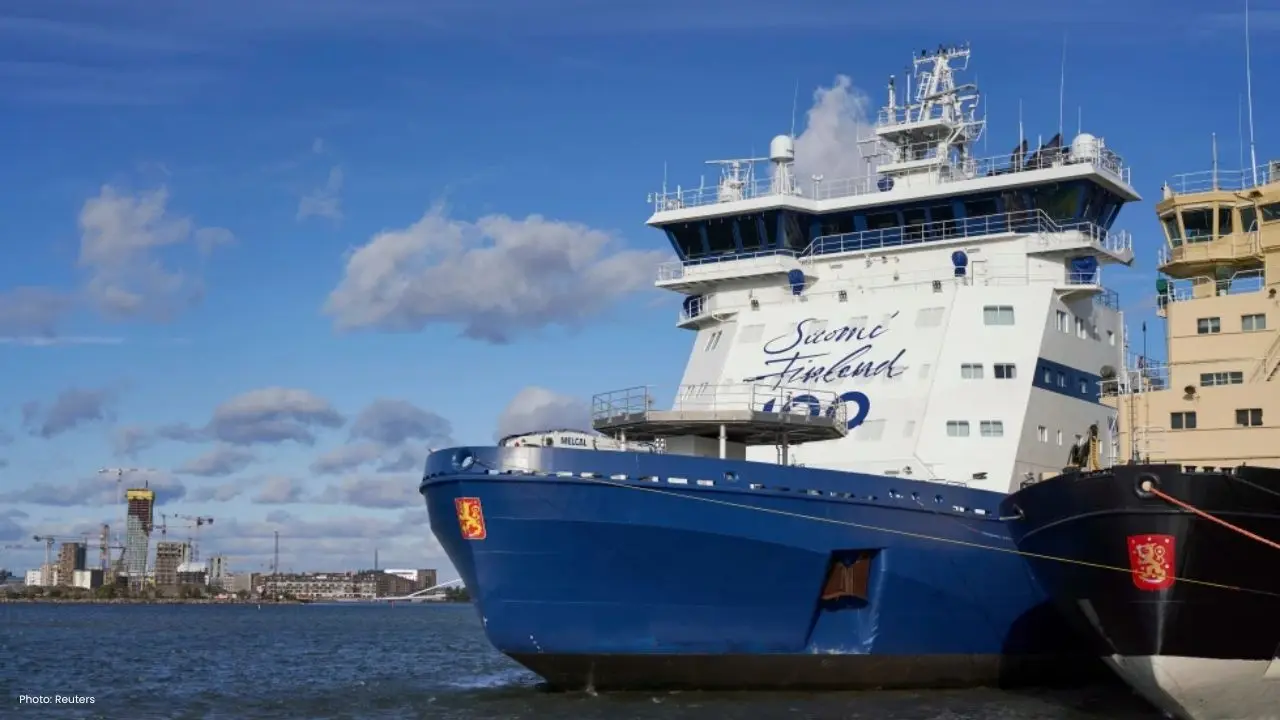
While discussions about Greenland often focus on political maneuvers, a more pressing issue for American, NATO, and European goals is the harsh Arctic ice.
The thick and shifting ice obstructs harbors, isolates coastlines, and conceals mineral resources, transforming surrounding waters into hazardous zones for navigation. To effectively traverse the waters around Greenland, one essential component is needed: icebreakers.
These enormous, sturdily constructed vessels are designed to break through frozen seas, crafting narrow passages that standard ships cannot manage. However, as the Arctic becomes increasingly vital for global security and resources, the United States finds itself critically lacking in these essential ships.
The U.S.'s Shortage of Icebreakers
At present, the U.S. boasts only three icebreakers, one of which is outdated and barely operational. In contrast, Russia has nearly 100 ice-capable vessels, including several nuclear-powered ships. Canada is augmenting its fleet to around 50, while China already exceeds the U.S. in icebreakers and is rapidly expanding its capabilities.
Washington has engaged in contracts to produce 11 new icebreakers, but even under the best-case scenario, these vessels will take years to be operational.
"If the U.S. aimed to transport significant resources to Greenland tomorrow, a two- to three-year period would impede access to the island around the clock," commented Alberto Rizzi from the European Council on Foreign Relations.
"On a map, Greenland appears to be encompassed by water. Yet, in reality, it is encircled by ice."
Strategic Importance of Greenland
U.S. President Donald Trump has consistently emphasized Greenland’s significance to American security and economic strategies. The island is positioned at an essential Arctic intersection and contains vast reserves of critical minerals, including rare earth elements vital for modern technology and defense systems.
During a recent address at the World Economic Forum in Davos, Trump asserted that accessing these minerals would entail drilling through "hundreds of feet of ice."
Nonetheless, experts argue that achieving this is unattainable without a dependable fleet of icebreakers to facilitate supply routes, support mining endeavors, and secure military sites.
Even ambitious defense initiatives, like the proposed $175 billion "Golden Dome" missile defense project, would struggle to be constructed or sustained without continuous Arctic access.
Limited Manufacturers of Icebreakers
The U.S. faces constraints when it comes to acquiring more icebreakers. Only a few nations, including Russia, China, Canada, and Finland, possess the expertise for designing and manufacturing these vessels.
Finland stands out as a prominent player, having built approximately 60% of the world’s icebreakers and designed nearly half of the remainder. This specialization stems from decades of operations in the icy Baltic Sea.
"These are highly specialized capabilities," Rizzi observed. "Finland turned necessity into strategic economic leverage."
Canada plays a pivotal role in this area, while China is increasingly developing its own advanced polar fleet.
The Ice Pact and Cooperation Challenges
During Trump’s administration, icebreaker construction was prioritized, a focus that continued under President Joe Biden through the Ice PACT collaboration with Canada and Finland.
As part of this agreement, plans are in place for 11 new icebreakers, with four to be constructed in Finland, and the rest to be built at shipyards in the U.S. and Canada, utilizing Finnish designs.
However, diplomatic strains related to Greenland and trade disputes have rendered cooperation politically precarious, even as experts maintain that the U.S. has no viable alternatives.
"Cooperation is essential in making this feasible," remarked Sophie Arts from the German Marshall Fund. "The U.S. currently lacks a pathway to achieve this independently."
The Financial Burden of Arctic Aspirations
Even with a robust icebreaker fleet, transforming Greenland into a significant mining or military center would entail enormous expenses. Infrastructure must be developed under some of the most severe conditions on the planet, with ROI potentially taking decades.
"Everything incurs higher costs in the Arctic—transportation, construction, maintenance, and security," Arctic specialist Marc Lanteigne noted. "Progress in this environment is slow."
Nonetheless, Denmark and other European allies have shown willingness for deeper collaboration, provided their sovereignty is respected.
Danish Prime Minister Mette Frederiksen expressed her support for enhanced Arctic security, including U.S.-led efforts, “as long as it respects our territorial integrity.”
Control Over Arctic Access
In spite of all the political rhetoric, one undeniable truth remains: Europe, particularly Finland, currently possesses the technical know-how to facilitate Arctic access.
Ursula von der Leyen, the President of the European Commission, emphasized this point recently, indicating that Finland is now supplying icebreakers to the U.S.
"This illustrates that Arctic security can only be attained collaboratively," she stated.
Following an emergency summit in Brussels, the European Union also announced increased defense investments in Greenland, including new icebreakers.
The Stark Reality
Absent a state-of-the-art icebreaker fleet, U.S. ambitions in Greenland remain largely hypothetical.
Minerals cannot be extracted, military bases cannot be reliably supplied, and power cannot be effectively exerted.
Ultimately, in the Arctic, resources like steel and engines are far more impactful than political declarations—and, for now, the U.S. is years away from amassing adequate supplies of either.