Photo:reddit
Hijacked Cessna Triggers Ground Stop at Vancouver Airport
On July 15, 2025, a highly unusual and concerning incident unfolded at Vancouver International Airport (YVR), one of Canada’s busiest and most secure travel hubs. A small Cessna 172 aircraft, allegedly hijacked from a flying club in Victoria, made an unauthorized landing at YVR, causing an emergency response, a full ground stop, and significant delays and diversions for both domestic and international flights.
The event shook travelers, disrupted dozens of flight paths, and exposed vulnerabilities in aviation security, particularly concerning small aircraft operations. Over the course of several tense minutes, law enforcement agencies coordinated swiftly to respond, intercept, and neutralize the potential threat. While the situation was resolved without injuries or further escalation, it raised serious questions about airport security, airspace regulation, and the preparedness of authorities to deal with unexpected aerial intrusions.
Aircraft Involved and Origin of the Incident
The aircraft at the center of the incident was a Cessna 172 Skyhawk, a small four-seat, single-engine aircraft often used for pilot training and personal recreational flying. It was reportedly taken without permission from a flight school in Victoria, British Columbia. The pilot, whose identity was not immediately revealed, did not file a flight plan nor maintain communication with air traffic control as required when entering controlled airspace.
As the Cessna departed from its initial location, its behavior began to raise alarms. The aircraft’s erratic flight pattern, lack of communication, and approach toward Vancouver International Airport prompted concerns from air traffic controllers. Given that small aircraft are not equipped with the same level of surveillance systems as commercial jets, the situation rapidly evolved into a potentially dangerous event.
Ground Stop and Immediate Airport Disruption
At approximately 1:10 p.m. Pacific Time, the Cessna entered the airspace near Vancouver International Airport. Within minutes, air traffic control recognized that the plane was uncommunicative and unauthorized to be in the vicinity of a major international airport. In response, a full ground stop was issued to halt all arriving flights, a rare measure indicating the seriousness of the threat.
The ground stop lasted approximately 39 minutes. During that time, incoming aircraft were diverted to alternate airports including Victoria, Abbotsford, Comox, Calgary, and even Seattle. Outbound flights were held on the tarmac. Some passengers onboard waiting planes captured videos showing police vehicles racing across the runway and tactical units being deployed.
This rapid escalation in activity at the airport left travelers inside terminals and on planes confused and concerned. Passengers shared accounts of delayed departures, grounded flights, and uncertainty about the nature of the emergency unfolding just outside their windows. The airport's public address system advised caution and reassured passengers that safety procedures were in place.
Arrest and Law Enforcement Operation
As the Cessna approached the airport, law enforcement agencies sprang into coordinated action. Richmond RCMP, the Lower Mainland Integrated Emergency Response Team, and airport security were all mobilized. With armed officers stationed across critical zones of the airport, the priority was to prevent the aircraft from endangering commercial traffic or civilians.
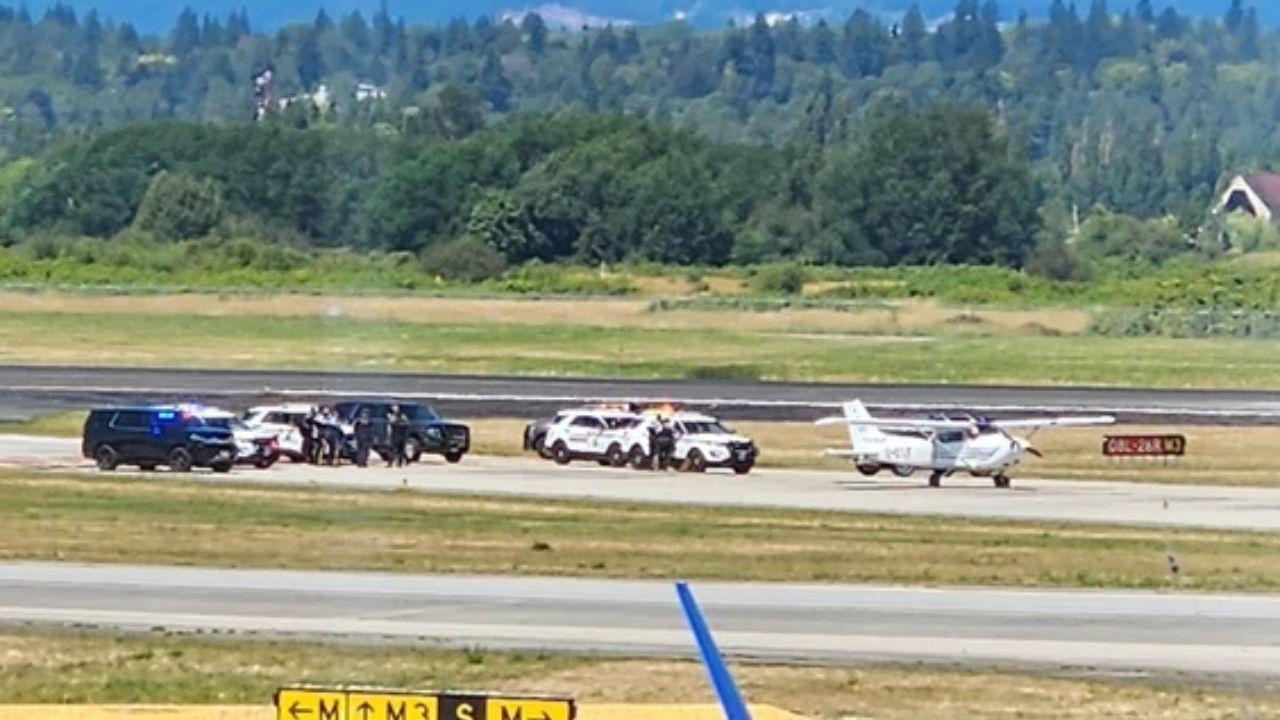
The pilot of the Cessna landed safely on one of YVR’s runways around 1:45 p.m. RCMP officers approached the aircraft cautiously. According to witnesses, police vehicles surrounded the plane, and officers ordered the pilot to exit. The individual complied, walked backward from the aircraft, and was arrested without further incident. No weapons were found, and no injuries were reported during the arrest or landing.
Authorities have yet to confirm whether the incident was a result of mental illness, a deliberate security breach, or a misguided flight. An investigation is ongoing to determine the suspect’s intent, possible affiliations, and how access to the aircraft was obtained. Initial reports suggest the plane may have been taken from a flight school without formal authorization or a scheduled purpose.
Impact on Flights and Passenger Experience
The temporary closure of the airport’s runways had immediate repercussions on air travel. At least nine incoming flights were diverted mid-route, leading to schedule disruptions that rippled across the region. Travelers heading to Vancouver from both domestic and international locations faced delays, cancellations, and in some cases, forced overnight stays at alternate airports.
Departing flights were also impacted, as aircraft scheduled to take off had to remain parked on the tarmac until the ground stop was lifted. Passengers described scenes of frustration and anxiety as they waited inside stationary planes, watching police activity unfold nearby. Airport screens showed flight statuses rapidly changing, and announcements were made to keep travelers informed as the situation developed.
Once the threat was neutralized and the suspect was in custody, the ground stop was lifted around 2:09 p.m. While normal flight operations resumed shortly thereafter, it took hours for the airport to recover from the backlog of delayed departures and diversions. Some travelers missed connecting flights, while others had to rebook journeys altogether.
Public Reaction and Eyewitness Reports
Social media played a significant role in providing real-time updates during the incident. Videos and posts from passengers, airport staff, and nearby residents depicted the unusual scene of a small aircraft landing unannounced, followed by an intense police response. One widely shared video showed a traveler capturing footage of the Cessna surrounded by police vehicles and officers with weapons drawn.
Many expressed gratitude for the swift law enforcement response but were equally concerned about how a rogue aircraft could enter restricted airspace and reach the runway without being intercepted earlier. Several travelers and aviation experts commented on the need for more stringent controls and better integration of private aircraft into national airspace security frameworks.
Security Implications and Aviation Safety Discussion
This incident has sparked renewed discussions on the vulnerabilities within the general aviation sector. Unlike commercial airliners, small private aircraft operate with fewer restrictions and less surveillance. While they serve important roles in training, tourism, and recreation, their accessibility makes them susceptible to unauthorized use.
Experts argue that Canada’s air traffic control systems and aviation regulations are robust, but events like this expose gaps in enforcement and response. Suggestions for improvement include enhanced screening of small aircraft operators, better communication technology for general aviation, and stricter policies on unauthorized departures.
Additionally, there are calls for implementing real-time aircraft tracking systems that could flag unusual behavior or non-communication earlier in flight. Aviation regulators may also consider updating regulations around aircraft key access, transponder requirements, and flight plan filings to reduce the chances of similar incidents occurring.
Airport and Government Response
Vancouver International Airport issued a statement shortly after the incident assuring the public that the situation was under control and thanking emergency responders for their quick action. The airport emphasized that passenger safety remained the top priority throughout the event and that all affected travelers would receive support and guidance regarding rebookings or changes to their itineraries.
Government officials, including representatives from Transport Canada and the RCMP, acknowledged the seriousness of the incident and promised a thorough investigation. The federal aviation authority is expected to conduct a full review of the flight’s origin, the nature of the airspace breach, and the law enforcement response to determine whether protocol changes are necessary.
Psychological Impact and Mental Health Considerations
While no physical harm occurred, the psychological effects on passengers, airport workers, and even responding officers should not be underestimated. Events involving perceived threats to aviation security often trigger emotional stress, fear, and trauma, even in the absence of violence.
It is not yet known whether the individual piloting the Cessna had any mental health history. However, incidents like these raise broader concerns about mental health screening and access to aircraft. Authorities may consider reviewing pilot certification processes and implementing better support systems for flight school students or recreational pilots experiencing emotional distress.
Lessons Learned and the Road Ahead
This incident, though resolved safely, serves as a critical learning opportunity for Canadian aviation authorities. It underscores the importance of constant vigilance, rapid response coordination, and robust air traffic monitoring. It also highlights how even non-commercial aircraft can pose serious challenges to airport security and flight operations.
The coordination between RCMP, airport security, and air traffic control was commendable. However, improvements can still be made in early detection, passenger communication during emergencies, and securing private aircraft to prevent unauthorized use. Airports and governments must continue working together to ensure that even small-scale aerial threats are addressed swiftly and effectively.
Conclusion
The hijacking of a Cessna 172 and its unauthorized landing at Vancouver International Airport on July 15, 2025, was a wake-up call for the aviation industry and security agencies. The incident disrupted travel, exposed gaps in current protocols, and reminded the public that even small aircraft can have major implications when misused.
Thanks to the rapid response of law enforcement and airport staff, a potential crisis was contained without casualties. Moving forward, policy changes, security enhancements, and better communication systems are likely to follow. For travelers, the event was a sobering reminder of how quickly normal operations can be upended by unexpected threats—but also a testament to the power of well-coordinated emergency management when it matters most.