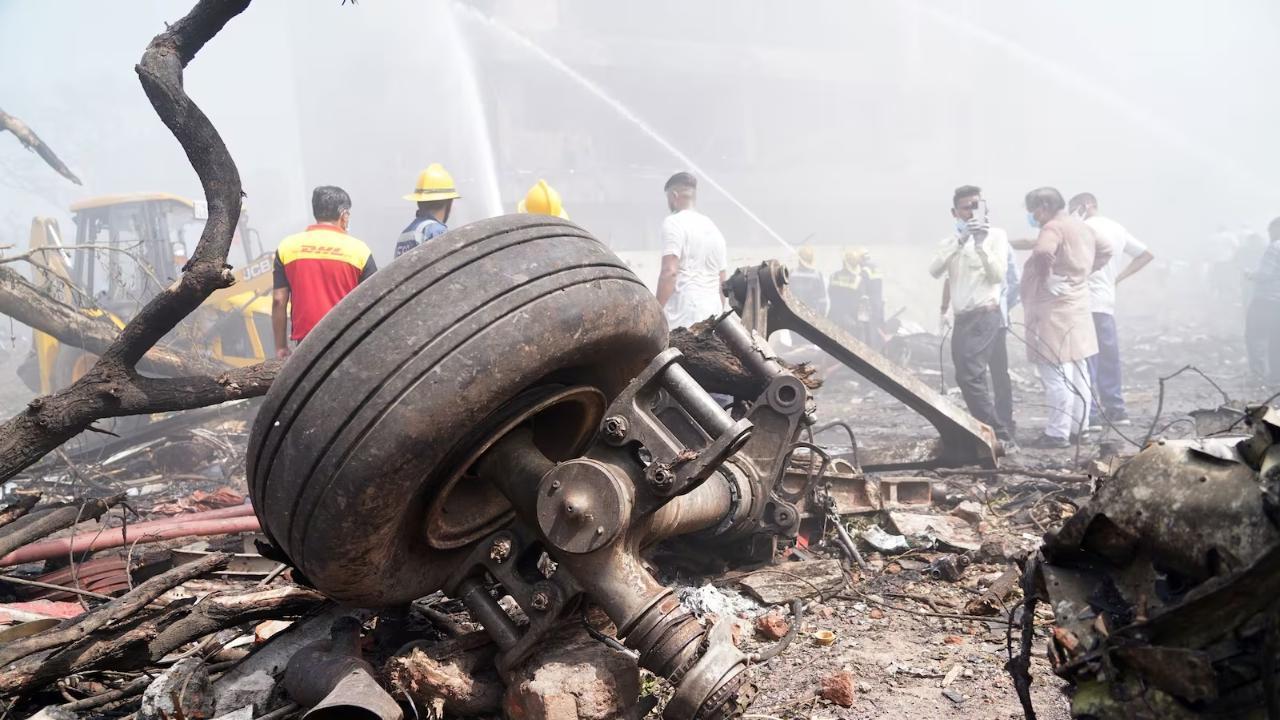
Photo:reuters
Catastrophic Failure After Takeoff: The Air India AI 171 Tragedy
In what is shaping up to be one of India’s most mysterious and technically baffling aviation disasters, Air India Flight AI 171 crashed just 29 seconds after takeoff on June 12, 2025. The Boeing 787 Dreamliner plunged into a residential structure moments after becoming airborne from Ahmedabad Airport, en route to London Gatwick. A preliminary report from India’s Aircraft Accident Investigation Bureau (AAIB) has revealed a chilling and perplexing cause: both engine fuel control switches had been flipped to the “CUTOFF” position immediately after liftoff.
A Deadly Drop: Timeline of the Final 29 Seconds
The sequence of events, as revealed in the preliminary findings, is both swift and shocking. The aircraft began its takeoff roll without incident, accelerating normally along the runway. Just seconds after rotation, both engines—GE GEnx-1B turbofans—lost power. Flight data shows that the engine fuel supply switches were moved from “RUN” to “CUTOFF” three seconds after liftoff, causing both engines to flame out. At this point, the aircraft was only a few hundred feet above ground level and moving at approximately 180 knots.
At second 10 of the flight, the pilots attempted to restart the engines. Engine 1 began to spool up, but Engine 2 never regained sufficient N2 core speed to relight. The cockpit voice recorder captured the pilots in a panicked exchange, questioning why the engines had been shut down. With no engine thrust, the Dreamliner could not maintain flight. It crashed into a hostel facility adjacent to a medical college just 29 seconds after takeoff.
The Aircraft and Crew: Fully Certified and Recently Inspected
The Boeing 787-8 involved had been delivered to Air India in 2018 and had accumulated just over 41,000 hours of flight time. It had undergone routine maintenance checks in April 2025, and no anomalies were recorded in the aircraft logbooks.
Captain Sumeet Sabharwal, 56, had over 15,600 hours of flight experience, including 4,300 hours on the Boeing 787. His first officer, Clive Kunder, 32, had approximately 3,400 hours in total with just over 1,100 on the Dreamliner. Both were considered competent and well-trained, according to Air India records.
Passenger List and Human Toll
There were 242 passengers and crew onboard, representing several nationalities, including citizens of India, the United Kingdom, Portugal, and Canada. Tragically, 241 of them perished. Nineteen additional casualties were reported on the ground as the aircraft impacted a multi-story dormitory. Only one passenger, Vishwash Kumar Ramesh, miraculously survived the incident after being ejected near the rear of the fuselage.
Critical Evidence: The Fuel Control Switches
The heart of the investigation centers on the fuel control switches located on the throttle quadrant. These switches are not meant to be tampered with during flight. Moving them to “CUTOFF” while airborne is equivalent to turning off an engine’s fuel supply entirely—a maneuver reserved only for emergencies like an in-flight fire.
Investigators determined that both switches were moved within a second of each other. This raises a highly disturbing possibility: either one pilot deliberately shut off both engines or there was an exceptionally rare mechanical or electrical failure.
Cockpit Dynamics: “Why Did You Cut Off?”
According to the voice recorder, one of the pilots exclaimed, “Why did you cut off?” immediately after the engines failed. The other replied, “I didn’t.” The exact identity of who said what is under scrutiny, but this exchange indicates clear confusion in the cockpit.
Aviation experts are now analyzing whether this reflects:
-
A sabotage attempt or deliberate action by one of the pilots.
-
An accidental misconfiguration of controls.
-
Or an as-yet-unknown electrical anomaly or software fault.
Boeing 787’s Fuel System: Not Easily Misused
The Boeing 787 Dreamliner is engineered to prevent accidental activation of critical engine functions. The fuel switches are guarded and spring-loaded to prevent movement unless lifted and deliberately pulled. Analysts have stated that the switches require deliberate action by either pilot and cannot be accidentally brushed or bumped into the “CUTOFF” position.
Moreover, both switches are positioned inches apart and must be activated independently. That both were flipped within seconds of each other further implies a coordinated or deliberate act rather than a mere mistake.
The Possibility of Intentional Shutdown
Investigators have not yet officially labeled the event as a suicide or sabotage attempt, but multiple red flags have triggered concern. While no suicide note or pre-crash anomalies were found in pilot behavior, parallels are being drawn with past incidents involving intentional acts, such as:
-
Germanwings Flight 9525 (2015), where a pilot deliberately crashed the plane.
-
EgyptAir Flight 990 (1999), where an intentional dive was suspected.
However, AI 171 differs in that there was no sudden dive or autopilot reprogramming. Instead, it involved direct manipulation of manual engine fuel controls.
Mechanical Failure or Design Flaw?
While human factors are a key investigative focus, the possibility of a mechanical defect or electrical anomaly cannot be dismissed. The FAA has previously issued bulletins about faulty locking mechanisms in some Boeing fuel switches, though none were deemed dangerous enough to warrant fleet-wide grounding.
Some aviation engineers have pointed to the aircraft’s Electronic Engine Control (EEC) systems, which interface with the fuel control units. A software error could, in theory, relay incorrect commands. However, Boeing and General Electric have both stated that no such anomaly has ever caused a dual engine flame-out during takeoff.
Eyewitness Reports and Ground Impact
Eyewitnesses near the airport described a horrifying spectacle. The aircraft reportedly climbed steeply before appearing to stall mid-air, banking left and then crashing nose-first into a building.
First responders arrived within minutes, but the fuselage had already erupted in flames. Recovery efforts were hampered by burning aviation fuel and debris. The flight data recorders were found buried within the wreckage but were still recoverable and legible.
Survivor’s Testimony: A Miracle Amid Tragedy
The only survivor, Vishwash Kumar Ramesh, has since been hospitalized with multiple injuries. According to initial reports, Ramesh had unfastened his seatbelt seconds before the crash and was near the rear galley when the impact occurred. He was thrown clear of the wreckage into a muddy field, likely cushioning the blow.
Doctors have confirmed that he suffered broken ribs, a fractured femur, and mild burns but remains stable. His survival has reignited discussions about rear cabin safety and crash survivability.
Air India’s Response and Operational Review
Air India has suspended all Dreamliner operations pending further inspection. Over 20 Boeing 787 aircraft are undergoing detailed maintenance checks, especially focusing on fuel control systems and EEC software logic.
The airline’s CEO stated, “We are deeply shaken. Nothing is more important than the lives lost. We will fully cooperate with AAIB and international experts.”
Regulatory Involvement and International Oversight
Due to the aircraft being a U.S.-manufactured Boeing product and the engines made by GE, the U.S. National Transportation Safety Board (NTSB), Federal Aviation Administration (FAA), and representatives from Boeing and GE are all collaborating with India’s AAIB.
The NTSB has assigned an investigator-in-charge to oversee all U.S.-based components involved in the analysis. FAA authorities are already reviewing maintenance records and crew licensing documentation.
Global Aviation Community Reacts
Aviation professionals and safety bodies around the world have responded with urgency. Airlines operating Boeing 787s have been advised to conduct internal reviews of cockpit protocols and switch functionality. Though no fleet-wide grounding has been announced, a “precautionary advisory” has been issued regarding the integrity of fuel control mechanisms.
Pilot Mental Health and Behavioral Screening
The incident has also brought renewed scrutiny to how airlines assess pilot mental health and behavioral patterns. In many recent tragedies, undiagnosed or hidden psychological issues played a role. Air India, like many global carriers, uses periodic psychometric screening—but many experts argue it's insufficient.
Some voices within the industry are now advocating for:
-
Real-time monitoring of abnormal cockpit switch inputs
-
Automated alerts when manual overrides are initiated at unusual phases of flight
-
Peer-based mental health support systems for pilots
Aircraft Automation vs. Manual Override Dangers
The Dreamliner is a highly automated aircraft, yet the crash shows that manual override capabilities—while essential—can also be a weak link. The balance between automation and human control continues to challenge designers.
Aviation designers now face fresh pressure to create additional safeguards preventing catastrophic consequences from a single pilot’s actions. Ideas include requiring dual confirmation for fuel cutoff activation or installing voice-command blocking protocols.
Training, SOPs, and Simulation
This incident could revolutionize how Standard Operating Procedures (SOPs) are taught. Many training institutions now face pressure to simulate dual engine failure immediately after takeoff—a rarely practiced emergency. Airlines may incorporate this case into simulator training to improve reaction time and engine relight procedures.
Final Report Awaited
India’s AAIB has stated that a full report is expected within 90 days. The investigation will include toxicology reports, pilot medical histories, cockpit psychology profiling, flight simulation recreation, and exhaustive mechanical testing of the fuel control systems.
Only once the final report is published will the true cause—be it technical, psychological, procedural, or criminal—be confirmed.
Conclusion: A Stark Reminder of Aviation’s Fragility
Air India Flight AI 171’s crash serves as a tragic reminder that even the most advanced aircraft can suffer catastrophic failure from a simple, inexplicable act—be it human error, equipment fault, or intentional sabotage.
The 29 seconds of airborne time have triggered global conversations about pilot authority, system design, and human oversight in increasingly automated cockpits.
As families mourn, and regulators examine every second of that flight, the aviation world waits, committed to ensuring such an incident never repeats.