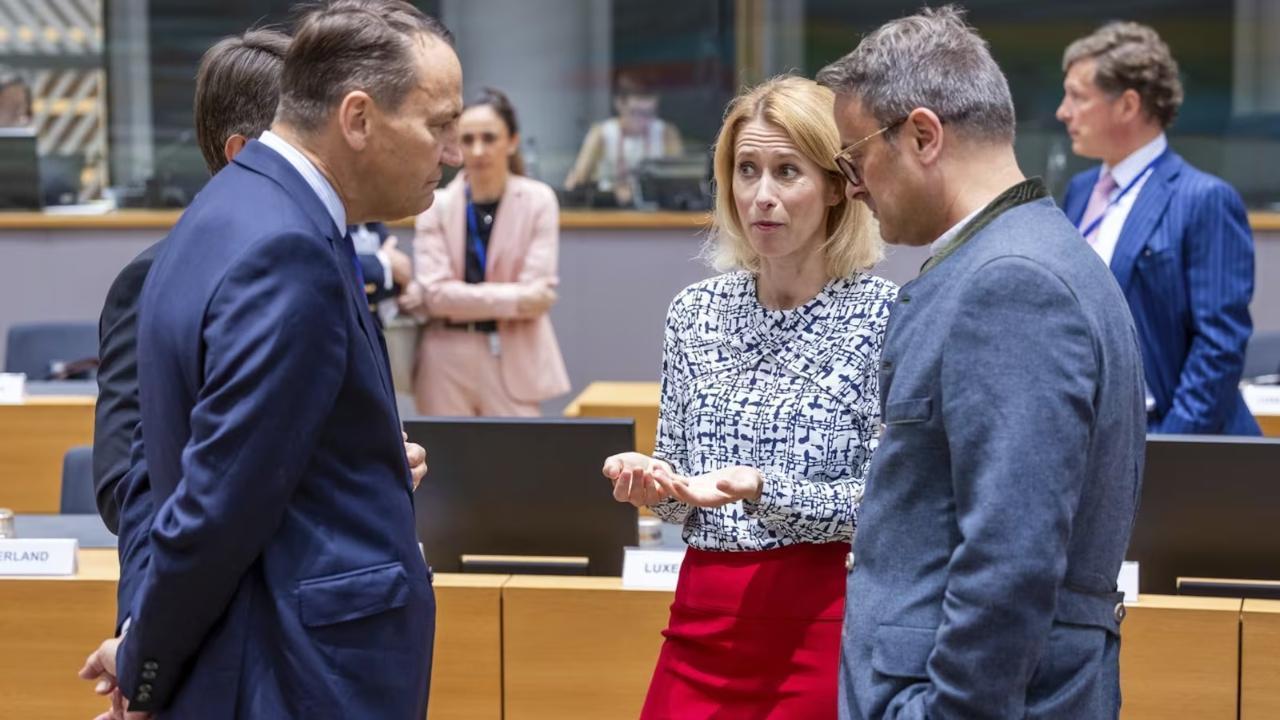
Photo:AP
EU Ministers Demand Transparency from Israel Over Gaza Humanitarian Deal Amid Escalating Crisis
The European Union is intensifying diplomatic pressure on Israel to provide greater clarity and accountability regarding a newly announced humanitarian agreement intended to increase aid to Gaza. The move comes as EU ministers raise urgent concerns about the deteriorating conditions in the besieged enclave, now in its 21st month of war. At the heart of the criticism is the perceived gap between Israel’s public commitments and the actual aid reaching Gazan civilians, many of whom are on the brink of starvation and lack access to basic healthcare, clean water, and shelter.
During a high-stakes ministerial meeting in Brussels, EU foreign ministers unanimously called on Israeli officials to provide detailed explanations about how the new humanitarian agreement—promoted as a breakthrough—will be implemented. The EU’s chief foreign policy representative, Kaja Kallas, emphasized that while some aid had started to enter Gaza following the deal, the volume remains far below what is needed to prevent a full-scale humanitarian collapse.
A Deal in Words, but a Crisis in Reality
The humanitarian deal, first publicized earlier this month, was presented as a coordinated effort between the European Union and Israeli Foreign Minister Gideon Saar to open more access points and expand the volume of aid shipments entering Gaza. The EU had hoped that this agreement would alleviate growing international frustration over aid blockages, especially at crossings where long lines of trucks have been stranded due to bureaucratic delays or Israeli security concerns.
But despite these announcements, European officials say only a fraction of the promised aid is arriving, and the lack of concrete timelines, monitoring mechanisms, or distribution guarantees has undermined faith in the agreement’s sincerity.
Ministers are now demanding that Israel offer biweekly updates on aid flows, publish real-time data on truck and fuel deliveries, and allow the EU or UN to verify that aid is reaching civilians in need. They are also urging the reopening or enhancement of key aid crossings, including Kerem Shalom and Erez, which have been operating below capacity or remain shuttered.
Aid Delays Costing Lives
According to multiple humanitarian organizations operating under increasingly dangerous conditions, the aid delays are already having devastating effects. Reports indicate that hundreds of civilians—many of them children—have died in the last six weeks alone, not from airstrikes, but from malnutrition, untreated infections, or lack of medicine. The UN recently warned that Gaza could experience irreversible famine within months unless access dramatically improves.
The EU is especially concerned about the targeting of aid convoys and civilians waiting at distribution points. Since late May, more than 700 Palestinians have reportedly been killed while attempting to access aid. These deaths, often caused by airstrikes or sniper fire near aid drop zones, have added urgency to European appeals for a safe and systematic aid delivery system.
Political Pressures and Ethical Oversight
Beyond humanitarian logistics, the EU is grappling with how to ethically and diplomatically support aid flows into a conflict zone governed in part by Israeli occupation forces and complicated by Hamas control and internal Palestinian political fragmentation.
A particular point of contention has been Israel’s push to route some aid through the Gaza Humanitarian Foundation, an entity recently created under Israeli oversight. EU ministers have expressed discomfort with this channel, citing concerns about independence, neutrality, and potential misuse of humanitarian aid for political leverage. Instead, they are pressing for all assistance to be coordinated through UN agencies and internationally recognized non-governmental organizations with established accountability systems.
Kaja Kallas emphasized that while the EU remains committed to helping Gaza, it cannot do so blindly. “We must ensure that aid is delivered with transparency, fairness, and respect for humanitarian principles,” she said, warning that the EU would not finance or facilitate aid flows that might be weaponized or manipulated.
Legal and Diplomatic Ramifications: EU-Israel Agreement Under Review
Several EU member states have gone a step further by initiating discussions to reassess the EU-Israel Association Agreement, a sweeping trade and cooperation pact that includes legally binding human rights provisions. If Israel is found to be violating these terms—particularly by impeding humanitarian aid or engaging in actions deemed disproportionate or indiscriminate in Gaza—sanctions or partial suspension of the agreement could follow.
Ireland, Belgium, the Netherlands, and Spain are reportedly leading this initiative, with support growing among smaller EU countries. France and Germany, while more cautious, are said to be monitoring the situation closely, wary of triggering a broader EU-Israel rift but increasingly troubled by the deteriorating humanitarian landscape and public outrage at home.
The Bigger Picture: Aid Amid War
The Israeli government maintains that it is committed to facilitating humanitarian relief while simultaneously conducting military operations to dismantle Hamas infrastructure. Israeli officials argue that the complexity of urban warfare in Gaza, combined with Hamas’s alleged use of civilian facilities for military purposes, complicates aid delivery and raises security risks. They point to repeated instances where tunnels, rocket-launching platforms, or command centers have been discovered near UN schools or hospitals.
But for many in the EU, these explanations no longer justify the mounting civilian toll or the aid obstruction. Humanitarian principles, they argue, must remain intact even during conflict. Several EU leaders have expressed dismay over what they describe as collective punishment, accusing Israel of conflating security concerns with blanket restrictions that harm children, families, and the elderly.
European Divisions and Public Sentiment
The humanitarian crisis in Gaza is increasingly becoming a domestic political issue across Europe. In the United Kingdom, France, Germany, and other EU nations, mass protests have erupted in recent weeks, demanding an immediate ceasefire and unrestricted humanitarian access. Activists and human rights groups have taken to city squares, government buildings, and international institutions to decry the apparent paralysis of global diplomacy.
These protests are also revealing divisions within the EU itself, with more progressive governments pushing for a tougher stance on Israel while others remain committed to Israel’s right to self-defense. The result is a delicate balancing act in Brussels, as the EU seeks to project unity while navigating deep internal disagreements.
Next Steps: What the EU Expects from Israel
To restore credibility and prevent further escalation, EU ministers have outlined several urgent expectations:
-
Detailed and transparent reporting of all aid shipments, including quantities, contents, and final destinations.
-
Expanded access points, including the permanent reopening of closed or limited crossings such as Kerem Shalom and Erez.
-
Full cooperation with international monitors, including potential EU personnel at border stations to verify aid movement.
-
Rejection of politicized aid delivery, particularly through non-neutral channels or institutions under partial Israeli control.
-
Commitment to civilian safety, including guarantees that aid distribution points will not be targeted or militarized.
Failure to meet these expectations could result in further diplomatic isolation for Israel within the European Union, economic repercussions, and growing public dissent.
The Road Ahead: Aid as a Litmus Test
Ultimately, the new humanitarian deal—and Israel’s implementation of it—has become a litmus test for broader international trust. With the war dragging on and Gaza’s civilian population facing ever-worsening conditions, the ability to deliver aid effectively and impartially is not just a logistical challenge—it is a moral imperative.
If Israel and the EU can navigate these tensions and construct a functional, ethical aid delivery system, it could pave the way for more constructive engagement and even preliminary ceasefire talks. But if mistrust deepens and aid fails to reach those in need, the humanitarian disaster in Gaza may soon eclipse even the horrors of war, leading to further regional instability and a loss of diplomatic leverage for all parties involved.
For now, Europe watches and waits—demanding answers, accountability, and action before more lives are lost to hunger, thirst, and despair in one of the world’s most densely populated and war-torn regions.