Iran is grappling with one of its most severe waves of unrest in years, as protests sweep across the nation despite a nationwide internet blackout and stern warnings from the government. What began as demonstrations over economic woes has morphed into outright discontent with the ruling authorities.
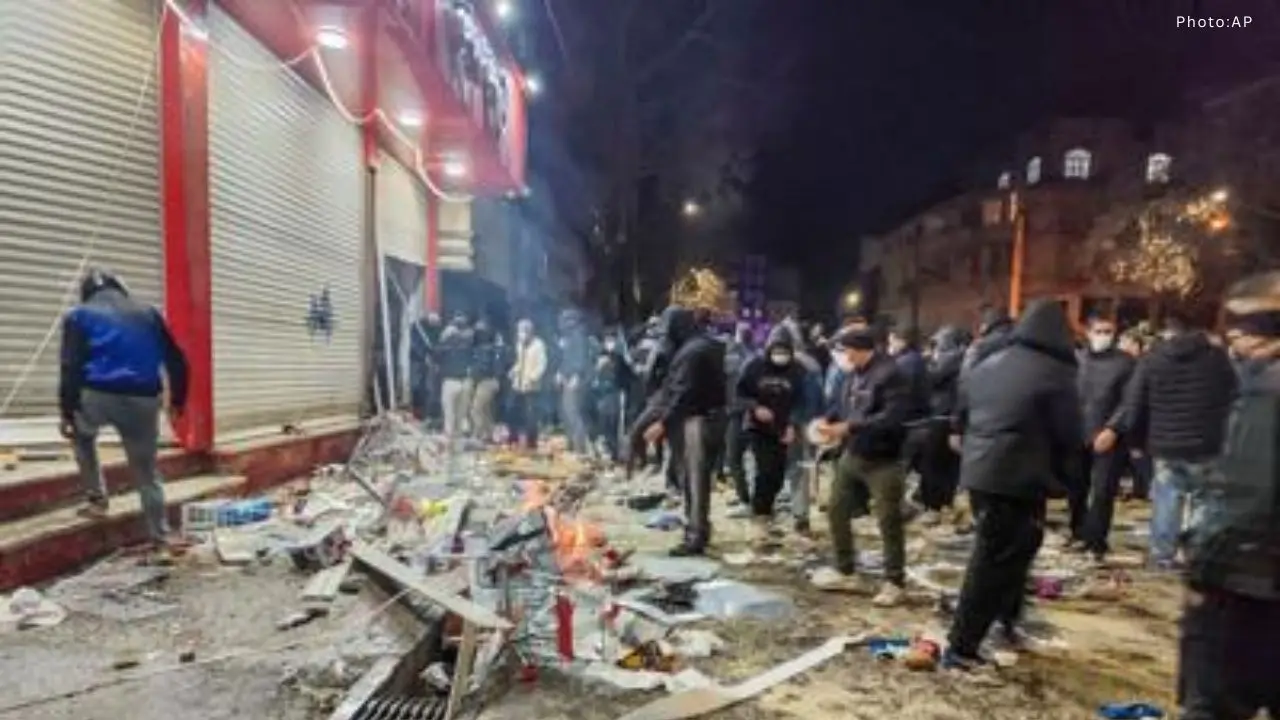
On Friday evening, activists circulated videos showing large gatherings in Tehran and various other cities where protesters chanted slogans, ignited fires, and blocked key roads. Even though government officials severed internet and international phone communications, crowds continued to assemble in defiance, signaling the depth of public outrage.
Human rights organizations report that at least 65 individuals have lost their lives since protests erupted in late December, with over 2,300 people detained. These figures have sparked concerns about an impending harsh crackdown reminiscent of prior protest movements in Iran.
In a televised address, Supreme Leader Ayatollah Ali Khamenei spoke on the turmoil. He accused the protesters of damaging their communities to please U.S. President Donald Trump, stating they were “ruining their own streets” and labeled Trump as a figure “whose hands are stained with the blood of Iranians.” Supporters present at the event were heard chanting anti-U.S. slogans.
Shortly after, state media branded the protesters as “terrorists,” a term historically employed to legitimize aggressive measures by security forces. Iran’s judiciary head, Gholamhossein Mohseni-Ejei, escalated tensions by warning that any punishments would be strict, decisive, and merciless.
Despite official warnings advising families to keep their children indoors, protests persisted. Videos circulating online depicted charred vehicles, blocked streets, and crowds chanting “Death to the dictator” and “Death to Khamenei.” In some northern Tehran neighborhoods, thousands reportedly filled the streets late into the night.
The unrest has expanded to other cities, including Zahedan and Hamedan. Iranian state television admitted that overnight violence resulted in several fatalities, including among security personnel, although comprehensive nationwide statistics were not disclosed.
A significant moment occurred after exiled Crown Prince Reza Pahlavi encouraged gatherings at 8 p.m. on consecutive nights. Many heeded the call, with slogans praising the former monarchy resonating for the first time in decades, illustrating the depth of rejection towards the current regime.
Some protestors even called for the return of the shah, a sentiment that once carried severe penalties. Analysts interpret this as a dual endorsement for Pahlavi and a broader yearning for change and relief from economic hardships.
Pahlavi subsequently reached out to President Trump, alerting him that the internet blackout might enable security forces to commit violence without global oversight. Trump reiterated his warnings to Iran’s regime, stating that the U.S. would take decisive measures if protesters were harmed. He clarified that military action would not involve ground forces but would nonetheless be significant.
International response has also amplified, with leadership from Germany, the UK, and France jointly condemning violence against protestors and urging Iran to permit peaceful demonstrations. Nobel Peace Prize laureate Shirin Ebadi criticized Iran’s system, arguing that a government that harms its populace forfeits moral authority.
The protests in Iran have evolved beyond mere economic concerns; they now pose a direct challenge to the existing political framework. With communication severed, threats escalating, and fatalities mounting, the country finds itself at a perilous juncture. Whether these protests will continue or be violently suppressed remains to be seen, but the widespread anger driving them is profound and difficult to extinguish.