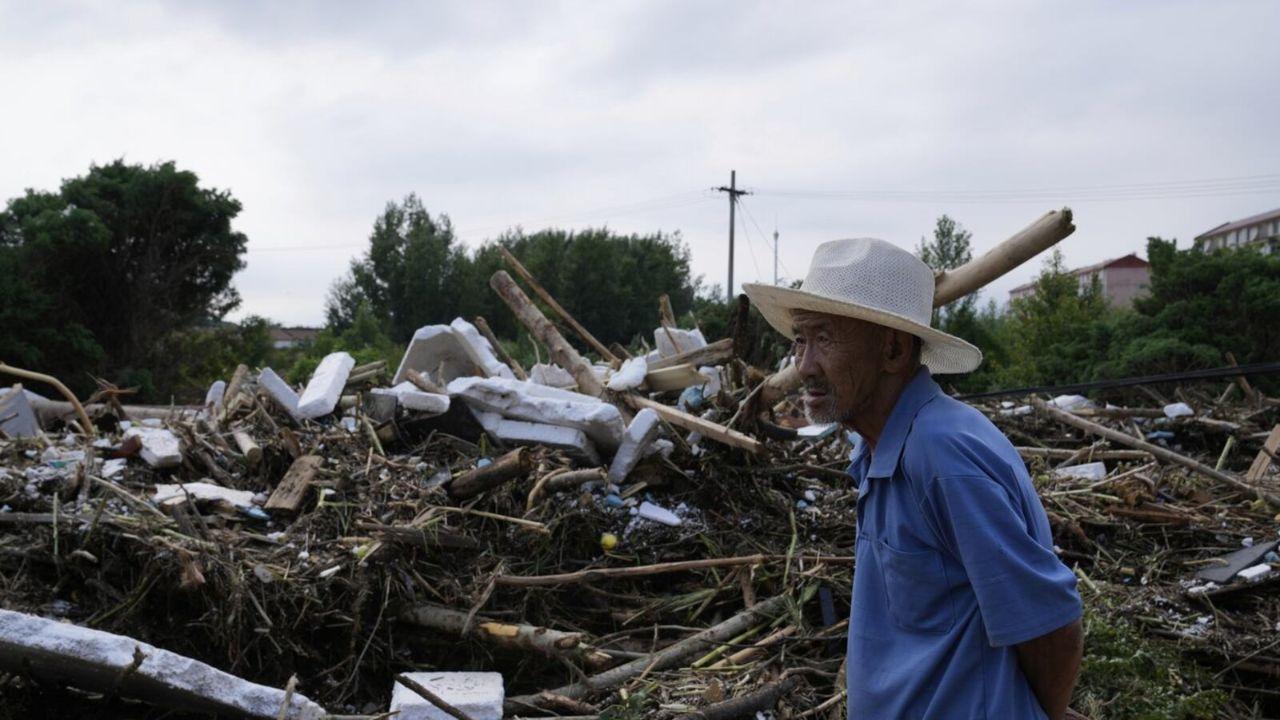
Photo:AP
Introduction: The Deluge That Brought a Superpower's Capital to Its Knees
In a terrifying display of nature's unbridled power, a weather event of historic proportions has descended upon Beijing, the sprawling and formidable capital of China. What began over the weekend as a severe weather warning has morphed into a full-blown catastrophe, as days of relentless, record-breaking torrential rain have submerged vast areas of the city and the surrounding Hebei province. This is not merely a flood; it is a deluge of almost biblical scale, an event that has unleashed deadly landslides, transformed multi-lane highways into churning brown rivers, and swept away homes, cars, and bridges with terrifying ease.
The storm has torn through the region's mountainous outskirts, leaving a heartbreaking trail of death and destruction. As of Tuesday, July 29, 2025, the disaster has claimed at least 34 lives, with many more still missing. It has triggered a massive, desperate evacuation of more than 80,000 people, turning them into climate refugees in their own country. A top-level emergency response has been mobilized by the Chinese government, from the highest echelons of power down to the frantic rescue workers on the ground, as the nation grapples with one of the most severe and destructive weather events to strike its political heartland in modern history.
The Human Cost: A Story Written in Loss, Grief, and Displacement
Behind the staggering statistics lies a deeply human story of personal tragedy, sudden loss, and the primal instinct for survival. The storm's fury was not evenly distributed; it was concentrated with devastating precision on the vulnerable, mountainous districts on the northern fringe of the Beijing municipality, where steep terrain and saturated soil created a perfect recipe for catastrophe.
-
A Grim and Mounting Tally of the Dead: The official death toll, released by state media, paints a grim picture. In the Beijing administrative area alone, at least 30 people have been confirmed dead. The vast majority of these fatalities—a staggering 28—were recorded in the hard-hit Miyun district, a region known for its scenic beauty and reservoirs, now a landscape of sorrow. Two other deaths were confirmed in the nearby Yanqing district. The tragedy spilled across provincial lines into neighboring Hebei, where a sudden and violent landslide roared through Luanping county, burying homes and killing four more people. The number is expected to rise, as at least eight other individuals remained missing in Hebei. For these families, an agonizing wait has begun, as rescue teams battle treacherous conditions in a desperate search for survivors, knowing that with each passing hour, the chances of a miracle diminish.
-
A Human Tide of Displacement: The scale of the flooding necessitated one of the largest and most urgent emergency evacuations the region has witnessed in years. As rivers breached their banks and landslides threatened to swallow entire villages, authorities scrambled to move people out of harm's way. More than 80,000 people have been forced to flee their homes in Beijing, with about 17,000 of those evacuated from the Miyun district alone. These are not just numbers; they represent tens of thousands of individual stories of terror and flight. They are families who awoke to the sound of rising water, grabbing their children and whatever small possessions they could carry before fleeing for higher ground. They are elderly residents, torn from the only homes they have ever known. They are now climate refugees, housed in temporary shelters set up in schools, gymnasiums, and community centers, grappling with the shock of their ordeal and the gnawing uncertainty of whether they will have homes or livelihoods to return to when the waters finally recede.
The Anatomy of a Superstorm: An Unprecedented Deluge
The catastrophic impact of the storm can be attributed to the sheer, almost unimaginable volume of water that fell from the sky in such a short period. It was a weather event that shattered records and overwhelmed all defenses, both natural and man-made.
-
The Miyun Superstorm: The mountainous Miyun district, the tragic epicenter of the disaster, was inundated with more than 21 inches (over 500 millimetres) of rain over the course of the storm. To put this extraordinary figure into context, this is a volume of rainfall that the region would typically expect to see over the course of several months, not in a handful of days. This unprecedented downpour turned gentle mountain streams into raging, debris-choked torrents. The water cascaded down the steep slopes, gaining speed and power, triggering the deadly landslides that buried roads, homes, and everything in their path.
-
The Miyun Reservoir: An Engineering Marvel Under Threat: The relentless rain created a second, parallel crisis at the massive Miyun reservoir. A critical piece of infrastructure built in 1959, the reservoir is one of the primary sources of drinking water for Beijing's 22 million residents. As the deluge continued, the water level in the reservoir swelled to its highest point in its 66-year history, placing immense pressure on the dam's structure. This created a terrifying and dangerous situation for authorities, who were faced with a Damoclean threat: the risk of a catastrophic dam failure that would unleash an apocalyptic wall of water on the densely populated plains downstream.
-
A Terrible but Necessary Choice: Faced with this dire prospect, engineers made the difficult but necessary decision to open the dam's floodgates, releasing enormous volumes of water in a controlled manner to relieve the pressure. This action, while preventing a far greater disaster, had its own severe consequences. It sent a man-made surge of water roaring down the already swollen river channels, compounding the natural floodwaters. Authorities issued urgent, frantic warnings to all residents living along the riverbanks to evacuate immediately, as the combined floodwaters posed an imminent threat to life and property.
-
The Cascade of Destruction: A Region Cut Off: The storm's impact rippled outwards, causing a systemic collapse of essential services in many areas. Power was knocked out to more than 130 villages, plunging them into darkness and cutting them off from sources of heat and cooked food. Communication lines—both cellular and landline—were severed, silencing entire communities and making it impossible for trapped residents to call for help or for officials to coordinate rescue efforts effectively. Over 30 major sections of road were either completely washed away or buried under tons of mud and rock from landslides, isolating towns and making it impossible for rescue vehicles and aid convoys to get through. In places like Taishitun, a town about 100 kilometres northeast of central Beijing, the aftermath was a scene of utter devastation. Photos and videos showed streets submerged in a thick, viscous sludge, uprooted trees scattered like matchsticks, and cars overturned, half-buried in the mud—a silent, grim testament to the water's raw power.
The Machinery of State Responds: A Top-Down Mobilization
The severity of the disaster in the nation's capital triggered a full-scale emergency response, mobilized with the speed and authority characteristic of China's centralized, top-down political system.
-
Directives from the Highest Level: The crisis immediately became a matter of national priority. President Xi Jinping, the country's paramount leader, issued a direct order, instructing all levels of government to "prioritize the safety of people's lives and property" and to spare no effort in their rescue and relief operations. This was followed by a statement from Premier Li Qiang, who publicly acknowledged the "serious casualties" and called for an urgent and coordinated response to rescue the missing, treat the injured, and provide aid to the displaced. In China's political system, such direct statements from the top leadership are not mere condolences; they are powerful directives that unleash the full resources of the state.
-
A Capital on High Alert: In Beijing itself, municipal authorities implemented a suite of strict emergency measures. A "red alert," the highest level in the country's weather warning system, was put in place. Residents were strongly advised to stay indoors and to avoid all non-essential travel. All schools were closed indefinitely, and all construction work across the vast metropolis was halted to prevent further accidents on unstable ground. The atmosphere in the city's urban core was one of tense quiet, a stark contrast to the chaos and destruction unfolding in the city's rural peripheries.
-
Mobilization for Rescue and Relief: In response to the high-level directives, a massive relief effort swung into motion. The central government allocated an initial 50 million yuan (approximately $7 million) in emergency relief funds for the hard-hit Hebei province, designated for supporting rescue operations and providing for the basic needs of the thousands of evacuees—food, clean water, shelter, and medical supplies. Thousands of rescue workers, including specialized urban search-and-rescue teams, firefighters, and units from the People's Liberation Army, were deployed to the region. They are now engaged in a dangerous and exhausting mission, working in treacherous conditions to search for the missing, clear roads, and work on the painstaking task of restoring power and communications to isolated communities.
A City Bracing for More, A Nation Reflecting on a New Reality
With weather forecasts grimly predicting more heavy rain in the coming days, the crisis in and around Beijing is dangerously far from over. Rescue teams continue their heroic but hazardous work, and the full, staggering extent of the damage to infrastructure, agriculture, and property is still being assessed and will likely take weeks, if not months, to fully comprehend. The financial cost of rebuilding will undoubtedly run into the billions.
This devastating event serves as a brutal and humbling reminder of the increasing vulnerability of even the world's most modern and powerful cities to the destructive force of extreme weather. The floods of July 2025 in Beijing will be remembered not just for their tragic human cost, but as a stark warning. As climate change continues to make such catastrophic events more frequent, more intense, and more unpredictable, this disaster will serve as a painful and urgent lesson in the critical need for greater investment in climate adaptation, infrastructure resilience, and early-warning systems, not just for China, but for the entire world. The long and difficult road to recovery and rebuilding for the people of Beijing and Hebei is just beginning.