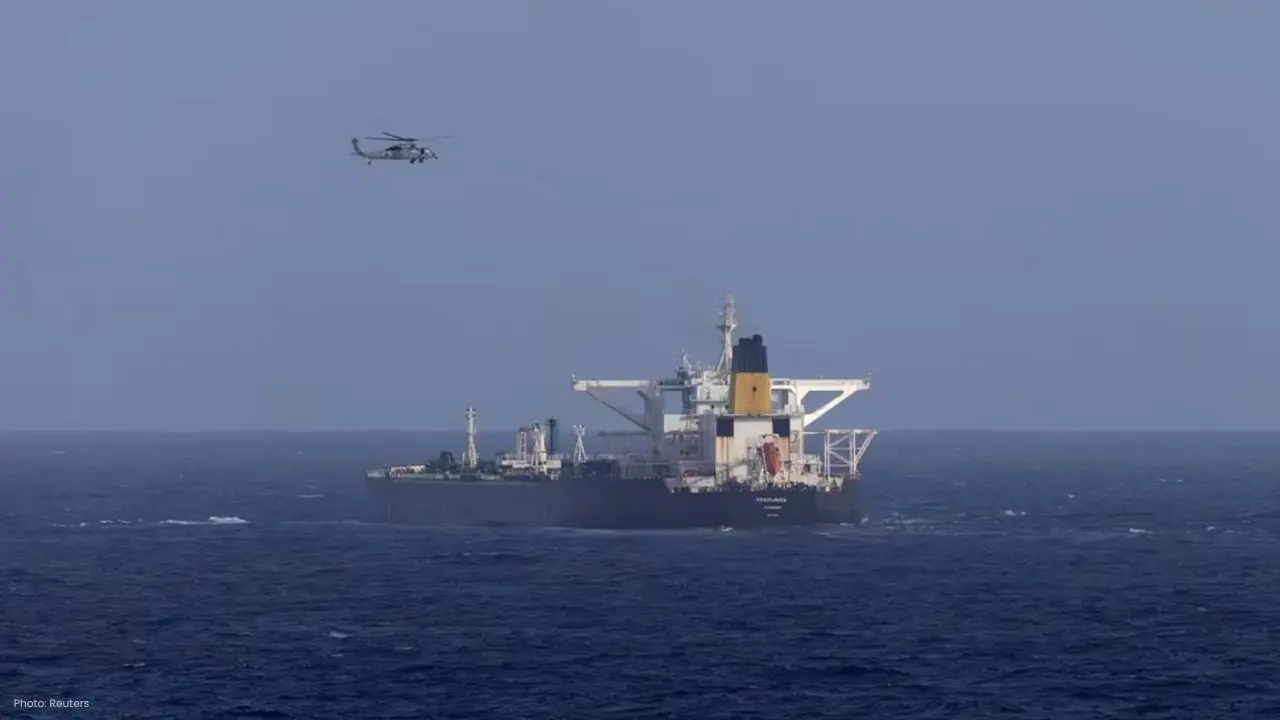
China has emerged as one of the strongest critics of Washington’s intensifying military and economic pressure on Venezuela, as the United States ramps up tanker interceptions and reinforces its presence in the Caribbean under President Donald Trump’s renewed hardline strategy.
At the center of Beijing’s concern is oil. Venezuela remains one of China’s key energy partners in Latin America, with analysts estimating that nearly 80% of Venezuelan crude exports in recent months were shipped to China. US actions targeting vessels linked to Venezuelan oil exports directly threaten those supply lines, placing Chinese economic interests squarely in Washington’s crosshairs.
Beijing has condemned the US interceptions as a “serious violation of international law”, warning against what it calls unilateral coercion and political bullying. In a recent diplomatic exchange, China reaffirmed its support for Venezuela’s sovereignty and opposition to external pressure aimed at regime change.
But beyond defending Caracas, Chinese officials and analysts see a larger strategic opportunity. In Chinese policy circles, Washington’s moves are being framed as evidence of America’s declining global leadership and a revival of outdated power politics — particularly Trump’s renewed embrace of the Monroe Doctrine.
Earlier this month, the White House released a revised national security strategy that reasserts US dominance in the Western Hemisphere, emphasizing the need to prevent “hostile foreign ownership” of strategic assets. While the doctrine was historically aimed at European colonial powers, China now sees itself as the implicit target.
The shift has sparked intense debate within China over whether the US is narrowing its global ambitions and focusing inward on its regional sphere. Some analysts argue that such a pivot could leave Beijing more room to expand its influence across Asia, Africa, and the Global South.
China has wasted no time reinforcing its counter-narrative. Days after Washington’s strategy announcement, Beijing released its first updated Latin America and Caribbean policy paper in nearly a decade, outlining plans to deepen cooperation across infrastructure, technology, aerospace, and law enforcement. The message was clear: China has no intention of retreating from a region where it has invested billions — and Venezuela remains a cornerstone of that engagement.
State-backed Chinese media have gone further, warning that continued US escalation could spiral into a prolonged conflict. One analyst likened the trajectory to a potential “second Vietnam War” should military pressure turn into direct intervention.
While China is unlikely to deploy military assets to defend Venezuela, its diplomatic posture reflects broader strategic calculations. Venezuelan oil accounted for roughly 5% of China’s total crude imports last month, and at least one intercepted tanker was linked to a Hong Kong–registered firm, underscoring Beijing’s material exposure.
Chinese officials are also closely studying how Washington’s hemispheric focus may affect US involvement in East Asia, particularly around Taiwan. Some Chinese scholars suggest the strategy hints at a world divided into competing spheres of influence, though many caution that any US pullback would likely be temporary.
For now, Beijing sees Trump’s Venezuela policy as a powerful rhetorical weapon — one that allows China to portray the US as an aggressive, outdated power while deflecting criticism of its own actions in the South China Sea and beyond.
As tensions rise, Venezuela has become more than a regional flashpoint — it is a testing ground for how global power, influence, and narrative control will be contested in a rapidly shifting world order.